SNGF: How Do You Use Artificial Intelligence Tools?
I’m having some Saturday Night Genealogy Fun (#SNGF), with help from Randy Seaver and his prompts! Feel free to join in.
Saturday Night Genealogy Fun: September 5, 2026
Prompt: “How do you use Artificial Intelligence (AI) tools to help you understand the lives, history, and geography associated with your family and your ancestors, that aid your genealogy and family history research?”
My Background
I am in technology, and happily jumped onto the Artificial Intelligence (AI) bandwagon years ago. I then added my genealogy work into the mix with the help of Steve Little and NGS’s Empowering Genealogists with Artificial Intelligence in the fall of 2023. How do I use AI in genealogy?
Let me count the ways…
I lead an AI Special Interest Group (SIG) so it’s a question I’m thrilled to be asked. My emphasis is generally on low-lift, high-impact applications.
I have also written about AI in my blog, and evolved it into adapting 52 Ancestors into my own flavor: 52 AI Ancestors.
My Own Top List
Primarily, I use AI for getting research ideas: I give it what I have and ask what to try next. It’s great when my brain is just stuck. I use it for organizing research (here are a bunch of notes I took, can you compile a timeline). Finally, I get help writing narratives (be sure to set up guardrails about sourced facts) – usually I write my draft and have AI critique it, including for this blog.
Many Other Ways We Explore AI
I asked Claude (of course I did) to create a list based on my meeting topics, past and future. I feel it’s important to delineate that we should do the research because that’s what we are good at. We should keep AI “in its lane” – that said, here are some great applications.
How AI Shows Up in Genealogy Research
- Finding & Reading Records
- Transcribing difficult or old handwriting (Transkribus)
- Translating foreign-language records
- Reading and interpreting records more broadly
- Using AI-powered search and hints within FamilySearch Labs
- Research Planning & Problem-Solving
- Building a research plan from a research question (GPS-grounded)
- Working brick walls — turning a stuck case into a next step
- Analyzing and sorting conflicting evidence, including similarly-named people
- Prompt design — using Context/Task/Format/Constraints to get better answers
- Organizing & Managing Research
- Organizing findings and querying your own research collection
- Reusable prompt templates and project folders (a repeatable workflow)
- Photo organization, colorization, and restoration (MyHeritage AI)
- DNA
- Making sense of match lists and clustering
- Writing & Sharing
- Writing up research findings and family narratives
- Creating life-sketch content, including AI-generated imagery, done responsibly
- Citing sources and research summaries
- Evaluation & Judgment (the thread running through everything)
- Verifying AI answers against primary sources before trusting them
- Comparing tools (ChatGPT, Claude, Gemini, Perplexity, Copilot) for different tasks
- Privacy practices — what’s safe to share about living relatives, DNA data, etc.
- Treating AI output as a hypothesis to check, not a fact to file away
What Matters Most
You’re the genealogist, and AI is a people-pleaser. Here’s what I think matters most: verification and judgment.
Try It
The beauty of it is, it’s super easy to get started in AI, and perfection is not expected. Just get started! Try getting AI to help with one genealogy task you already do, and see what you think of the results.
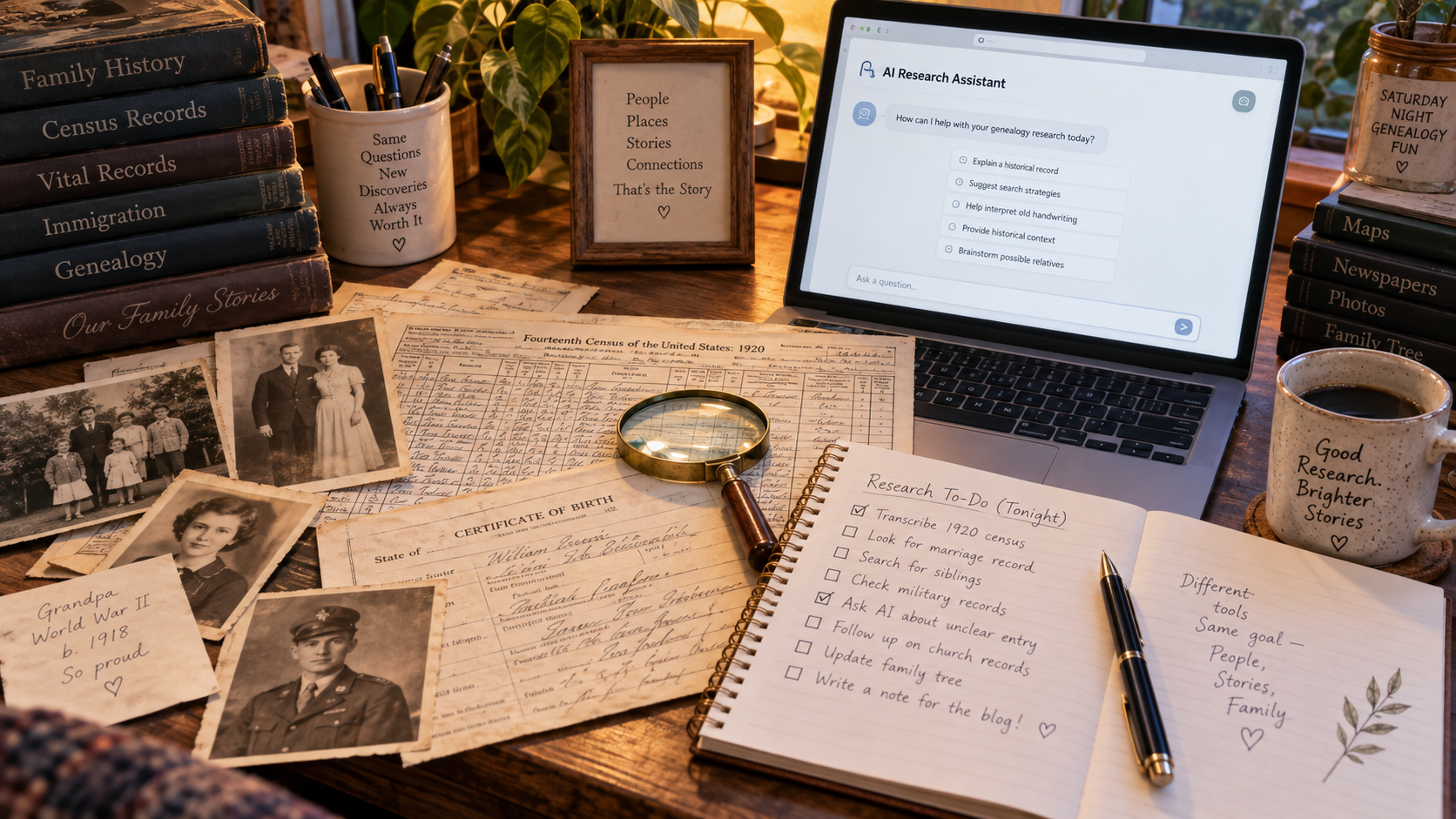
Created with ChatGPT
AI Disclosure
This post was created by me with the help of AI tools. While AI helps organize research, the storytelling and discoveries are my own.


I’m not particularly into AI, but asking for research ideas is a great idea.
LikeLike
Thanks! There are many incremental value-adds, hoping this one is the first of many for you.
LikeLike