I’ve adapted Amy Johnson Crow’s 52 Ancestors in 52 Weeks challenge.
Each week I follow my children’s ahnentafel numbering to select the featured ancestor, ensuring no one through the mid–sixth generation is left behind.
52 Ancestors in 52 Weeks: 2026 Week 20: At the Cemetery
Introduction
My Week 20 ancestor is Szmujl/o Morthaj “Mordecai” Gudelski.
Discussion
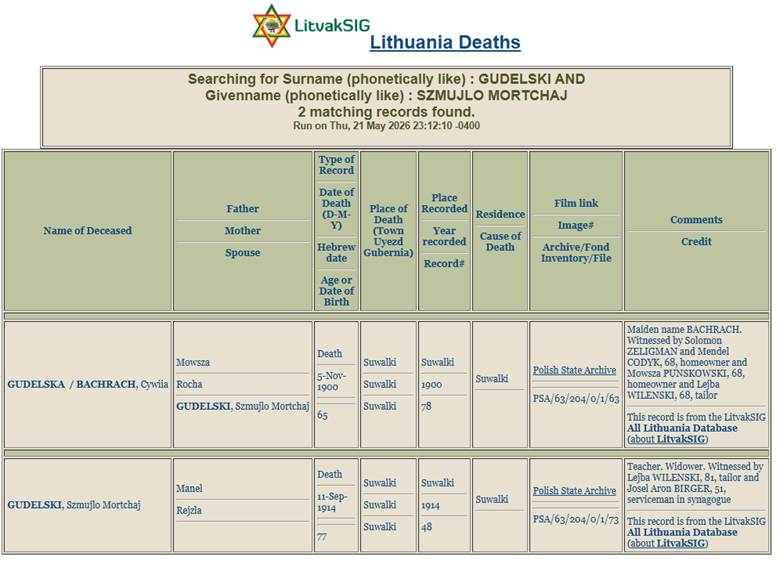
I was lucky enough to find Mordechai’s death record indexed in LitvakSIG (bless them, and yes I donated!), which also linked to the actual record in the Polish State Archives!
Here is the index (he is the second hit; his wife is the first):
That Polish State Archive link brings me to the film scan, and I scroll through to deaths and then record 48, to find:
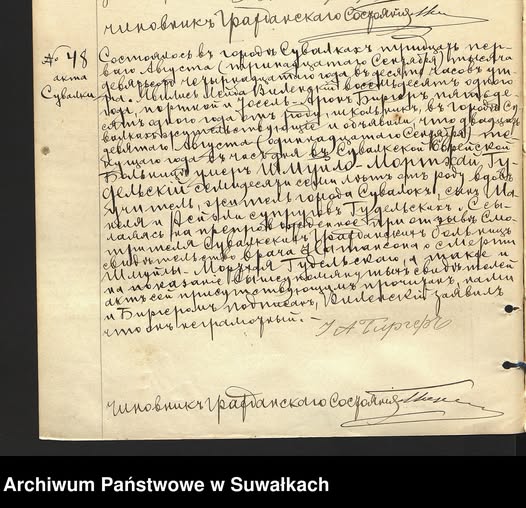
I got Russian translation help (Suwalki was Russian-occupied at that time) from some very generous volunteers:

So thanks to the detailed record – the parents, occupation, and location all jibe with what I expected – I now know I have precise death info.
But to the prompt – where was he buried?
To that, I’ll turn to AI: I opened up Gemini and asked,
A Jewish relative died in September 1914, in Suwalki town, Suwalki Uyezd, and Suwalki Gubernia. Where might he have been buried?
The LLM gave me very good information, broken down by burial site, surviving documentation, and historical context, all of which I’ve summarized below. Gemini suggested, with apparent confidence, that the most likely burial place was “Suwałki Jewish Cemetery (ul. Zarzecze), which was the primary and active burial ground for the Jewish community of the town and surrounding uyezd (district) at that time.”
Gemini suggested that Mordechai was most likely buried in the Suwałki Jewish Cemetery on ul. Zarzecze, the primary Jewish cemetery serving the town and district at the time. It also cautioned that the cemetery was badly damaged during World War II, with many matzevot removed or reused, though some fragments were later recovered and preserved in lapidarium walls. That answer gave me both hope and a reality check: I may never find his exact grave, but I may have found the place where he was laid to rest.
It suggested some archival organizations with which to follow up: JRI-Poland, The State Archives in Suwałki, and The Lithuanian State Historical Archives. After my next prompt, it also gave more specific info: links to the cemetery itself, and some key organizations involved in it: The Foundation for the Preservation of Jewish Heritage in Poland (FODŻ), Virtual Shtetl / POLIN Museum of the History of Polish Jews, The State Archives in Suwałki (Archiwum Państwowe w Suwałkach), and Local Municipal and Historical Societies.
Finally, it offered help drafting emails to any of these organizations.
If it wasn’t past my bedtime (and this blog remaining to be polished and posted), I would go to another LLM for its opinion, and potentially a third LLM to ask it to compare the answers. (Try it, I promise it’s fun!)
It also gave me two links for this cemetery:
Google Maps: https://www.google.com/maps/place/Cmentarz+%C5%BCydowski+-+wej%C5%9Bcie/@54.0967374,22.9194432,469m/data=!3m2!1e3!4b1!4m6!3m5!1s0x46e10303f3866a31:0xd9eb008383360713!8m2!3d54.0967374!4d22.9194432!16s%2Fg%2F11sw4bnt36?entry=ttu&g_ep=EgoyMDI2MDUxNy4wIKXMDSoASAFQAw%3D%3D
The Cemetery, which apparently has a searchable database, which does not seem to turn up my person: https://www.cmentarzzydowski.suwalki.grobonet.com/#google_vignette
I may never find Mordechai’s exact grave. But knowing that there was likely one cemetery serving his community in Suwałki gives me something tangible: a place to imagine, a place to research, and maybe someday, a place to visit. For now, that feels like a meaningful step closer.

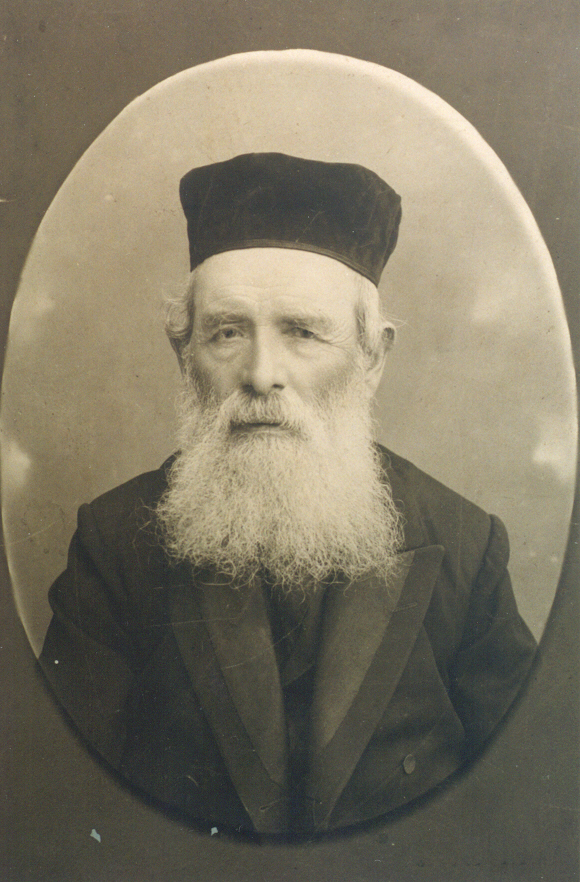
And finally, a super cool photo of the man in question (thanks to cousin Robert):
AI Disclosure
This post was created by me with the help of AI tools. While AI helps organize research, the storytelling and discoveries are my own.
Next Week’s Topic: An Unexpected Strength
 The Ancestor Whisperer