SNGF: Oldest Record
I’m having some Saturday Night Genealogy Fun (#SNGF), with help from Randy Seaver and his prompts! Feel free to join in.
Saturday Night Genealogy Fun: September 26, 2026
Prompt: “What is “Your Oldest Confirmed Record?” What is one of the oldest documents you’ve personally found for any ancestor?”
A Lucky Find
Not long after I discovered I was a Thibou (shout-out to Dorothy Koenig and Bill Vinehout, both RIP), I did a random Google search for the surname. Hey, don’t knock it till you’ve tried it!
That search turned up PURE GOLD in the form of a manuscript.
My oldest confirmed record is a letter written by my seventh great-grandfather, Louis Thibou, in 1683.
Louis Thibou’s Letter
This discovery came long before I had heard of the now-defunct NUCMC catalog for manuscripts. The Teaching American History in South Carolina website had posted documents online, including “Letter from Louis Thibou to friends and family in France, 1683” (archived here).
Louis was a French Huguenot who had fled to London and then, in 1680, was sent aboard the Richmond to settle Carolina.
The beginning of his letter reads a little like a sales pitch for Carolina, but then Louis moves on to more personal matters—and that’s where it becomes especially fascinating to me as a genealogist.
You can read the entire English transcription at the link above, but here are some of the gems that absolutely enthralled me:
“I shall give you details about this country and its mode of life, and first of all I shall describe to you that it is a wooded country with lovely savannas or plains crossed by fine rivers very full of fish in which anyone who likes can fish and with enough oysters to feed a kingdom.”
And this wonderfully practical assessment:
“Carolina is a good country for anyone who is not lazy; however poor he may be, he can live well provided he is willing to take a little trouble.”
But then the letter becomes personal:
“[W]hen I arrive[d] with my wife and 3 children I was not worth a farthing and my furniture did not consist of very much, whereas now I am beginning to live well.”
And more personal still:
“My wife and all my family are well, thank God. My poor little Loton [?] died out here but God has given us a son who is called Jacob after the one we lost in England; the captain of a warship was his godfather.”
Then there is this:
“I beg to you let me have some news and to convey the enclosed to M. Marriette of Place Maubert, Paris.”
Marriette was his wife’s maiden name—a tantalizing genealogical clue tucked inside an ordinary request.
Louis also wrote:
“Once again I beg you to write to me and to give us news of our relatives, how they are getting on in France under the persecution.”
And finally, one of the lines that leaves me with more questions than answers:
“I beg you to tell the mother of the little boy I brought along that he is well and that I have received the letter she wrote.”
Who was that little boy? I would love to know.
So Many Clues
That is what strikes me whenever I return to this letter. There are so many clues packed into it: children born and lost, relatives in France, his wife’s family, migration, religion, economic circumstances, social connections—and even an unidentified child who traveled with Louis.
Each time I read the letter, I notice something else.
I might have to run the letter through AI and see what additional clues I’ve overlooked. That sounds like a future project!
My Takeaway
Tom Jones teaches us about “the perils of source snobbery”—the danger of sticking only to well-regarded sources and not even checking supposedly unreliable ones, such as mug books, online family trees, and the like.
I am as guilty of source snobbery as anyone.
But I am very glad that, all those years ago, I simply typed a surname into Google and went looking.
That lucky internet search eventually taught me something I have tried to remember ever since: take in all the information first. Then evaluate it.
You never know where the clue that leads to PURE GOLD might be hiding.
My Personal Touch
And there is one more chapter to this story.
I am delighted to say that I eventually made a trip to the Columbiana Public Library and held Louis’ original 1683 letter in my own hands!
After first discovering his words as the result of a random internet search, actually holding the document he had written more than three centuries earlier was something very special.
More on that journey here.
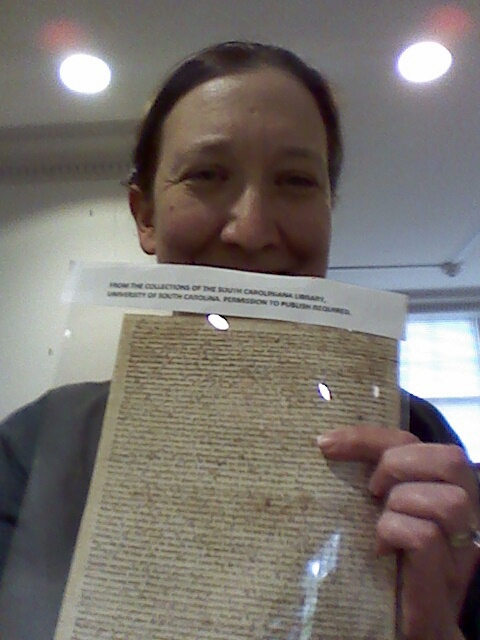
Me holding the 343 year old letter written by my seventh great grandfather, Louis Thibou
AI Disclosure
This post was created by me with the help of AI tools. While AI helps organize research, the storytelling and discoveries are my own.
https://theancestorwhisperer.com/wp-content/uploads/2025/03/image-1.jpeg


That is truly a fabulous find. If only more letters written by our ancestors had survived. We would have primary documentation of a day in their lives and, as you mention, provided with new family clues.
LikeLiked by 1 person
Dumb luck for the win? 🙂 Thanks, Linda! I am mourning the loss of NUCMC and wonder if there will be something replacing it – preserving the documents is only half the battle.
LikeLike