I’ve adapted Amy Johnson Crow’s 52 Ancestors in 52 Weeks challenge.
Each week I follow my children’s ahnentafel numbering to select the featured ancestor, ensuring no one through the mid–sixth generation is left behind.
52 Ancestors in 52 Weeks: 2026 Week 27: A Record I Read Differently Now
Introduction
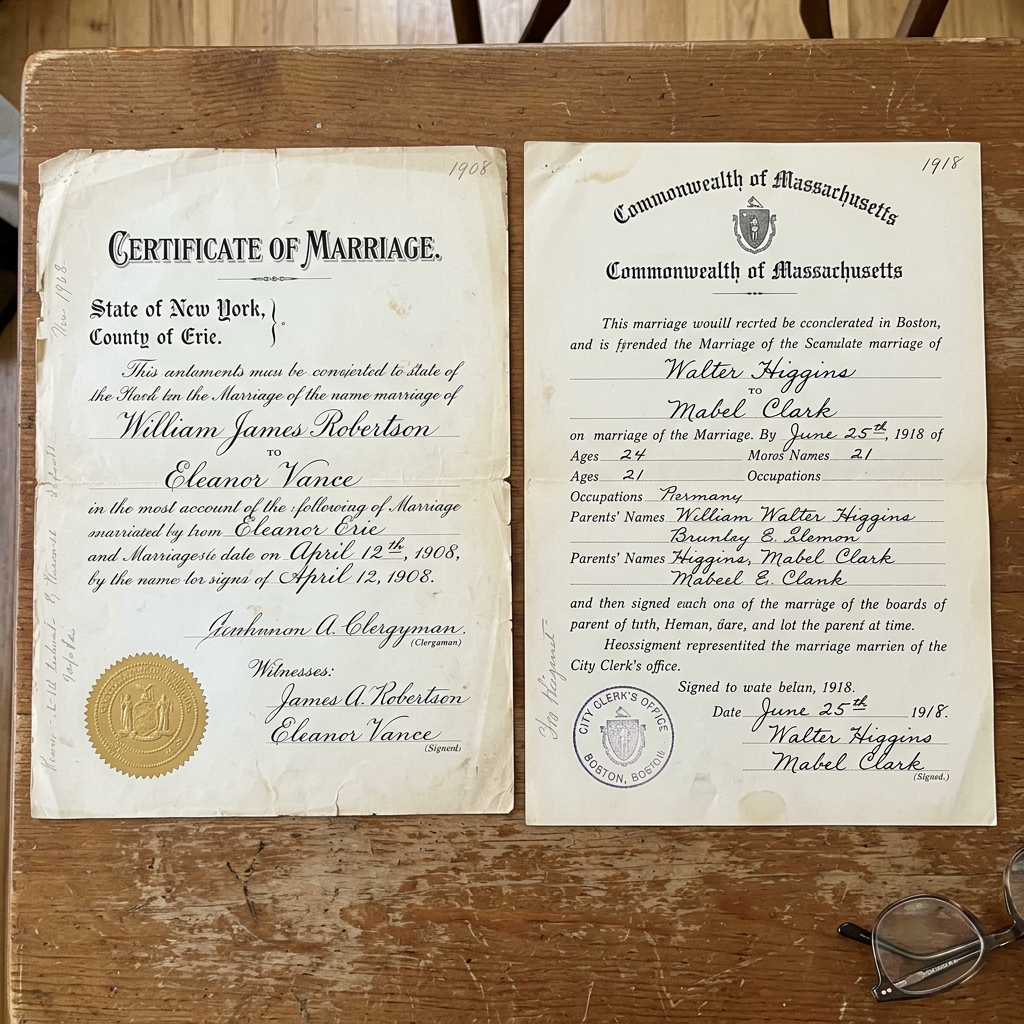
My Week 27 ancestor is Mary Agnes Hart, and the record I read differently now is her 1918 marriage record.
Discussion
I have the New York City marriage record of Francis William “Frank” Carey and Mary Agnes “Agnes” Hart dated 1918.
The problem is, they started having children in 1909.
The family had always said they were married in 1908, and I have a photo of their 60th wedding anniversary party in 1968.
There’s a saying which goes, “The first baby can come anytime; the rest take nine months,” meaning a couple often marry after conception. But this was no “early baby” issue – it was a ten-year gap between marriage dates!
But further research helped explain this. There IS a Roman Catholic church record for a 1908 marriage. For whatever reason, I have not found a corresponding civil record.
And then I noticed the timing. Francis had to register for the World War I draft. Under the draft classification system, a wife and dependent children could matter. [1] Was that what finally gave Frank and Agnes a reason to put their marriage on the civil record? I can’t prove it—but suddenly that 1918 date looked much less mysterious.
That could explain why the civil marriage record appears only after their fourth child was born. 😊
Summary
I was so quick to judge that 1918 marriage record because I thought I knew what a marriage date meant. Now I know that one date may tell only one part of the story. I don’t promise I won’t jump to conclusions again—but perhaps I’ll be a little slower about it.
AI Disclosure
This post was created by me with the help of AI tools. While AI helps organize research, the storytelling and discoveries are my own.
Next Week’s Topic: Leisure Time
[1] Under the 1918 Selective Service regulations, a married registrant whose wife or children were mainly dependent on his labor for support could be placed in Class IV. https://commons.wikimedia.org/wiki/File:Selective_service_regulations_prescribed_by_the_President_under_the_authority_vested_in_him_by_the_terms_of_the_Selective_Service_Law_(act_of_Congress_approved_May_18,_1917)_(IA_cu31924006483261).pdf
 The Ancestor Whisperer