The Ancestor Who Stays With Me
I’ve adapted Amy Johnson Crow’s 52 Ancestors in 52 Weeks challenge.
Each week I follow my children’s ahnentafel numbering to select the featured ancestor, ensuring no one through the mid–sixth generation is left behind.
52 Ancestors in 52 Weeks: 2026 Week 25: The Ancestor Who Stays With Me
Introduction
The theme for Week 25 is “The Ancestor Who Stays With Me.” Sometimes an ancestor lingers in our minds not because we knew them, but because something about their story reaches across time and refuses to let go.
For me, that ancestor is Anna Driskol Anderson, my great-grandmother.
I never knew Anna. She died of kidney disease when my grandfather was still a boy. But her story stays with me because of the question I cannot quite put down:
What was it like to know you would not see your children grow up?
A Mother Facing Mortality
Anna’s death certificate says she died in 1922. The cause was chronic interstitial nephritis, a kidney disease she had apparently suffered from for “several years.” [1] That phrase stops me every time.
Several years.
Not a sudden accident. Not a brief illness. Something lingering. Something that likely shaped the rhythm of her household long before the final days came.
When my grandfather was a boy, he overheard his parents talking. They mentioned that Anna had only one kidney. I do not know exactly what Anna understood about her illness, or how much the doctors of the time could tell her with certainty. But I suspect she knew enough. She must have known her body was fragile. She may have known her future was uncertain.
And she had three children.
That is the part that stays with me.
What does a wife and mother think about when she is facing her own mortality? Does she worry about the practical things: meals, laundry, school, shoes, the household routines that keep children’s lives steady? Does she wonder who will comfort them when they cry? Does she try to memorize their faces as they are, knowing she may not be there to see who they become?
I do not know. But I cannot help wondering.
An Illness That Echoed Through the Family
Anna’s illness also seems to echo backward in the family. Her mother may have died from kidney disease as well. A potential mother died in Staten Island in 1901 of “uraemia due to cystic degeneration of kidneys.” [2] If this was Anna’s mother, then Anna had already lost her own mother before she married.
Her father was long gone by then, too.
So when Anna stood at the beginning of her married life, she did so without parents. Years later, her own children would know that same sorrow. They, too, would lose their mother too soon.
That repetition is painful to sit with. It reminds me that genealogy is not only a record of dates and names. Sometimes it reveals patterns of grief – losses that ripple through generations, shaping people whose memories we inherit only in fragments.
The Family She Left Behind
I hope Anna was not afraid that her husband would fail their children. From what I can see, he stepped up. He carried on after her death and cared for the family as best he could.
But tragedy was not finished with them. He became ill and died only two years after Anna.
That means Anna’s children lost both parents within a short span of time. I think about that, too. I think about my grandfather as a boy, first losing his mother, then his father. I think about what he must have carried quietly into adulthood.
And still, the story did not end there.
All three of Anna’s children grew up, married, and had children of their own. Her life was short, but it continued through them. It continued through my grandfather. It continued through my family.
It continues every time I say her name.
Why Anna Stays With Me
Anna Driskol Anderson stays with me because her story is unfinished in the way so many ancestral stories are unfinished. I have records. I have clues. I have a cause of death, a family pattern, and a childhood memory passed down from my grandfather.
But I do not have her voice.
I do not know what she feared, what she hoped, or what she wanted most for her children. I only know that she was a young mother who did not get enough time, and that more than a century later, her great-grandchild is still thinking about her.
Perhaps Anna stays with me because her story asks me to imagine not only how she died, but how deeply she must have loved.
Maybe that is one of the quiet gifts of family history. We cannot give our ancestors more years. We cannot undo their grief or answer every question.
But we can remember them.
And sometimes, remembering is how they stay.
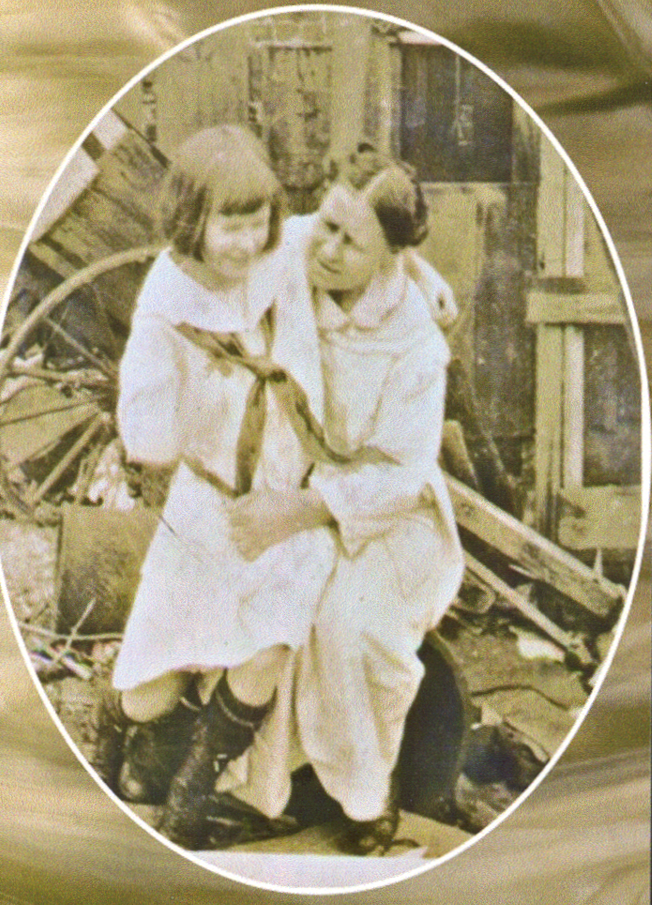
Anna and a daughter
AI Disclosure
This post was created by me with the help of AI tools. While AI helps organize research, the storytelling and discoveries are my own.
Next Week’s Topic: A Hard Choice
[1] Death Certificate. Staten Island deaths, 1922, Certificate number 884.
[2] There is a Malvina Driscoll who died in Staten Island in 1901. Staten Island Deaths, 1901, #280. Died at S. R. Smith infirmary, 3/10/1901. Uraemia due to cystic degeneration of kidneys. Buried St. Peter’s Cemetery 3/12/1901. Age 59, white, married, housewife, b. Poland. Parents b. Poland. resided 12 Seymour Avenue.

