A Place That Matters
I’ve adapted Amy Johnson Crow’s 52 Ancestors in 52 Weeks challenge.
Each week I follow my children’s ahnentafel numbering to select the featured ancestor, ensuring no one through the mid–sixth generation is left behind.
52 Ancestors in 52 Weeks: 2026 Week 23: A Place That Matters
Introduction
My Week 23 ancestor is Khana Rachkovski.
Discussion
Khana Rachkovski was born about 1828–1833 in what appears in the records as Veisiejai, Seinai, Suwalki. By 1864 she had married Mortkhel Rabinowitz. Eleven children are linked to them in the documents, most of them born in Veisiejai, and Khana died in 1901 at age 67 in Seirijai, Sejny, Suwalki.
At first glance, those place names can feel like a tangle: Veisiejai, Seirijai, Seinai, Sejny, Suwalki. But they are not all equivalent places. Veisiejai and Seirijai were the towns. Seinai/Sejny was the district or county name. Suwałki was the larger province or gubernia. In other words, Khana was not moving from one distant world to another. Her life seems to have unfolded within a small regional network in what is now southern Lithuania, near the present-day Polish border.
That matters because place names in genealogy can sometimes flatten a life instead of revealing it. “Suwalki” can sound like a single location, but for Khana it was more like a landscape: villages and market towns, Jewish communities, changing record languages, and borders that shifted around families who may not have moved very far at all.
Veisiejai and Seirijai were close — roughly ten miles apart as the crow flies. Close enough that families may have known one another across town lines. Close enough for marriage networks, market days, visits, and movement between households. Close enough that Khana’s death in Seirijai does not necessarily suggest a dramatic migration, but perhaps the later chapter of a life still rooted in the same local world.
The names themselves tell part of the story. Veisiejai also appears as Wiejsieje in Polish and Vishai/Vishey in Yiddish. Seirijai appears as Sereje in Polish and Serei in Yiddish. The records changed language during Khana’s lifetime, and the same place could wear different names depending on who wrote it down. That is one of the quiet challenges of researching families from this region: the ancestor stayed in place, but the paperwork did not.
For me, this makes Veisiejai matter not just as a birthplace, but as an anchor. It is the place that holds Khana’s beginnings, her marriage, and the births of most of her children. Seirijai, nearby, holds the end of her documented life. Between those two towns is not a long journey on a map, but it may contain nearly all of what the records allow me to know about her world.
The factual place framework here is supported by JewishGen’s listings for Veisiejai and Seirijai, which place both towns in Sejny/Seinai and Suwałki in the 1900-era records; JewishGen gives Veisiejai as 14 miles east of Sejny and Seirijai as 21 miles east-northeast of Sejny. The broader JewishGen Communities Database also lists Veisiejai and Seirijai under Sejny district and Suwałki province in the Russian Empire.
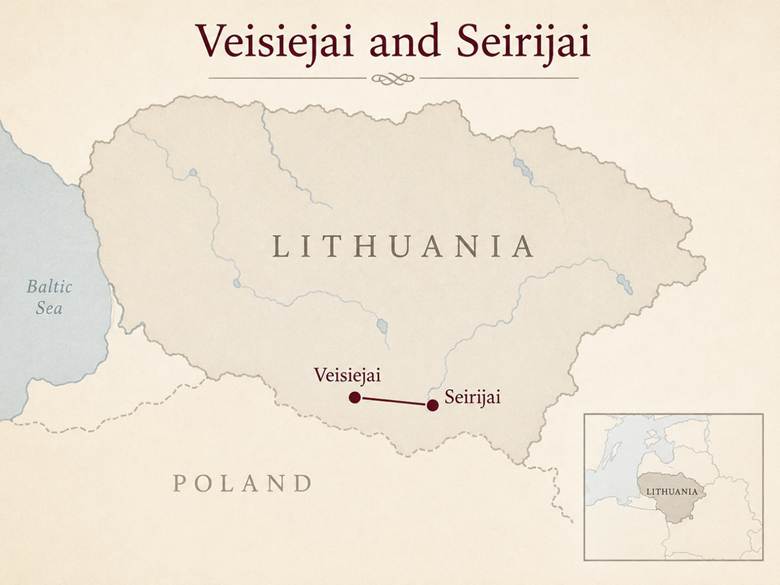
ChatGPT, 02Jun2026
AI Disclosure
This post was created by me with the help of AI tools. While AI helps organize research, the storytelling and discoveries are my own.
Next Week’s Topic: Possibilities

