A Name With Meaning
I’ve adapted Amy Johnson Crow’s 52 Ancestors in 52 Weeks challenge.
Each week I follow my children’s ahnentafel numbering to select the featured ancestor, ensuring no one through the mid–sixth generation is left behind.
52 Ancestors in 52 Weeks: 2026 Week 22: A Name With Meaning
Introduction
My Week 22 ancestor is Mortkhel Rabinowitz.
Discussion
Both of my mother-in-law’s grandfathers were named Mordechai, or something very close to it. Had they both immigrated to the United States, that might have been confusing. But as far as I know, she never knew either of them.
I know almost nothing about Mortkhel as a person, but his name gives me one small way to think about the role he may have played in his family.
Mortkhel appears to be a Yiddish or regional form of Mordechai/Mordecai, the biblical name of Esther’s cousin and guardian in the Book of Esther. That biblical connection is the part of the name that caught my attention.
Mortkhel Rabinowitz was born about 1828. I know his father was Rubin, but no further information about his ancestry has been located. Birth records from this period are sparse, and his has not been located. He married Khana Rotovsky by 1864, when their first known child was born, and perhaps earlier. The records place the family in Veisiejai, then part of the Sejny district in Suwalki gubernia.
What I know of Mortkhel comes mostly through the records of his family. Eleven children have been tentatively identified. He was described as a lake owner and land tenant in his children’s birth records, suggesting he had property and agricultural interests in the area.
His wife Khana died on January 17, 1901, leaving Mortkhel a widower at 73. No records of him have been identified after that.
I have not found grandchildren named after him, perhaps because he lived long enough that the tradition of not naming children after living relatives would have delayed that possibility.
The name does not literally mean “guardian,” as far as I can tell. But the biblical Mordecai is remembered as Esther’s cousin and protector, the man who raised her after her parents died. That makes me look at “my” Mortkhel a little differently. The records do not give me his voice, his personality, or even the end of his story. They give me land, a lake, a wife, and eleven children linked to him through the records. Perhaps that is its own kind of meaning: a man glimpsed mostly through the family he helped anchor.
Did Mortkhel’s name die with him? Perhaps. I have not yet found grandchildren named after him, and if he lived longer than I can currently document, that may be one reason. But names have a way of lingering even when they disappear from the records. Mortkhel’s name leads me back to Mordecai, to guardianship, and to the quieter question of what it meant to hold a family together in nineteenth-century Suwalki. That makes his eleven children worth following—not only to see whether the name continued, but to understand what kind of family story grew from him.
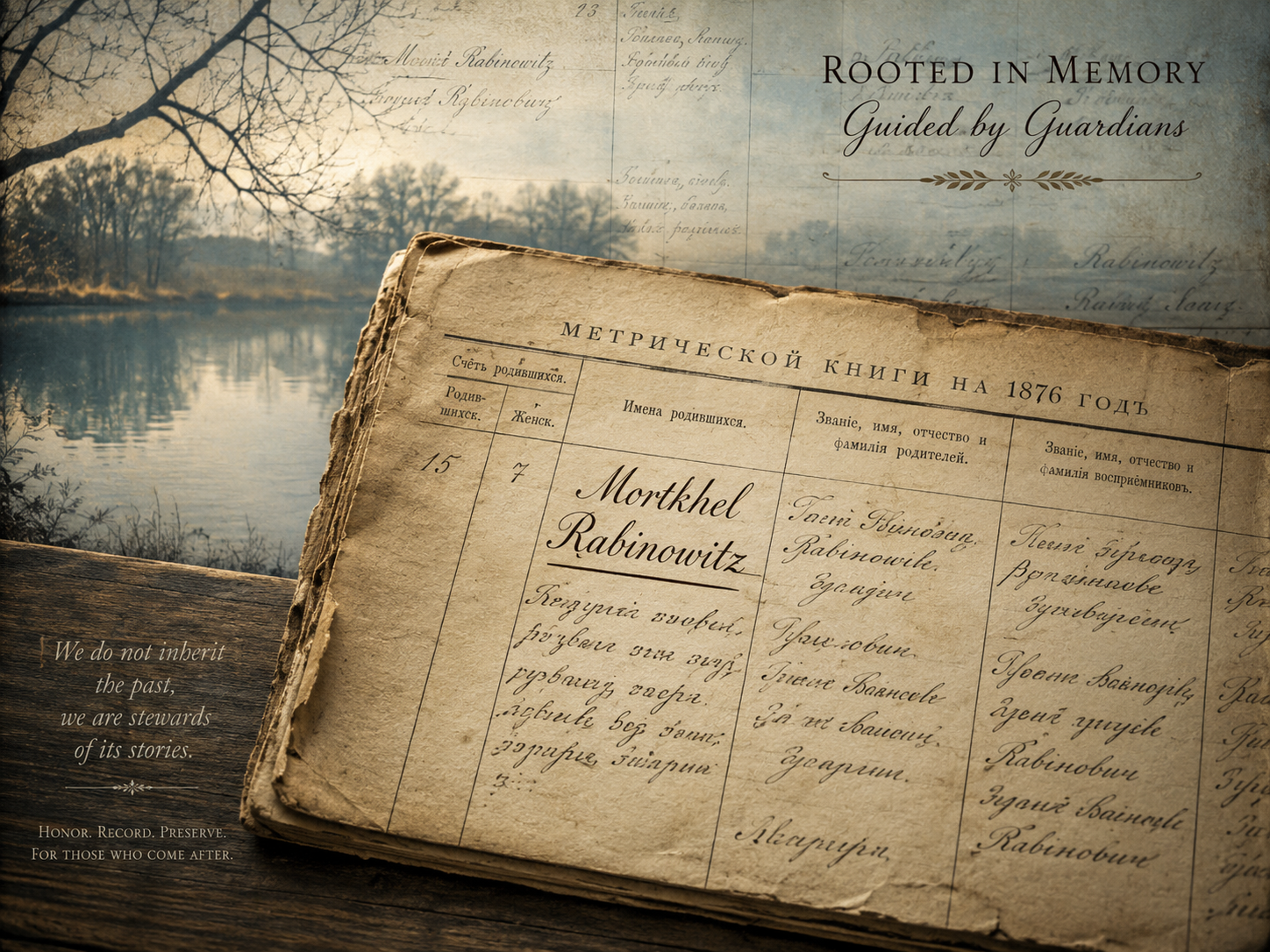
ChatGPT, 02Jun2026
AI Disclosure
This post was created by me with the help of AI tools. While AI helps organize research, the storytelling and discoveries are my own.
Next Week’s Topic: A Place That Matters

