SNGF: How Do You Use Artificial Intelligence Tools?

SNGF: How Do You Use Artificial Intelligence Tools?

I’m having some Saturday Night Genealogy Fun (#SNGF), with help from Randy Seaver and his prompts! Feel free to join in.

Saturday Night Genealogy Fun: September 5, 2026

Prompt: “How do you use Artificial Intelligence (AI) tools to help you understand the lives, history, and geography associated with your family and your ancestors, that aid your genealogy and family history research?”

My Background

I am in technology, and happily jumped onto the Artificial Intelligence (AI) bandwagon years ago. I then added my genealogy work into the mix with the help of Steve Little and NGS’s Empowering Genealogists with Artificial Intelligence in the fall of 2023. How do I use AI in genealogy?

Let me count the ways…

I lead an AI Special Interest Group (SIG) so it’s a question I’m thrilled to be asked. My emphasis is generally on low-lift, high-impact applications.

I have also written about AI in my blog, and evolved it into adapting 52 Ancestors into my own flavor: 52 AI Ancestors.

My Own Top List

Primarily, I use AI for getting  research ideas: I give it what I have and ask what to try next. It’s great when my brain is just stuck. I use it for organizing research (here are a bunch of notes I took, can you compile a timeline). Finally, I get help writing narratives (be sure to set up guardrails about sourced facts) – usually I write my draft and have AI critique it, including for this blog.

Many Other Ways We Explore AI

I asked Claude (of course I did) to create a list based on my meeting topics, past and future. I feel it’s important to delineate that we should do the research because that’s what we are good at. We should keep AI “in its lane” – that said, here are some great applications.

How AI Shows Up in Genealogy Research

  • Finding & Reading Records
    • Transcribing difficult or old handwriting (Transkribus)
    • Translating foreign-language records
    • Reading and interpreting records more broadly
    • Using AI-powered search and hints within FamilySearch Labs
  • Research Planning & Problem-Solving
    • Building a research plan from a research question (GPS-grounded)
    • Working brick walls — turning a stuck case into a next step
    • Analyzing and sorting conflicting evidence, including similarly-named people
    • Prompt design — using Context/Task/Format/Constraints to get better answers
  • Organizing & Managing Research
    • Organizing findings and querying your own research collection
    • Reusable prompt templates and project folders (a repeatable workflow)
    • Photo organization, colorization, and restoration (MyHeritage AI)
  • DNA
    • Making sense of match lists and clustering
  • Writing & Sharing
    • Writing up research findings and family narratives
    • Creating life-sketch content, including AI-generated imagery, done responsibly
    • Citing sources and research summaries
  • Evaluation & Judgment (the thread running through everything)
    • Verifying AI answers against primary sources before trusting them
    • Comparing tools (ChatGPT, Claude, Gemini, Perplexity, Copilot) for different tasks
    • Privacy practices — what’s safe to share about living relatives, DNA data, etc.
    • Treating AI output as a hypothesis to check, not a fact to file away

What Matters Most

You’re the genealogist, and AI is a people-pleaser. Here’s what I think matters most: verification and judgment.

Try It

The beauty of it is, it’s super easy to get started in AI, and perfection is not expected. Just get started! Try getting AI to help with one genealogy task you already do, and see what you think of the results.
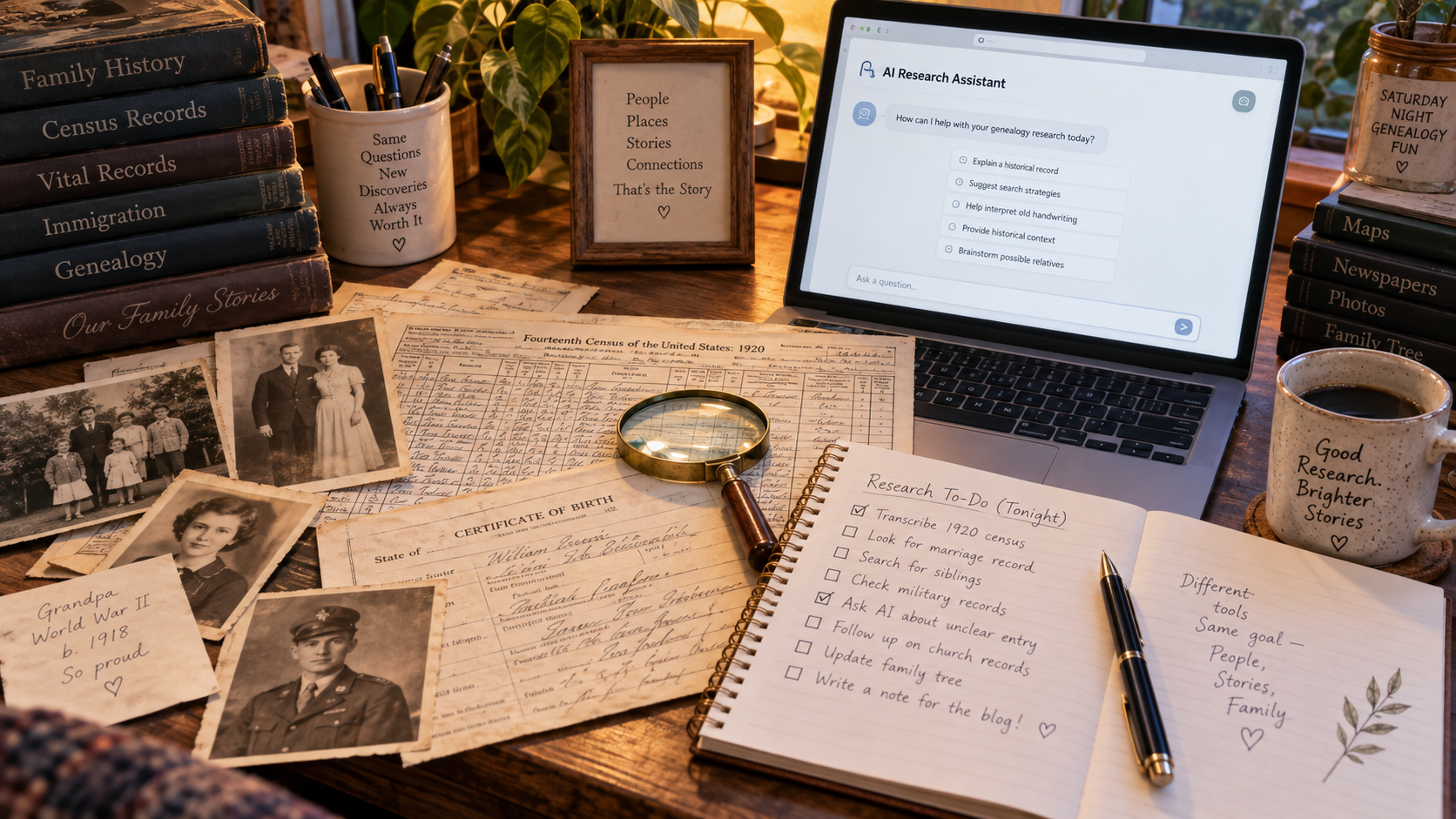
Created with ChatGPT

AI Disclosure

This post was created by me with the help of AI tools. While AI helps organize research, the storytelling and discoveries are my own.
SNGF: January 10, 2026

I’m having some Saturday Night Genealogy Fun (#SNGF), with help from Randy Seaver and his prompts! Feel free to join in.

Saturday Night Genealogy Fun: January 10, 2026

Prompt:

“1) Do you have Research Notes for some of your ancestors in a number of sources and papers, or perhaps in a Person Note or Research Note in your desktop family tree program, and dread trying to put them into a coherent genealogical sketch or research note?  

2) This week, take all of the Research Notes you have for one person in your tree and put them all in one word processor document. Organize them if you want – you don’t have to.  Make a PDF file of your new word processor document and name it.  

3) Go to your favorite LLM (you know, ChatGPT, Claude, Gemini, Perplexity, or any other LLM), load the document, and ask the LLM to “Please organize the research notes in the attached document for [your ancestor’s name, birth and death year] and create an engaging biography about him and his family. Do not use any information other than what is provided.”

2) Tell us about your experiment in condensing your notes and creating a biography of an ancestor”

Introduction

Not too long ago, a cousin asked me to document her relationship to a second cousin of hers, Grace, so my cousin could visit Grace in a nursing home. I happily did the research and the writeup and provided a report to her. This report was the basis for this week’s prompt.

Discussion

I first took a course in Empowering Genealogists with Artificial Intelligence back in October 2023, and we have come a very long way in the two years since. Using this week’s prompt and my existing research report, ChatGPT 5.2 produced a surprisingly strong and coherent write-up.

Early large language models were notorious for hallucinating – and still will if left without guardrails – but this one was explicitly instructed to rely only on the facts provided. It followed that instruction carefully. In addition to the requested biography, the LLM also produced:

  • Organized research notes
  • Identity and name variations
  • Core facts such as birth, residences, and marriage
  • Family relationships
  • A list of key sources referenced

What impressed me most, though, was that it went a step further and suggested possible next steps for refining the work, without being prompted to do so. Those suggestions included (and the first clearly reflects prior conversations I’ve had with it):

  • Refining the biography to match a sixth-generation narrative style (as used in my Ancestors Book)
  • Adding Evidence Explained–style source citations inline
  • Creating a one-page family sketch or relationship explanation suitable for an appendix or proof summary

Seeing this level of structured analysis and forward-looking support makes me seriously consider whether running our work through an AI, carefully and thoughtfully, could become a regular way to identify gaps or next research opportunities.

Challenge

So rather than just talking about the possibilities, this week’s challenge invites you to try the experiment yourself.

Try it and see what you think!

Want to Learn More?

Old documents being entered into a computer

AI Disclosure

This post was created by me with the help of AI tools. While AI helps organize research, the storytelling and discoveries are my own.
52 AI Ancestors in 52 Weeks: Week 30: Religious traditions

I’ve combined Amy Johnson Crow’s 52 ancestors in 52 weeks challenge, and Steve Little’s The 2025 AI Genealogy Do-Over, to create a unique 52 AI ancestors in 52 weeks party!

52 AI Ancestors in 52 Weeks: Week 30: Religious traditions

Boomerangs and Belief: Tracing the Faith Footprints of My Ancestors

Introduction

What makes a person fall away from their religious institution? What kind of a schism must there be for a person to no longer publicly worship?

Discussion

My family has many instances of parting ways with their churches. The oldest one I know of is my great-grandfather, who was upset that the Roman Catholic church wouldn’t bury his mom because she hadn’t been active in their (new?) hometown. My grandmother disagreed with the Church over birth control, and my father over divorce.

Some of them rejoined; others joined different denominations, and others stayed away for their lifetime.

Robert Frost, in his poem “The Death of the Hired Man,” said, “Home is the place where, when you have to go there, they have to take you in.” I think your religious home operates in a similar manner – our Creator welcomes us back into the fold, whenever we are ready.

So while it may be said that my family’s religious tradition is boomeranging, it may also be knowledge and confidence in God’s love and acceptance.

How AI can help

Religion is such a personal thing, I struggled to come up with telling the reader how to use it in terms of religion! So ChatGPT and I came up with several options.

AI may not know the state of your soul, but it’s pretty handy when you’re tracing where your ancestors stood on Sunday mornings. Here’s how it can help:

  1. Translation of Old Religious Records
    Found a Latin baptism record or a German church book? AI translation tools like DeepL or Google Translate (with a little human double-checking) can help you read the meaning behind the ink smudges.
  2. Summarizing Church Histories
    Want to know what the Methodist split was about in 1844 or why some churches stopped performing baptisms? Paste those long historical documents into AI tools like ChatGPT to get a plain-English summary.
  3. Writing Sensitive Stories
    Struggling with how to write about a family member who left a faith community? AI can suggest gentle, neutral phrasing that keeps the focus on your ancestor’s journey.
  4. Identifying Denominational Shifts in Census and Directories
    Ask AI to help you spot changes in religious identity over time from records. Did “Catholic” become “None” in a later census? That’s a story spark.
  5. Generating Maps of Religious Migration
    Use AI-assisted tools like Mapbox or even ChatGPT plugins (for premium users) to visualize how your ancestors moved—and how their religious affiliations may have shifted regionally.
  6. Creating Devotional or Reflective Writing Prompts
    If you’re writing a memory book or family devotional, AI can suggest prompts like “Describe a time your ancestor might have questioned their faith” or “What church rituals did your grandmother pass down?” You might be surprised what you – or family members – know.

Challenge for Readers

Try one of these:

  • Option 1: Paste a church newsletter or old religious diary into ChatGPT and ask it to summarize key events or beliefs.
  • Option 2: Ask ChatGPT to help rephrase a story about a family religious split in a more compassionate or neutral tone.

Want to Learn More?

A few resources, all free:

FamilySearch Wiki – Church Records by Country
https://www.familysearch.org/en/wiki/Main_Page
Great for learning how to find religious records across different traditions and regions.

Internet Archive – Denominational Histories
https://archive.org
Search for books like A History of the Baptist Churches or Roman Catholicism in America for church context.

ChatGPT Prompt Directory for Genealogists
Want more prompt ideas? Check out Steve Little’s AI prompt guide for genealogists (available via his site or podcast).

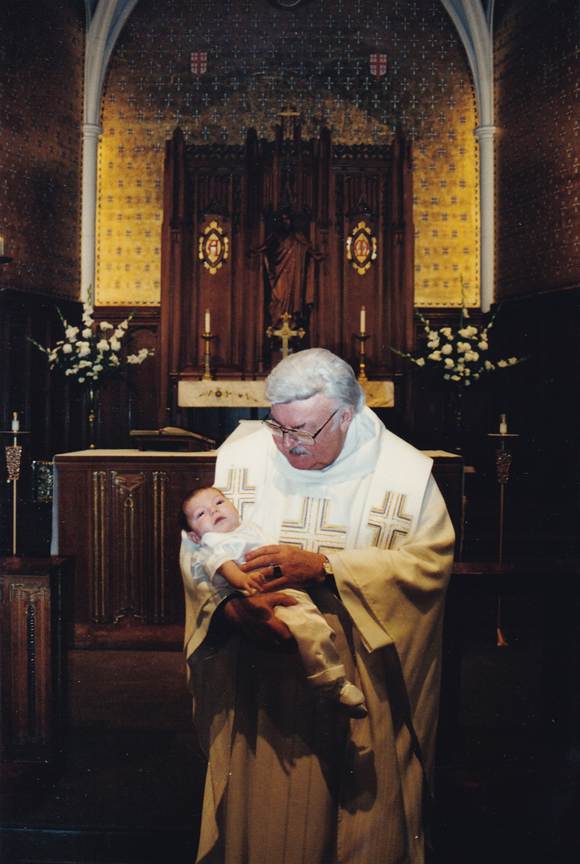
Pictured: Rev. Dr. Dale D. Hansen after baptizing my son — one of our family’s returns to church.

Figure 1 Rev. Dr. Dale D. Hansen and my older son

Next Week’s Topic: “Earliest ancestor”

AI Disclosure

This post was created by me with the help of AI tools. While AI helps organize research, the storytelling and discoveries are my own.

A Brutal Editor (with Zero Feelings): Using AI to Tighten Your Genealogy Writing

Using AI to improve my genealogical writing

I am writing a book for my children about their ancestors. They are not interested in their history now, but perhaps they or their children will be. This book is to hedge against my inability to assist them whenever that happy day comes.

Every year I focus on a new generation to research and improve it. Every month I set myself subtasks within that generation.

For June, I am focusing more on writing a quality biographical sketch.

I tried several AI tools, including ChatGPT and Claude (another writing assistant), but Claude gave me the most actionable feedback.

  1. Create a style sheet. You may choose the format of your choice, of course; perhaps it will be The New York Genealogical and Biographical Record, The Register, or The American Genealogist. Whichever you choose, there will probably be guidelines for prospective authors. You can point AI to those guidelines. I asked it:

Create a style sheet for a biographical sketch in genealogy. Lean toward the format discussed in https://www.newyorkfamilyhistory.org/writing-nygb-record

2. Run your sketch through that style sheet. I asked it:

Using this style sheet, suggest improvements for: <insert your sketch>

I will warn you, Claude was brutal. It gave suggestions in these areas, for example:

  • Major Issues to Address
  • Suggested Revision
  • Technical Corrections Needed
  • Missing Elements to Add
  • Critical Changes Needed
  • Research suggestions

Here’s a screenshot:

Each item included detailed explanations and suggestions, not just vague critiques.

And finally, take a look at my improved Malvina Hendell sketch.

Before:

After:

The rewrite read tighter, more professional, and far more historically grounded. Even I was impressed. I have been doing AI for a while now, and this really WOWed me. I made a note to go back and redo earlier generations in my book as well, it was that good.

Try it! It’s like having a no-nonsense editor on call—who never sleeps. Try it and let me know how it works for your writing.