52 Ancestors: Making a Home in Suwałki
I’ve adapted Amy Johnson Crow’s 52 Ancestors in 52 Weeks challenge.
Each week I follow my children’s ahnentafel numbering to select the featured ancestor, ensuring no one through the mid–sixth generation is left behind.
52 Ancestors in 52 Weeks: 2026 Week 43: Homemade
Introduction
My Week 43 ancestor is Rochla. When I first saw that this week’s 52 Ancestors theme was “Homemade,” I wondered what I could possibly write about Rochla () Bachrach. She was born around 1800 and died in Suwałki in 1867. I have no recipe in her handwriting, no piece of needlework, no treasured household object passed down through generations. I don’t even know whether she enjoyed cooking or sewing.
But perhaps I’ve been thinking about “homemade” too narrowly.
Rochla helped create a home for her family. It was a home in which children were born, some grew to adulthood and married, and others died far too young. It was a home that faced the loss of her husband in 1846. And although I know remarkably little about the objects that filled that home, I can begin to reconstruct the family who lived within it.
A Home Filled With Family
At first, I really had no idea what I’d discuss here, as Rochla’s identity has been a hard-fought win for me (no one told me about her; I found her with the help of LitvakSIG and JewishGen), much less any artifacts from her or stories about her. But truly, the best way to honor the woman is to honor the home that she made.
Rochla was born in the late 1790s, based on surviving records, which differ a little in the year but not a significant amount. She probably married Mowsza Bachrach around 1816-1820 and went on to have several children in Suwałki: Jochwa about 1821, Izrael in 1824, Chonel (1829), Chaja (1832), and Cywa (1835). They saw Jochwa married in 1837, and Rochla continued to add to the family with Cywia (1839-1839) and Chana (1842), born when her eldest sister was 21.
There are likely more children – records are spotty and some of these did not have birth records, but I calculated their births from their marriages and deaths. The records we do have, though, help to show a vibrant, growing family.
A Home Through Joy and Loss
Daughter Cywia died as a baby, aged only “3/4” [of a year].
Mowsza, Rochla’s husband, acted as a witness to their daughter Jochwa’s death in 1845. Jochwa had been married just 8 years and had had son Berko the month before her death.
Sadly, Berko himself died at just seven years old.
Less than a year later, on 18 March 1846, Mowsza died in Suwałki at the age of 54.
Rochla was a widow for 21 years, and her family story continued long after Mowsza’s death. She saw additional children marry (Chaia in 1848, Cywa in 1855, and Chana Beyla in 1859), and their marriage records continued to identify her. She died in 1867.
What Remains of Rochla’s Home
No recipe, piece of needlework, or household possession has survived to tell me about Rochla’s everyday life. What has survived are the records of the family she helped create. They show children being born, growing up, marrying, and sometimes dying far too young. They show a family rooted in Suwałki for decades, even as individual lives came and went.
I may never know what Rochla made with her hands. But I do know something about the home she made with her family. And perhaps, for this week’s theme, that is enough.
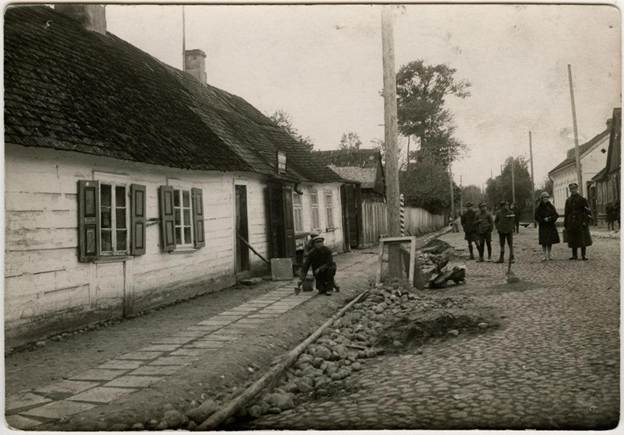
Mk.muzeum.suwalki.pl – Suwałki na starej fotografii – MUZEUM IM. MARII KONOPNICKIEJ
AI Disclosure
This post was created by me with the help of AI tools. While AI helps organize research, the storytelling and discoveries are my own.
Next Week’s Topic: What Surprised Me Most

