I’ve adapted Amy Johnson Crow’s 52 ancestors in 52 weeks challenge.
Each week’s post follows my children’s ahnentafel numbering, which determines the featured ancestor.
This ensures no one until mid-sixth generation gets left behind.
52 Ancestors in 52 Weeks: 2026 Week 08: A Big Decision
Introduction
My assigned Week 8 ancestor is Samuel Birnbaum.
I never met the man – my husband’s grandfather – and my husband didn’t know him either, just met him once or twice, according to hubby.
So I’m not working off any personal knowledge, just research.
Samuel Birnbaum made two big moves in his lifetime, and I’m definitely curious why he did.
Discussion
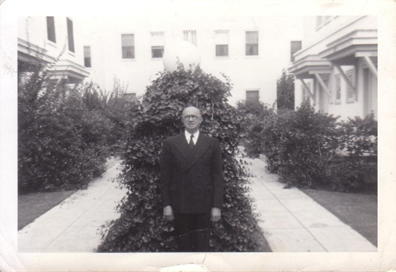
Samuel Birnbaum was born 18 April 1885 in Eperjes, Saros County, Hungary (now Prešov, Slovakia). On 24 February 1902, at age sixteen, he arrived in New York aboard the Kronprinz Wilhelm, stating he was joining his brother, Morris Berkovitz.
By 1906 he had married Anna Brenda Frank in Manhattan and established himself as a butcher. He filed his declaration of intent in 1909 and was naturalized in 1912.
After decades in New York City, Samuel, his wife, and their youngest son relocated to Los Angeles between 1940 and 1942, where he died in 1954.
Why did Samuel leave Europe for the US?
I don’t know the answer to this. Millions of Jews left Eastern Europe between 1880 and 1924, driven by economic hardship, antisemitism, conscription, and family networks. Samuel arrived in 1902, following a brother whose trail I have yet to uncover. That timing alone suggests he was part of that larger exodus.
What records might answer that question?
Passenger manifests sometimes note whether an immigrant had been in the U.S. before. Naturalization records can contain affidavits naming relatives. Hungarian civil records might clarify family structure and confirm the brother he claimed to follow.
What made Samuel move from New York to California at the beginning of World War II?
Moving across the country in your mid-50s isn’t a small decision. It suggests either urgency, opportunity, or family pull. Did the youngest son get a job and bring his parents? (The youngest son has proven more difficult to trace. I’ve found his WWII draft card and he worked for the Credit Service Bureau, which doesn’t seem to be war-related, but the 1950 census says he served in the armed forces.)
To move beyond speculation, I need to turn to the records. It’s time to pick up the threads here and braid them together.
Down the rabbit hole…
If you give a mouse a muffin, there are a bunch of tasks you need to do. And if you ask me about my grandfather-in-law, I remember some unexamined tidbits. But far better that, than running into a blank slate! Every unanswered question is an invitation. Off to research now!
Research Steps
To better understand Samuel’s two major moves, I plan to:
- Re-examine his naturalization file for witnesses or supporting affidavits that might identify the elusive brother Morris Berkovitz.
- Search passenger manifests and border crossings for alternate spellings of Morris’s name.
- Compare New York City directories (late 1930s–early 1940s) with Los Angeles directories to narrow the exact year of relocation.
- Revisit the youngest son’s World War II draft registration and service record for clues about residence or occupation changes.
- Locate Samuel’s California death certificate and obituary to identify the informant and any extended family listed.
Big decisions often leave paper trails. My task now is to find them.
Summary
Samuel Birnbaum made at least two life-altering decisions: to leave Hungary for America in 1902 and to leave New York for California four decades later. I don’t yet know what drove those choices, but the historical context offers possibilities. For now, the questions remain. The next step is to test the records and see whether those big decisions left clearer traces than I’ve yet uncovered.
AI Disclosure
This post was created by me with the help of AI tools. While AI helps organize research, the storytelling and discoveries are my own.
Next Week’s Topic: Conflicting Clues
 The Ancestor Whisperer