I’ve combined Amy Johnson Crow’s 52 ancestors in 52 weeks challenge, and Steve Little’s The 2025 AI Genealogy Do-Over, to create a unique 52 AI ancestors in 52 weeks party!
52 AI Ancestors in 52 Weeks: Week 35: Off to Work
Introduction
Introduction: The Family Commute
I used to watch my dad board the bus to “the city” (Manhattan) every morning. Same time. Same bus. Same briefcase. There was something both comforting and mysterious about it. I didn’t really know what he did all day. I just knew he went to work. That ritual – coat on, door shut, bus gone – was the first time I realized adults had lives beyond the kitchen table.
Mom was a stay at home with three young children, and Daddy’s arrival heralded dinner and a fun evening. Perhaps we’d work with us on his HO trains, or maybe Star Trek was on that night, or maybe there was another project that needed doing.
Discussion
Section 1: The Man with Molten Type
Before my dad commuted and long before I tapped my first line of code, my (maternal) grandfather worked as a linotype operator: a job that’s now as extinct as the machines he used.
If you’ve never seen one, imagine a typewriter and a small smelter had a very noisy, very dangerous baby. Each line of text was literally cast in hot lead. He didn’t just “type” – he composed entire newspaper pages, one line at a time, one letter at a time, backwards and in metal.
I was 4 when Grandpa retired and didn’t get to visit his place of employment. But years later, in middle school, I took a printing class and got to experience typesetting firsthand. I made several memos with headings such as “Memo from Janet.”
Grandpa’s job demanded precision and speed. A missed letter could ruin a whole page. Burned fingers weren’t rare. But he did it every day for 40 years at the same place.
Section 2: Then Came the Code
Just as he arranged type into meaning, I would later arrange code into logic.
Fast forward a few decades, and I found myself in front of a screen instead of a metal keyboard as a computer programmer. When I started, we used punch cards! Eight-inch floppy disks! (gasp) COBOL! Now, code lives in the cloud, and debugging means asking an AI model what went wrong.
But really, the job hasn’t changed that much. Like my grandfather, I still sit in front of a machine and try to arrange symbols into meaning. His lines were made of lead; mine are made of logic.
I am awed and amazed when I consider the change that has happened in my industry in the past 40 years. Steve Little said in his AI class, “I’ve spent 40 years preparing for this year and the next.” I feel the same way. My father’s routine, my grandfather’s grasp of language, and my logic skills all come together in my current job of creating educational materials for technology learners.
Sometimes I wonder what he would think of my job. Would he laugh at the idea of “virtual servers”? Would he nod in approval at a well-written script? Or would he just say, “At least you’re not setting your eyebrows on fire”?
How AI can help
AI can’t cast a line of hot lead, but it can help us work with the printed word in new ways. Tools like OCR (optical character recognition) can turn old newspapers or documents into searchable text. AI can even clean up fuzzy scans, translate foreign-language articles, and suggest connections you might have missed in census or work records. Just as my grandfather worked to set the words straight, I can now ask AI to straighten out a crooked page from 1905.
This isn’t just theory—AI has already changed how we do genealogy research. One great example of AI doing this is indexing the United States Federal Census.
FamilySearch says that it took 17 years to index the 1880 census. With the help of AI and human reviewers, the 1950 census was completely indexed and reviewed in three months. And usually whatever was still an issue, could be located with the help of tools like Steve Morse’s Census ED finder.
Challenge for Readers
Think about the workers in your own family tree.
- Who had a job that no longer exists?
- Can you picture a relative “off to work” each day—maybe with a lunch pail, uniform, or briefcase?
- Write a short memory, or search the census to see how your ancestors described their occupation.
Then, consider how that work has changed—or vanished—over time. Share your story in the comments or with your own #52Ancestors entry.
Want to Learn More?
Curious about linotype machines? Check out these:
- Linotype at Wikimedia Commons – a close-up view of the machine my grandfather worked on.
- Library of Congress Newspaper Navigator – explore historic newspapers that linotype operators helped set.
- FamilySearch Wiki: Occupations – tips for understanding your ancestor’s work.
- AI Genealogy Do-Over with Steve Little – a modern approach to using AI in family history.
Conclusion: Work, Then and Now
Three generations, three very different workdays—but the rhythm is oddly familiar. We leave the house (or open the laptop), focus on our task, and come home changed—sometimes tired, sometimes proud, sometimes wondering what we really accomplished.
I have long impressed upon my children the value of education. I hope as a corollary they see how important hard work is as well.
Today, no one boards a bus in my household, and molten metal is blissfully absent. But the spirit of showing up and shaping something with your brain and hands? That’s alive and well.
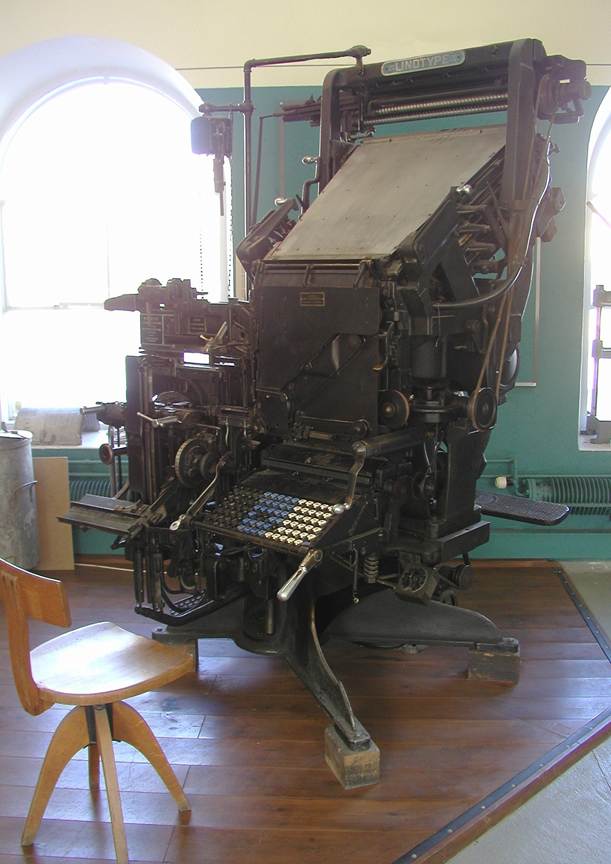
Figure 1 Linotype typesetting machine at Wikimedia Commons
https://commons.wikimedia.org/wiki/File%3ALinotype_typesetting_machine.JPG
Next Week’s Topic: “Off to school”
AI Disclosure
This post was created by me with the help of AI tools. While AI helps organize research, the storytelling and discoveries are my own.
 The Ancestor Whisperer
