I’ve combined Amy Johnson Crow’s 52 ancestors in 52 weeks challenge, and Steve Little’s The 2025 AI Genealogy Do-Over, to create a unique 52 AI ancestors in 52 weeks party!
52 AI Ancestors in 52 Weeks: Week 17: DNA
Introduction
Whose NPE is this, anyway?, or, Check your biases at the door
A couple of years ago, I had an intriguing DNA match on 23andMe. Our Relatives in common indicated a match on my Ohio branch – maternal grandfather’s line. The match has a somewhat unique name and is from a town 8 miles from where Grandpa was born. Unfortunately, that is the town the match died in, three months after the message I sent him on 23andMe. Since he’s not living, I’ll call him RZ here.
RZ has a reasonably easy lineage to trace, and we clearly branched apart once we went back 2 generations from Grandpa. It should have been easy to identify our common ancestor. But it wasn’t. I became convinced that RZ had an NPE. RZ’s mom was born 12 years after her closest sibling, and when her “sister” was 17… perhaps one of Grandpa’s brothers fathered a child with RZ’s mom’s “sister”… my digging didn’t produce convincing evidence (e.g., opportunity in the form of the same location).
Discussion
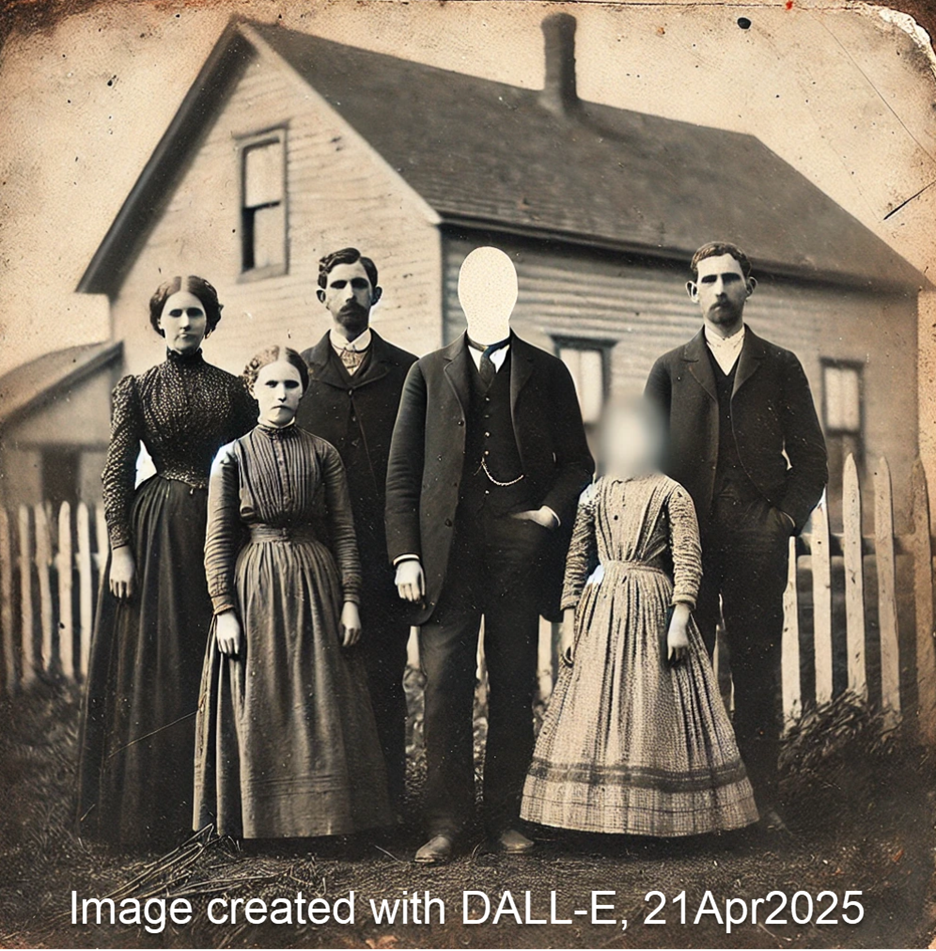
I took two of Steve Little’s Artificial Intelligence classes given at the National Genealogical Society and his course AI Genealogy Seminars: From Basics to Breakthroughs at the Genealogical Research Institute of Pittsburgh (GRIP) (wow! Highly recommend all of them). During the latter, Steve was showing us his custom chat Photo Analyst, and we used a photo I had of Grandpa with his siblings, parents, and grandfather. Steve asked me if the photo showed three generations or four and I suddenly had a light bulb moment.
Grandpa was born ten years after his next older sibling, when his sisters were 17 and 19… suddenly it wasn’t so obvious that it was RZ’s mom that was the NPE after all.
How AI can help
It’s tempting to stare at a brick wall and hope it blinks first. But when it comes to DNA mysteries, AI can be your sidekick with better night vision.
Here’s how AI assisted me:
- Clustering DNA Matches: While DNA sites offer tools like “shared matches,” I used ChatGPT to summarize common surnames and locations across clusters. Asking it, “Do you see any recurring names or places in this list of matches?” can nudge you in a direction you hadn’t considered.
- Reframing the Question: AI helped me phrase the real question: “Could the NPE be on my side instead?” That reframing gave me the ah-ha moment during Steve Little’s seminar. Sometimes it’s not the facts that need changing—it’s the lens.
Despite the current uncertainty around 23andMe, I’m reluctant to give up my account there, in the hopes that a Relative in common there will break through this mystery.
If you’re feeling stuck, AI might not have the answer, but it sure can ask a better question.
Summary and challenge
Sometimes DNA doesn’t reveal a clean answer—it kicks up dust and asks if you’re sure that branch belongs where you thought it did. What started as a search for someone else’s NPE brought me face-to-face with my own family’s possibilities.
Your turn:
Challenge #1: Use ChatGPT to compare 3–5 of your DNA matches. Ask it to spot shared surnames or birthplaces. Copy-paste the match notes or segment info (no personal identifiers!) and ask, “What patterns do you notice?”
Challenge #2: Have an old photo? Upload it to an AI photo enhancer like MyHeritage’s Deep Nostalgia or use ChatGPT’s image tools to generate a caption or age estimate. What stories surface?
Genealogy isn’t about finding the answer—it’s about learning to ask better ones, again and again.
We’ll wade into the world of Institutions next week—those places that held, housed, or helped (sometimes harmed) our ancestors. Think prisons, hospitals, orphanages, and more. Bring tissues… and curiosity.
Disclosure
This post was created by me and refined with AI assistance. While AI helps organize research, the storytelling and discoveries are my own.
 The Ancestor Whisperer