Unexpected

Unexpected

I’ve adapted Amy Johnson Crow’s 52 Ancestors in 52 Weeks challenge.
Each week I follow my children’s ahnentafel numbering to select the featured ancestor, ensuring no one through the mid–sixth generation is left behind.

52 Ancestors in 52 Weeks: 2026 Week 15: Unexpected

Introduction

My Week 15 ancestor is Edith Makey West. When I thought about the theme “Unexpected,” I realized that her life was shaped by unexpected mothering in many forms: first when her aunt stepped in after her mother’s death, then when a stepmother took on that role, and later when Grandma herself helped raise my generation.

Discussion

We say, “It takes a village to raise a child,” but it really did in many ways. Grandma’s mother died when she and her siblings were young children, and her mother’s married, childless sister, Aunt Edith, stepped in to help raise the three of them. Grandma remained very fond of Aunt Edith and Uncle Peter for the rest of her life. Aunt Edith died relatively young, but my uncle remembered Uncle Peter, so clearly the families remained close.

Once Grandma’s father remarried, he and his new wife brought the children back and informed them, “This is your mother now.” Grandma did, in fact, treat the woman as a mother, including caring for her after Grandma’s dad passed away. When Grandma told me family stories, she would mention, “My mother” and I would clarify that she meant her stepmother. (Not to be mean, of course, but I wanted to attribute the family stories to the right person.)

Finally, after my mother left my father and took us with her, she went home to her parents. Grandma helped raise us while my mother secured her footing, returned to the workforce, gained financial stability, and generally settled into single parenting. I never, ever heard Grandma issue the slightest complaint about all this new responsibility for a retired couple.

Summary

Grandma once told me, while recounting the family history, that the men in her family had it tough. I told her I thought the women did too; they were simply expected to endure, adapt, and keep going.

What feels most unexpected to me is not a hidden record or a family story proven true, but the way mothering kept taking new forms in Grandma’s life. After losing her own mother, she was cared for by Aunt Edith. Later, a stepmother took on that role in the household. And when her own daughter needed help, Grandma stepped in to help raise the next generation. In the end, the unexpected discovery is that in our family, mothering was not always about who had the title, but about who showed up.

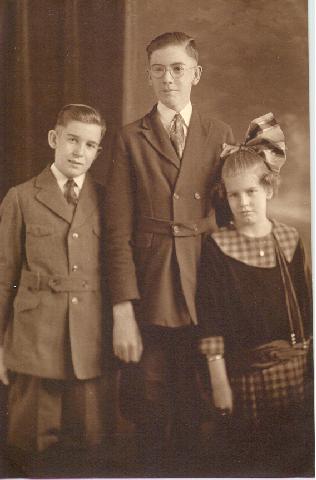
Walter, Harry, and Edith Makey

AI Disclosure

This post was created by me with the help of AI tools. While AI helps organize research, the storytelling and discoveries are my own.

Next Week’s Topic: A Quiet Life

An Address With a Story

An Address With a Story

I’ve adapted Amy Johnson Crow’s 52 Ancestors in 52 Weeks challenge.
Each week I follow my children’s ahnentafel numbering to select the featured ancestor, ensuring no one through the mid–sixth generation is left behind.

52 Ancestors in 52 Weeks: 2026 Week 12: An Address With a Story

Introduction

My assigned Week 12 ancestor is my paternal grandfather, Edward Anderson (1912–1985).

I’ve only ever known Grandpa to live at 60 Hillview Street, in Naugatuck, Connecticut. Of course, that wasn’t always the case – and it wasn’t even the plan.

Discussion

Grandpa was orphaned just days before his twelfth birthday. He and his two sisters were separated, each sent to different places. Grandma told me he lived with Uncle Jim and Aunt Lena for a time, but he seemed to spend much of his youth in “a home” – likely an orphanage, possibly St. Michael’s Home in Staten Island, New York.

By 1930, I found him as a young man rooming with two other young men, perhaps also without family support. He was working for a “rubber house,” where I believe he remained for the rest of his career.

By the next federal census, he had married, and he and his bride were living in Manhattan. They were still there in 1950.

Not long after, they moved to Staten Island, where I believe they purchased their first home.

At some point, Grandpa’s employer wanted to relocate him, but they chose not to go. The next time the company asked, Grandma told me, they felt they couldn’t refuse – they would be risking the household’s only income.

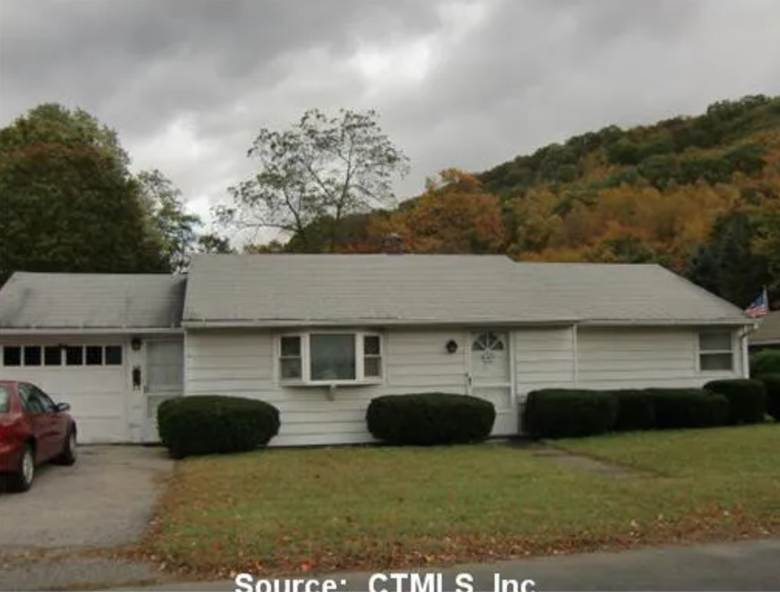
That decision brought them to Naugatuck, Connecticut, home of the United States Rubber Company. They bought what they considered a starter home: two bedrooms, one bath, and no expectation that it would be permanent.

Yet something about the house suited them. They made it their own. Grandpa lived the remaining 20 years of his life there, and Grandma stayed another 24 after that.

What they thought would be temporary became their forever home.

When my younger cousin once asked me for memories of Grandpa (she had been only a preschooler when he died) I told her about the walks he would take me on through that neighborhood. They knew their neighbors. Family settled nearby. It felt like a place where they had finally found peace.

I believe they were happy in that home.

Figure 1 Image from realtor.com

Challenge

What address has a special connection for you?

AI Disclosure

This post was created by me with the help of AI tools. While AI helps organize research, the storytelling and discoveries are my own.

Next Week’s Topic: A Family Pattern

52 AI Ancestors in 52 Weeks: Week 34: Play time

I’ve combined Amy Johnson Crow’s 52 ancestors in 52 weeks challenge, and Steve Little’s The 2025 AI Genealogy Do-Over, to create a unique 52 AI ancestors in 52 weeks party!

52 AI Ancestors in 52 Weeks: Week 34: Play time

Introduction

Grandpa was a jokester. He once had Grandma retrieve something from under the couch for him – which turned out to be plastic “dog poop.” “Oh, Gordon,” she said, for the umpteenth time, shaking her head.

When thinking about play time, my mind automatically goes to my grandfather, Gordon West (1907-1981). But which play are we talking about?

Grandma had a devil of a time deciphering the items he put on shopping lists – aches for eggs, like that. He played my first April Fool’s joke on me (Santa Claus was outside the window) and acted very surprised when I played the same joke on him right back (hey, I was 4).  He left written instructions “To earl organ” so that we would know how to oil the instrument.

Discussion

But Grandpa’s playfulness wasn’t just in his jokes. It was also in his music. The playing I most remember Grandpa for was his Hammond organ. Grandpa earned a living playing the organ at the movie theater before “talkies” (movies with sound) came out. (Google tells me that The Jazz Singer popularized them in 1927, and they were ubiquitous by 1930, when Grandpa turned 23.)

He then had a tough search for work during the Depression. A friend offered him a job as a linotype operator for no pay, which he used to get a job at the Staten Island Advance and he worked at it for 41 years (according to an article about his retirement).

Still, Grandpa never forgot his roots and never lost his love for music. I remember Grandpa playing for the grandchildren and us dancing to such classics as Tie a Yellow Ribbon Round the Ole Oak Tree (which was actually new when he played it for us), and similar.

Dancing in the living room while Grandpa played the organ is the last childhood joy I remember.

So, in a way, this is about my play time as well.

Love you, Grandpa.

Organ oiling instructions, where he purposely spelled "oil" as "earl"

How AI can help

While Grandpa provided the heart of this story, AI gave me a few gentle nudges. I used it to double-check when “talkies” became mainstream and to help clarify a few fuzzy details around his career shift. AI didn’t write this story, but it did help me ask better questions. And sometimes, that’s all the help you need.

Challenge for Readers

Think about someone in your own family tree who brought playfulness into daily life. Did they tell jokes, pull pranks, play music, or encourage dancing in the living room? Share their story, or a favorite memory of your own “play time.”

Next Week’s Topic: “Off to work”

AI Disclosure

This post was created by me with the help of AI tools. While AI helps organize research, the storytelling and discoveries are my own.