Grandpa was a jokester. He once had Grandma retrieve something from under the couch for him – which turned out to be plastic “dog poop.” “Oh, Gordon,” she said, for the umpteenth time, shaking her head.
When thinking about play time, my mind automatically goes to my grandfather, Gordon West (1907-1981). But which play are we talking about?
Grandma had a devil of a time deciphering the items he put on shopping lists – aches for eggs, like that. He played my first April Fool’s joke on me (Santa Claus was outside the window) and acted very surprised when I played the same joke on him right back (hey, I was 4). He left written instructions “To earl organ” so that we would know how to oil the instrument.
Discussion
But Grandpa’s playfulness wasn’t just in his jokes. It was also in his music. The playing I most remember Grandpa for was his Hammond organ. Grandpa earned a living playing the organ at the movie theater before “talkies” (movies with sound) came out. (Google tells me that The Jazz Singer popularized them in 1927, and they were ubiquitous by 1930, when Grandpa turned 23.)
He then had a tough search for work during the Depression. A friend offered him a job as a linotype operator for no pay, which he used to get a job at the Staten Island Advance and he worked at it for 41 years (according to an article about his retirement).
Still, Grandpa never forgot his roots and never lost his love for music. I remember Grandpa playing for the grandchildren and us dancing to such classics as Tie a Yellow Ribbon Round the Ole Oak Tree (which was actually new when he played it for us), and similar.
Dancing in the living room while Grandpa played the organ is the last childhood joy I remember.
So, in a way, this is about my play time as well.
Love you, Grandpa.
How AI can help
While Grandpa provided the heart of this story, AI gave me a few gentle nudges. I used it to double-check when “talkies” became mainstream and to help clarify a few fuzzy details around his career shift. AI didn’t write this story, but it did help me ask better questions. And sometimes, that’s all the help you need.
Challenge for Readers
Think about someone in your own family tree who brought playfulness into daily life. Did they tell jokes, pull pranks, play music, or encourage dancing in the living room? Share their story, or a favorite memory of your own “play time.”
Next Week’s Topic: “Off to work”
AI Disclosure
This post was created by me with the help of AI tools. While AI helps organize research, the storytelling and discoveries are my own.
52 AI Ancestors in 52 Weeks: Week 33: Legal troubles
Introduction
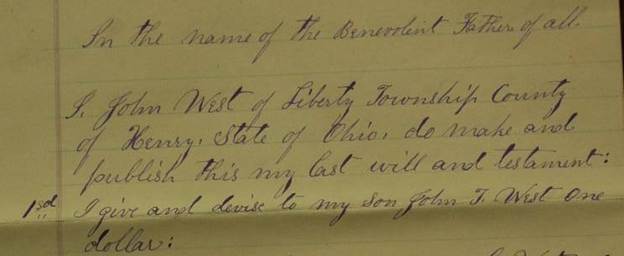
My first clue was my ancestor John West’s will, dated 01 December 1875, and proven 30 September 1876: “I, John West… give and devise to my son John T. West one dollar.”[1]
Figure 1 Opening lines of John West’s 1875 will, Henry County, Ohio
I would be remiss if I did not mention that I was the fortunate recipient of a copy of this will before FamilySearch got them online, thanks to a volunteer from the sadly disbanded Henry County (Ohio) Genealogical Society. [Shoutout to Jim Rebar!]
Discussion
It seems my great-great grandfather John T. and his father had a schism which was never resolved. Digging into court records revealed more information: In September 1870, John the father, “an old man over seventy” sold his son John T some land for a fraction of its value in return for the son supporting the father “as long as he shall live.”
The father and son did not get along well; the father claims the son required him to “perform manual labor continually,” verbally abused him, did not furnish him with necessary clothing or sufficient food, and more. The father did “not feel safe longer to remain in the family of” his son. The father asserts the son was intending to sell what was left of the father’s property “with the view and intention to leave the state,” which may be corroborated by a letter I have written by the son’s wife (see 52 AI Ancestors in 52 Weeks: Week 7: Letters and Diaries). This complaint was sworn on December 17, 1875, when the father moved out of the son’s house., about two weeks after the will mentioned above.
In January, the son filed a statement alleging that the complaints were untrue and he was ready and willing to support his father as contractually obligated. He submitted a financial statement for 5 years, 3 months, and two weeks of boarding and purchases, mostly clothing.
The father responded on February 19, disagreeing with his son’s statement.
Sadly, in “the October term” of that year, the plaintiff “has departed this life,” and was later dismissed.
I’m sorry that father and son never mended their rift, and am sorry that the family pattern has carried forward, to some extent. While my research took patience, time, and long distance volunteer help, I now know there are AI tools that can make the search easier.
How AI Can Help (as suggested by, of course, AI)
AI can be useful when you’re researching an ancestor with a colorful legal history. Here’s how I might have used them in my own search to understand the John Wests:
Transcribing and Summarizing Old Legal Documents Many legal records are written in challenging handwriting or dense legal language. AI-powered transcription tools can turn scanned documents into readable text, while summarizers can condense them into plain language without losing important details.
Finding Background from Historical Laws AI can search digitized law books, newspapers, and historical archives to explain the laws of the time. This can help you understand why your ancestor might have been in trouble – or what their rights and obligations were.
Cross-Referencing with Other Records Court cases often connect to land deeds, wills, or even census data. AI search tools can spot names, places, and dates across different record sets, saving hours of manual work.
Creating Timelines AI can take scattered facts and dates from different sources and lay them out in an easy-to-follow timeline. This can reveal patterns, conflicts, or missing pieces in your ancestor’s story.
Tip: Always review AI’s results against the original sources – AI is great at spotting leads, but it’s not a substitute for your genealogist’s judgment.
Challenge for Readers
Decode a Court Record with AI
Find a legal record from your own research: a will, court case, or land dispute.
Use an AI-powered transcription tool (such as Transkribus or Google Docs OCR) to turn the scan into text.
Paste the text into a free AI tool and ask it to explain the document in plain English.
Compare its interpretation with your own.
AI Timeline Builder
Gather 5–10 dated events from your ancestor’s legal troubles (court filings, sales of property, letters, etc.).
Feed the events into a free AI tool like ChatGPT free plan or Claude.ai and ask it to arrange them into a chronological timeline with a short summary for each event.
Look for gaps or unexpected patterns you might have missed before.
If I’d had these tools when I first read John West’s will, I might have untangled the drama faster.
Want to Learn More?
📚 Suggested Resources
Transcription Tools
Transkribus – For handwritten historical documents.
52 AI Ancestors in 52 Weeks: Week 32 Wide open spaces
Introduction
This is a Public Service Announcement about researching at the United States Bureau of Land Management (BLM). There is no better use of the Wide Open Spaces topic if you’re in the US.
Discussion
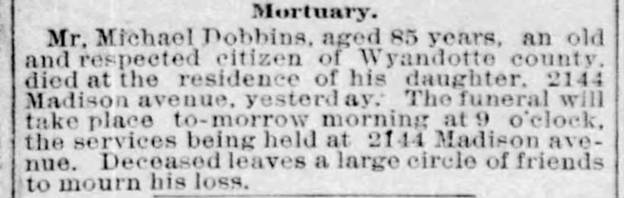
What prompted me to think of this was a to-do list item which unfortunately was only in my head until now. Michael DOBBINS and his wife Mary MALONE were an Irish couple with several children. The family emigrated bit by bit during An Gorta Mór (The Great Hunger). They settled in Morris County, New Jersey for a time, where at least two daughters married and settled, and then the parents and younger children moved out to Shawnee, Wyandotte, Kansas, to farm. Numerous census schedules show Michael engaged in farming and with a considerable amount of land.
His will (Ancestry link; it’s restricted on FamilySearch) distributed much land:
To my daughter Bridget Murphy: west half of South East (1/4) quarter of south west (1/4) quarter of section Eighteen (18) Town Eleven (11) Range Twenty five (25) containing twenty acres…
To my son Michael Dobbins the west half (1/2) of north east quarter (1/4) of South West quarter (1/4) of section Eighteen (18) Township Eleven (11) Range Twenty five (25) containing twenty acres…
To William Dobbins and James Dobbins the children of my [deceased] son James Dobbins the East half of South East quarter (1/4) of South West quarter (1/4) of Section (18) Eighteen, town Eleven (11) Range twenty five (25) containing twenty acres…
(Side note: Michael’s son James was killed in a duel in 1879.) I went back to the 1880 census, agricultural schedules (Ancestry link), and sure enough he has 58 acres improved and 2 acres unimproved, farm valued at $3,000.
What brought this poor Irish immigrant to Kansas? How did he end up with sixty acres of land? I suspect the answer for both questions is the same. I wonder if I might find answers at the Bureau of Land Management.
How AI can help
I went to Microsoft Researcher, and asked:
How do I use the Bureau of Land Management for genealogical research, if my ancestor unexpectedly got property in Kansas?
It gave me the chance to be more specific in my prompting ( 😊 ) so I replied:
My poor ancestor in New Jersey, Michael Dobbins, moved to Shawnee Township, Wyandotte, Kansas around 1865 and acquired 60 acres of property. How would he have been able to do this?
I added:
How would I be able to research any records that might exist around this grant or acquisition?
Microsoft Researcher was surprisingly thorough – AI gave me a to-do list I didn’t know I needed. It kindly provided me with a hefty output called Genealogical Research Report: Land Acquisition in 1860s Kansas (Case of Michael Dobbins). I’ll attach it at the bottom of this post. What it does (its thinking) is in the beginning, and the report starts on page 8. I think the list on page 11 is the meat of it:
This research is still on my to-do list (this was a big enough rabbit hole for today), but I now have a better idea what to do and where to go.
Challenge for Readers
Use Microsoft Researcher or Perplexity to suggest records for your specific situation: especially location and time frame and possible military service.
Chronicling America (Library of Congress Newspapers) https://chroniclingamerica.loc.gov Use to find ancestor mentions, land auctions, or westward movement articles.
52 AI Ancestors in 52 Weeks: Week 31: Earliest Ancestor
Introduction
“How far back have you gone?” It’s a common question from non-genealogists. But I’m excited to discuss it today with genealogists! My earliest known ancestors are Philippe du Trieux, and his wife Jaquemyne Noiret. Philippe was born 1586 in Roubaix, Flanders, then Belgium, and Jacquemine in 1593 in Lille, France.
Discussion
As a Walloon, he moved often, first to Leiden and then Amsterdam in the Netherlands (where Jacquemine died, and Philippe remarried to Susanna du Chesne) and finally to New Amsterdam in 1624. His descendants have invented many “facts” and it’s a challenge sorting it all out. The 1926 article cited below is still an authority, and much more credible than most of what is floating around online.
Philippe, his children and his second wife were among the very first settlers in what is now Manhattan. He erected a house on the Bever Graft, the article says, and later lived on Smits Vly (valley). Philippe was appointed as a court messenger, or marshal, by Governor Kieft in 1638.
Philippe is thought to have been killed with his son in an “Indian attack” between 1649 and 1653.
The really intriguing thing is we have a lead on Philippe’s possible parents! There is a Jaquemyne du Trieux widow of Philippe (not to be confused with our Philippe and his first wife Jacquemine) mentioned in Leiden records, as being from Norwich England.
In the record of the Walloon Church at Leyden:
“April 22, 1601. Jaquemyne, widow of Philippe du Trieu, received into Church of Leyden, by letter from Norwich, England.”
This Jaquemyne and her deceased husband might well have been the parents of Philippe who came to New Amsterdam in 1624, but we have no proof that such is the case.[1]
How AI can help
Researching ancestors from the 1500s might sound like trying to solve a cold case with half the clues missing – and most written in languages we don’t speak. Here’s where AI can lend a hand:
Language Translation Made Easy AI tools like Google Translate or DeepL can quickly translate Dutch, French, Latin, or old Walloon records. While not perfect, they’re a great first pass to understand what a document says before consulting a professional.
Reading Between the Lines (Literally) Many old documents are hard to read because of handwriting. AI handwriting recognition tools, such as Transkribus, can help transcribe and interpret those difficult letters and notations – especially helpful in 17th-century church or court records.
Sorting the Fact from Family Folklore Generative AI can look at multiple versions of a family story or online tree entries, note patterns and outliers, and point you toward the most supported facts. It’s like a polite cousin who says, “Yes, but according to actual sources…”
Timeline Generation With basic info and dates, you can use AI tools (like ChatGPT or free timeline generators online) to auto-create a visual or text-based timeline. This helps you spot gaps, contradictions, or opportunities for new searches.
Hypothesis Testing For Philippe’s possible parentage, AI can help you outline different possibilities and suggest what records you’d need to explore each one. Think of it as a brainstorming buddy for brick walls.
Research
Yes, really! There are some very good researcher agents out there. They can provide a good start to your own research. Try Microsoft Researcher (I love it, but have to prompt hard to get it to be less wordy) or Perplexity (Mark Thompson and Steve Little talked about its Comet in this podcast).
Challenge for Readers
Who is your earliest ancestor? How much documentation is there on them? Consider creating a timeline to firm up their known facts – I found the one in the Record article to be very useful.
Already created a timeline for your earliest ancestor? Excellent. Let’s build on that using AI:
AI-Powered Timeline Prompt Enter the known events and dates for your ancestor into ChatGPT and ask: “Can you create a basic timeline of events for [ancestor’s name], and suggest what kinds of records I might look for at each stage?”
Compare Online Trees Cautiously Use AI to review summaries from different online trees (e.g., WikiTree, Ancestry, FamilySearch) by copying and pasting entries. Ask: “Can you summarize key differences and potential errors in these family trees?”
Geographic Migration Map Upload your ancestor’s locations to a free AI-powered map tool like MyHeritage’s PedigreeMap or even Google’s My Maps. Let AI help visualize migration paths and see patterns that might point to more records.
By Jacob van Meurs – This is an image from the Atlas of Mutual Heritage and the Koninklijke Bibliotheek, the Dutch National Library.The metadata of this file is public domain under a Creative Commons Public Domain Dedication (CC-ZERO). This permission has been archived as ticket #2014051410008887, Public Domain, https://commons.wikimedia.org/w/index.php?curid=33308107
Next Week’s Topic: “Wide open spaces”
AI Disclosure
This post was created by me with the help of AI tools. While AI helps organize research, the storytelling and discoveries are my own.
[1] Howard S. F. Randolph, editor, The House of Truax (The New York Genealogical and Biographical Record: vol. 57, no. 3 (1926)), p. 208.
52 AI Ancestors in 52 Weeks: Week 30: Religious traditions
Boomerangs and Belief: Tracing the Faith Footprints of My Ancestors
Introduction
What makes a person fall away from their religious institution? What kind of a schism must there be for a person to no longer publicly worship?
Discussion
My family has many instances of parting ways with their churches. The oldest one I know of is my great-grandfather, who was upset that the Roman Catholic church wouldn’t bury his mom because she hadn’t been active in their (new?) hometown. My grandmother disagreed with the Church over birth control, and my father over divorce.
Some of them rejoined; others joined different denominations, and others stayed away for their lifetime.
Robert Frost, in his poem “The Death of the Hired Man,” said, “Home is the place where, when you have to go there, they have to take you in.” I think your religious home operates in a similar manner – our Creator welcomes us back into the fold, whenever we are ready.
So while it may be said that my family’s religious tradition is boomeranging, it may also be knowledge and confidence in God’s love and acceptance.
How AI can help
Religion is such a personal thing, I struggled to come up with telling the reader how to use it in terms of religion! So ChatGPT and I came up with several options.
AI may not know the state of your soul, but it’s pretty handy when you’re tracing where your ancestors stood on Sunday mornings. Here’s how it can help:
Translation of Old Religious Records Found a Latin baptism record or a German church book? AI translation tools like DeepL or Google Translate (with a little human double-checking) can help you read the meaning behind the ink smudges.
Summarizing Church Histories Want to know what the Methodist split was about in 1844 or why some churches stopped performing baptisms? Paste those long historical documents into AI tools like ChatGPT to get a plain-English summary.
Writing Sensitive Stories Struggling with how to write about a family member who left a faith community? AI can suggest gentle, neutral phrasing that keeps the focus on your ancestor’s journey.
Identifying Denominational Shifts in Census and Directories Ask AI to help you spot changes in religious identity over time from records. Did “Catholic” become “None” in a later census? That’s a story spark.
Generating Maps of Religious Migration Use AI-assisted tools like Mapbox or even ChatGPT plugins (for premium users) to visualize how your ancestors moved—and how their religious affiliations may have shifted regionally.
Creating Devotional or Reflective Writing Prompts If you’re writing a memory book or family devotional, AI can suggest prompts like “Describe a time your ancestor might have questioned their faith” or “What church rituals did your grandmother pass down?” You might be surprised what you – or family members – know.
Challenge for Readers
Try one of these:
Option 1: Paste a church newsletter or old religious diary into ChatGPT and ask it to summarize key events or beliefs.
Option 2: Ask ChatGPT to help rephrase a story about a family religious split in a more compassionate or neutral tone.
Internet Archive – Denominational Histories https://archive.org Search for books like A History of the Baptist Churches or Roman Catholicism in America for church context.
ChatGPT Prompt Directory for Genealogists Want more prompt ideas? Check out Steve Little’s AI prompt guide for genealogists (available via his site or podcast).
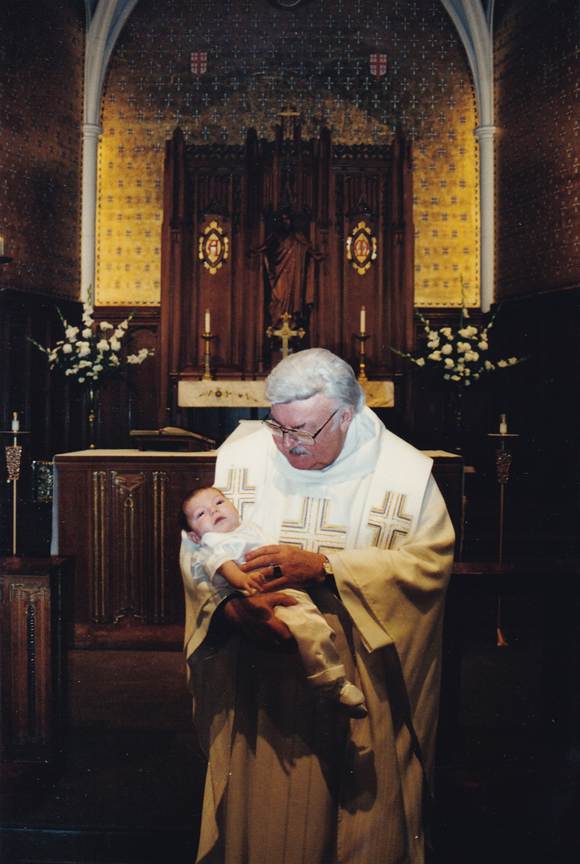
Pictured: Rev. Dr. Dale D. Hansen after baptizing my son — one of our family’s returns to church.
Figure 1 Rev. Dr. Dale D. Hansen and my older son
Next Week’s Topic: “Earliest ancestor”
AI Disclosure
This post was created by me with the help of AI tools. While AI helps organize research, the storytelling and discoveries are my own.
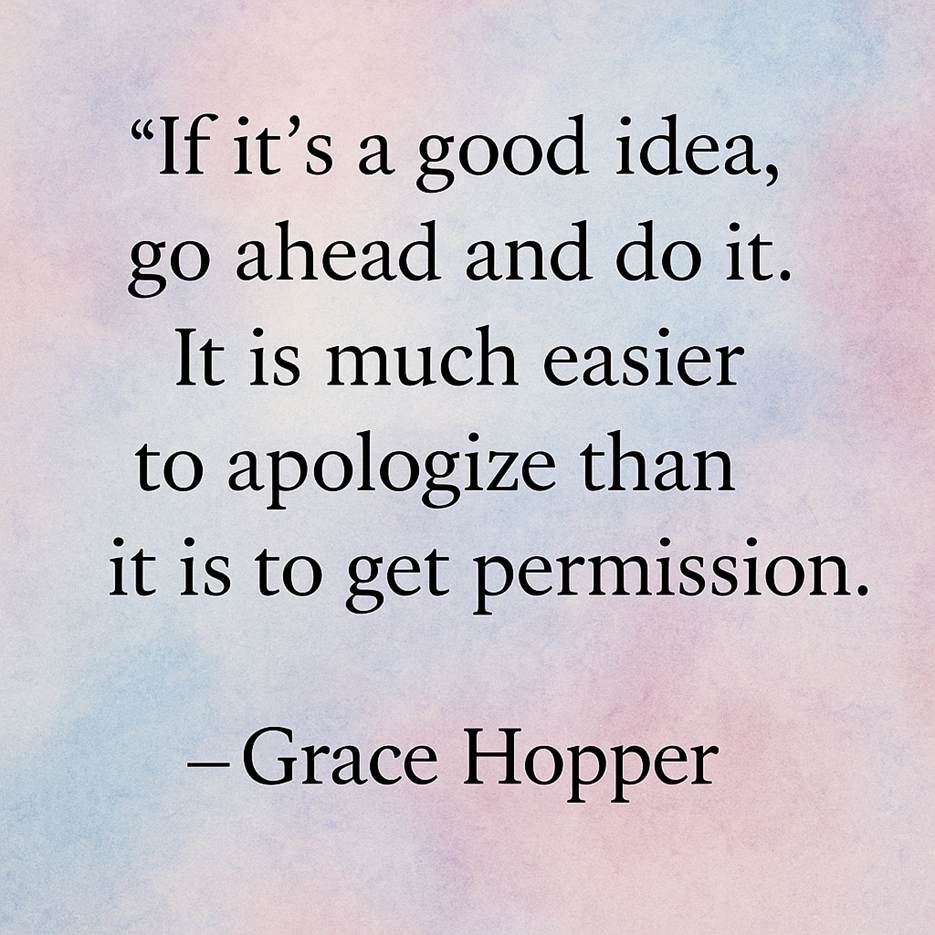
Every once in a while, someone comes along who changes the course of technology – not with a bang, but with a well-placed line of code and a sense of humor. Grace MURRAY HOPPER (1906-1992), a Rear Admiral in the U.S. Navy and one of the earliest computer programmers, didn’t just break barriers – she moved them. She also once carried around pieces of wire to teach people about nanoseconds. You know… as one does.
She’s also my sixth cousin once removed.
Who Was Grace Hopper?
Born in 1906, Grace Hopper was the kind of child who took apart alarm clocks to understand how they worked. As an adult, she brought that same curiosity to computing – only now she was dissecting early computers and writing code that would shape generations.
While many of us are mystified by how our phones magically order groceries or suggest suspiciously perfect ads, Hopper was building the foundation for all that. She was one of the first to argue that computers should “speak English” rather than requiring users to speak in ones and zeroes. (Honestly, she had a point.)
What Made Her So Memorable?
Here are a few things about Grace Hopper that might surprise – and inspire – you:
She created the first compiler in 1952. That means she figured out how to tell computers what to do in a more natural language – and taught them how to translate that into machine instructions.
She helped develop COBOL, a language still running the back end of banks, government agencies, and airports around the world. Not bad for something she helped write over 60 years ago. [Back in the day, I programmed in COBOL myself.]
She’s credited with coining the term “computer bug.” After finding an actual moth stuck inside a computer relay, she taped it into her notebook with the note: “First actual case of bug being found.”
She was told she was too old and too small to join the Navy during WWII. She joined anyway – because when has “no” ever stopped a determined woman?
She didn’t retire until age 79. And she did it with flair. She retired as the oldest active-duty commissioned officer in the U.S. Navy.
She taught with props. Her famous nanosecond wire demonstration helped people visualize how fast computers operate. It’s still used in classrooms today.
Want to understand Hopper’s genius with your own hands? Try this:
Measure a nanosecond. Cut a piece of string about 11.8 inches long. That’s how far light travels in one nanosecond. Now imagine your computer doing millions of things in that time.
Write a plain-language “program.” Pretend you’re telling a computer how to make a peanut butter sandwich. Sounds easy? Give your instructions to someone else and see if it works without guesswork. That’s what Hopper was solving: making computers understand clear, human instructions.
What Can We Learn from Her?
Hopper wasn’t just smart – she was practical. She believed in making things simpler, not fancier. She valued curiosity over credentials, and patience over prestige.
As genealogists and digital explorers, there’s something deeply familiar about that mindset. We spend hours untangling family trees and wrestling with clunky software. Hopper reminds us that tech doesn’t have to be mysterious – it just needs the right instructions and a little stubbornness.
But what about that cousin business?
Grace Brewster Murray was born in New York City, as per her Wikipedia entry. She was the eldest of three children. Her parents, Walter Fletcher Murray and Mary Campbell Van Horne, were of Scottish and Dutch descent, and attended West End Collegiate Church. Her great-grandfather, Alexander Wilson Russell, an admiral in the US Navy, fought in the Battle of Mobile Bay during the Civil War.
Grace Brewster Murray (1906-1992) – Mary Campbell Van Horne (1883-1960) – John Garret Van Horne (1853-1932) – Mary Jane Britton (1832-?) – Abraham Britton Sr. (1803-1866) – Cornelius Britton (1778-1832) – Abraham Britton (abt 1752-bef 1791) – Nathaniel Britton (bef 1729-1792) and Mary ?Fountain? (?-aft 1792), my sixth great grandparents, so Grace and I are sixth cousins once removed.
From Grace to GPT: What Would Hopper Think of AI Today?
Grace Hopper argued for the idea that computers should speak a human-friendly language. Today, AI takes that concept to a whole new level – chatting, summarizing, and yes, even writing blog posts. If Hopper could debug a room-sized machine with a moth and a notebook, she’d probably have a field day with AI’s quirks.
For genealogists, AI isn’t about replacing the thrill of a good document find – it’s about translating messy, hard-to-read data into searchable hints, or helping you brainstorm blog posts (like this one). Hopper’s compiler turned human language into machine instructions. AI, in a way, brings that full circle: it turns data back into human language, stories, and sometimes… cousin connections.
Next time you ask ChatGPT to help you explain the difference between a second cousin and a cousin once removed, just remember: you’re standing on the nanosecond-length shoulders of giants like Grace Hopper.
Want to Learn More?
📖 Grace Hopper and the Invention of the Information Age by Kurt Beyer
This post was drafted with the help of GenAI Blogging Buddy, your AI-powered assistant for turning good blog posts into great ones. It was reviewed and shaped by a human for clarity, tone, and wit (OK, maybe I wasn’t the witty one).
“Who is someone in your family tree who traveled?” asks Amy Johnson Crow in this week’s prompt.
Here are some people who came to mind:
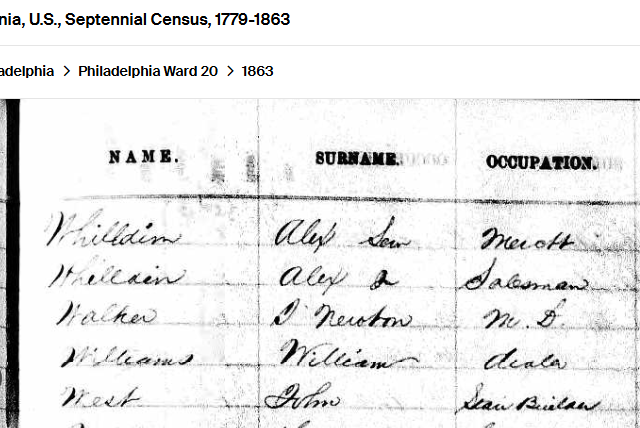
My grandfather’s grandfather, John T. West, moved from Maryland to Virginia to New Jersey to Pennsylvania to Ohio, and according to a letter my grandfather’s grandmother wrote to her son, was thinking about moving out to Michigan.
My father, Robert E. Anderson, newly divorced, fought for longer visitation with his children than the typical Saturday visit given to divorced dads at the time. He used the two-week summer visits to take us on road trip adventures, which I fondly remember (and long to recreate) decades later.
Perhaps my best-traveled ancestor was Louis Thibou, who migrated from France to England to the Carolinas to Antigua, with apparently trips to New York and Philadelphia as well.
Discussion
But the well-traveled ancestor who is intriguing me this week is my grandmother, Edith MAKEY WEST (1913-1997). She and her husband A. Gordon WEST (1907-1981) truly enjoyed their road trips. When possible, they took their grandchildren with them. When I was 7, we went on a trip from New York to the fairly new Disney World in Florida, with a stop at Colonial Williamsburg. I remember being driven to many, many fairs (State fairs? County fairs? I’m not sure).
They proudly hung photos from an Alaska cruise in their den.
I remember well a photo of my grandfather on a trip they took to Hawai’i.
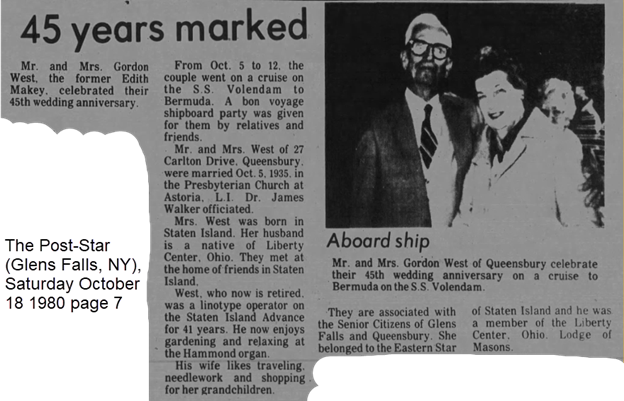
They celebrated their 45th wedding anniversary with a trip to Bermuda with friends, reported in their local newspaper for both their old and new residences.
After Grandpa died, Grandma went on trips with the town’s Senior Center, including one memorable paddleboat trip on the Mississippi River, which I’m determined to do as well. Grandma told me very proudly that she and Grandpa had visited 37 of the 50 United States.
I am determined to honor my ancestors’ adventurous spirits by doing traveling of my own! I have two maps hung in my kitchen: a map of the countries of the world, and another of the states in the country, with magnetic pins marking the places the family has traveled. Where do I travel? Should I travel to ancestral locations? Or perhaps Wonders of the World? Or maybe I should aim for all seven continents. I’ve seen a great list of the best botanical gardens in the world. Last summer we did a waterfall tour in our state.
How AI can help
AI can be a terrific partner in trip planning! It can help give you ideas, and it can help plan a trip you decide on.
I used ChatGPT and Claude.
Where should I go? I used ChatGPT because it has successfully read GEDCOM files for me in the past.
I asked ChatGPT:
Using the attached gedcom file, please list all the places in Ireland which are mentioned.
It replied:
Specific Locations in Ireland Mentioned:
Delvin, Westmeath, Ireland
Killucan, Westmeath, Ireland
Kilkenny, Ireland
Trim, Meath, Ireland
Carroll, Ireland (possibly a reference to a townland or misrendered from “County Carlow”)
2. Help me plan a trip! I used Claude for this because it helped me to plan a hypothetical trip in the past.
I asked Claude:
You are an expert travel guide.
I plan to visit Ireland to visit my ancestral homelands. Please plan a realistic itinerary for me
* Timing: end of June
* Duration: 7 days
* Style: hotels
* Activities: historical sites, a Roman Catholic church at each location, moderate physical activity (no excessive stairs/climbing), hidden gems
Claude’s itinerary truly surprised me—detailed, thoughtful, and full of hidden gems. See a sample here, and a link to the entire itinerary below.
I forgot to specify my travel in and out but it assumed travel via Dublin airport. Each day noted the location, the home base, the accommodation, events in the morning, afternoon, and evening, and a hidden gem. Overall it gave practical information such as car rental, GPS need, petrol stations. It provided genealogy research tips which included four resources, notes on Catholic churches, weather preparation, budget, and so much more. You can view the entire itinerary here.
But note that it gave me notes in the chat which are not reproduced in the itinerary:
I’ll create a wonderful 7-day Ireland itinerary focused on your ancestral homelands in the heart of the country. Late June is perfect timing – long daylight hours, mild weather, and everything in full bloom.
This itinerary is designed specifically around your ancestral locations in the Irish Midlands while incorporating the historical depth and genealogical opportunities you’re seeking. The route flows naturally from north to south, minimizing driving time while maximizing your connection to the landscape your ancestors knew.
A few special highlights for your genealogical interests:
Westmeath County Library in Mullingar has excellent local history and genealogy resources, and the staff are incredibly helpful with family research. The Delvin Heritage Centre may have specific records about families from that area.
Late June timing is ideal – you’ll have nearly 18 hours of daylight, the countryside will be lush and green, and you’ll avoid the peak summer crowds while still having everything open and accessible.
The hidden gems I’ve included – like Fore Abbey with its ancient legends and Kilfane Glen’s fairy-tale atmosphere – will give you a deeper sense of Ireland’s mystical character that your ancestors would have known.
I mean, really, are you not floored?
For full disclosure, I asked Claude for a map and am less than impressed. I need to refine my prompt or use a different model.
I then asked what reservations I needed to make and was again impressed. First, it listed them in time order (4-6 weeks out, 2-3 weeks ahead, on arrival). Second, it listed all sorts of reservations: sites to visit, car rental, special dining, genealogy research.
Challenge
Pick one AI model (Claude, ChatGPT, Perplexity, Gemini, or Copilot) and ask it to help you plan a genealogy research trip.
If you’re not sure where to start, try prompts like:
“Here is my ancestor’s hometown. What genealogy sites can I visit nearby?”
“Create a 5-day itinerary for a research trip to [location].”
“List Catholic churches and local libraries in [ancestral town].”
Even if you’re only dreaming today, seeing the plan might just get you packing.
Summary
Sometimes our ancestors traveled by necessity. Sometimes by choice. What if we made space for the kind of trip they wanted—but for ourselves? I tested AI to plan a genealogical research trip to Ireland, but you can use it for any adventure. Let the past inspire your next destination.
Whether it’s retracing an ancestor’s steps, seeing the Seven Wonders, or trying voluntourism, the possibilities are wide open. And if you’re stuck on where to start, AI can spark ideas too. Dream it, map it, maybe even book it.
In 1910, John is in a Soldier’s and Sailor’s home with no occupation:[10]
And finally, in 1920, he is in the Solder’s and Sailor’s home with no occupation again: [11]
Third generation
John T.’s son, John Thomas West Jr., not my ancestor, also became a carpenter.
When the prompt came out this week, “Family business,” I was stumped as to what I would discuss. But I think a three-generation craft is respectable for this purpose!
Another string
My great-grandfather on another line was a financial secretary; his son in law (my grandfather) was an accountant; his son (my father) was a tax accountant. It skipped a generation, but my son is a Certified Public Accountant.
How AI can help
AI can speed up occupational sleuthing by scanning census records, city directories, and digitized newspapers for mentions of trades, apprenticeships, and business listings. Tools like ChatGPT can summarize occupation trends in a timeline, helping you spot shifts like when John T. traded his tools for a plow – or back again. AI can even suggest leads, like tax records or guild memberships, you might not have considered.
Want to map your family’s job history? Ask your favorite AI assistant to help sort your ancestors by occupation and decade. It’s like a career fair with everyone already dressed for the part.
Challenge
Try this:
Timeline Game: Make a visual timeline of your ancestor’s occupations using census and city directory data. Add changes in location or family structure to spot patterns.
Skill Set Detective: Choose one ancestor’s job and research what tools, training, or licensing it involved in their era. Use AI to compare their role to modern equivalents—was your 1860 stair builder today’s architectural woodworker?
Bonus challenge: Ask ChatGPT to help write a “Help Wanted” ad your ancestor might have answered—or placed!
Summary
Fleshing out ancestor’s livelihoods can help fill out their stories, and noticing changes in occupation can show perhaps hard times like my ancestor probably faced on the Ohio frontier. Looking for occupational patterns can shed new light on our family tree.
AI tools can help speed up the research, but the real gold is in noticing the stories between the job titles.
This post was created by me with the help of AI tools. While AI helps organize research, the storytelling and discoveries are my own.
[1] Ancestry.com. 1850 United States Federal Census [database on-line]. Lehi, UT, USA: Ancestry.com Operations, Inc., 2009. Images reproduced by FamilySearch. Original data: Seventh Census of the United States, 1850; (National Archives Microfilm Publication M432, 1009 rolls); Records of the Bureau of the Census, Record Group 29; National Archives, Washington, D.C.
[2] Ancestry.com. 1860 United States Federal Census [database on-line]. Lehi, UT, USA: Ancestry.com Operations, Inc., 2009. Images reproduced by FamilySearch. Original data:1860 U.S. census, population schedule. NARA microfilm publication M653, 1,438 rolls. Washington, D.C.: National Archives and Records Administration, n.d.
[3] Ancestry.com. Pennsylvania, U.S., Septennial Census, 1779-1863 [database on-line]. Provo, UT, USA: Ancestry.com Operations, Inc., 2012. Original data: Septennial Census Returns, 1779–1863. Box 1026, microfilm, 14 rolls. Records of the House of Representatives. Records of the General Assembly, Record Group 7. Pennsylvania Historical and Museum Commission, Harrisburg, PA.
[4] Ancestry.com. 1870 United States Federal Census [database on-line]. Lehi, UT, USA: Ancestry.com Operations, Inc., 2009. Images reproduced by FamilySearch. Original data:1870 U.S. census, population schedules. NARA microfilm publication M593, 1,761 rolls. Washington, D.C.: National Archives and Records Administration, n.d
[5] The National Archives in Washington, DC; Record Group: Records of the Bureau of the Census; Record Group Number: 29; Series Number: M432; Residence Date: 1850; Home in 1850: Spring Garden Ward 5, Philadelphia, Pennsylvania; Roll: 819; Page: 223b
[6] Ancestry.com. 1860 United States Federal Census [database on-line]. Lehi, UT, USA: Ancestry.com Operations, Inc., 2009. Images reproduced by FamilySearch. Original data:1860 U.S. census, population schedule. NARA microfilm publication M653, 1,438 rolls. Washington, D.C.: National Archives and Records Administration, n.d.
[7] Ancestry.com. 1870 United States Federal Census [database on-line]. Lehi, UT, USA: Ancestry.com Operations, Inc., 2009. Images reproduced by FamilySearch. Original data:1870 U.S. census, population schedules. NARA microfilm publication M593, 1,761 rolls. Washington, D.C.: National Archives and Records Administration,
[8] Year: 1880; Census Place: Liberty Center, Henry, Ohio; Roll: 1032; Page: 30d; Enumeration District: 109
[9] Year: 1900; Census Place: Liberty Center, Henry, Ohio; Roll: 1286; Page: 11; Enumeration District: 0027
52 AI Ancestors in 52 Weeks: Week 26: Favorite name
Introduction
My grandmother, Edith Lillian MAKEY WEST (born 1913), was named after her maternal aunt Edith BRITTON GILSHENAN. She always said she hated it and insisted that none of us name any children after her.
But secretly, it seems, she wanted it. So very late in her life, my mother named her new dog Lily. Grandma chortled.
Two years after Grandma died, I had a son, who I named Evan, in order to use her first initial. I hope she’s smiling down on him!
Discussion
I’ll wager we all had name stories! But where did these names originate?
Did you know that the Social Security Administration publicizes the most popular baby names? Last year they were Liam and Olivia. https://www.ssa.gov/oact/babynames/ You can view popularity of names by Change in popularity, top 5 names, decade, state, or U.S. territory.
I selected the 1940s and it showed the top 200 given names for each gender. The dropdown goes back as far as the 1880s, the decade Aunt Edith was born, when she got the 31st most popular girl’s name.
How AI can help
AI can bring a lot of insight to that, though. I went to ChatGPT and asked it
When did the name Edith become popular and why?
Its response went much farther back than the Social Security office did. ChatGPT told me that the name became popular in late 19th-and early 20th-century England and America, but that its origins well predated that, to the Old English, and gave me a history, including saints and royalty with that name.
Were people who were named Edith in 1884 named after anyone in particular?
It gave a lot of possibilities but none of them rang true for me. It added: People named Edith in 1884 were typically not named after a single popular figure which was quite useful.
Challenge
Select someone that you think may have been given a then-popular name, and ask your favorite LLM about it. I chose ChatGPT because I’m comfortable with it, but there are others that specialize in research; for example, Microsoft Researcher or Claude Opus or Gemini. Feel free to run the questions through all three, or others!
Make sure to iterate. Few of us get it 100% spot on the first try. Dig in to find what you’re looking for!
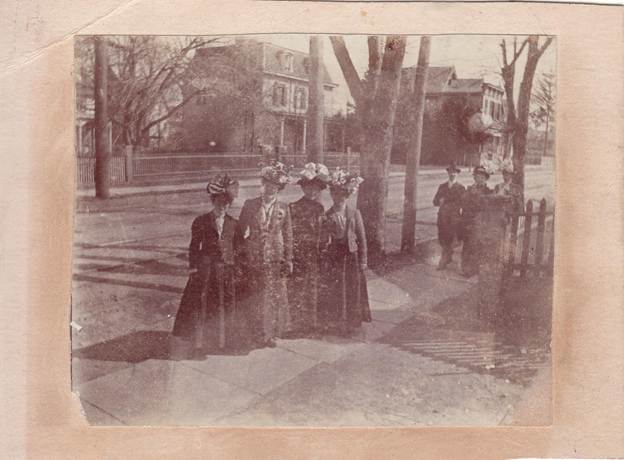
Figure 1 Family photo, Easter Sunday 1900. Edith Britton Gilshenan believed to be present.
Summary
Names hold stories—and sometimes contradictions. Grandma Edith disliked hers, yet giggled when it was revived for a beloved dog. Using the name’s first initial for a grandson showed how names can subtly honor family ties. This week’s theme invites readers to reflect on favorite names in their tree, investigate their origins, and consider their cultural meaning. Tools like the Social Security baby name database offer insight into popularity over time, while AI tools like ChatGPT can add rich historical context that isn’t in the standard indexes. The takeaway? Every name has a backstory—your job is to go looking for it, and ask better questions when you do.
What’s your favorite name in your family tree—and what do you know about where it came from?
Further Resources
🛠️ Further Resources
Social Security Administration Baby Names Database https://www.ssa.gov/oact/babynames/ Explore U.S. baby name trends by year, state, and more.
ChatGPT https://chat.openai.com Ask about name origins, cultural context, or compare historical trends.
Microsoft Researcher (via Copilot) Available through Microsoft 365 subscriptions. Great for digging deeper into historical naming conventions. Access it via Copilot https://m365.cloud.microsoft/chat/
Claude (Anthropic) https://claude.ai A conversational AI with a gentle touch for genealogical inquiries.
Gemini by Google https://gemini.google.com Cross-reference multiple sources on historical figures and name origins.
I just learned that the Florida State Genealogical Society will be hosting a Poolside Chat with the esteemed LaBrenda Garrett-Nelson, JD, LLM, CG®, FASG, entitled “An Enslaved Person’s FAN Club.” The registration link is here. Don’t waste time, this is Thursday, June 19, at 8pm EDT!
Introduction
My favorite “FAN Club” story is also my “boy next door” story. My husband’s grandparents, Samuel Birnbaum and Anna Frank, were living at the same Manhattan address in the 1905 census – and married the following year.[1]
Discussion
The family lived at 348 E. 46th Street in Manhattan, and there were 16 heads of families at that address.
On their marriage certificate the following year, they reported residing at different addresses, he at where they had been, and she at a new one.
Anna’s future husband was a neighbor – literally the N in FAN club.
How AI can help
I discussed using AI to help identify the FAN Club back in week 5: 52 AI Ancestors in 52 Weeks: Week 5: Challenge. We can just drop pages of passenger lists into a LLM, and pages of censuses, and look for common names among them.
But can we now take it farther?
Of course we can!
Here’s a thought: witnesses. As we’ve gotten more diligent about our research, we have certainly noted the witnesses in our records. Who has witnessed marriages, baptisms, land transactions, wills? If they are in your GEDcom, drop it into ChatGPT or another AI and ask it to find commonalities.
Of course, it’s possible that the minister’s wife witnessed all the marriages the clergyman performed. But it’s also possible the bride’s sister is listed instead.
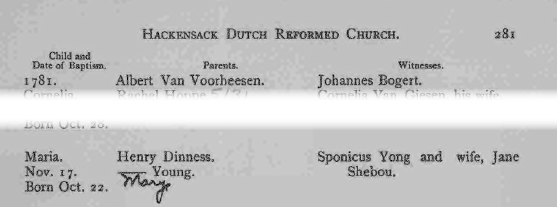
Side rant: Oh my goodness, what I wouldn’t give to know the relationship of Sponicus Yong to his godchild Maria, daughter of Mary Young!
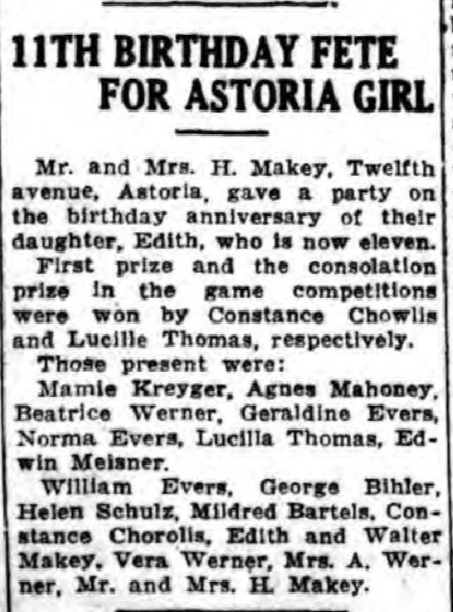
Here’s another thought: Newspaper gossip. Check out my grandmother’s 11th birthday party notice, and guess how many of these guests were family members:
I can’t answer that yet, but I do think that I will ask AI to help me identify these people. I chose Gemini, though Microsoft Researcher would probably do well also, and asked:
Help me to identify these guests at the birthday fete in 1924 in Queens, New York
Spoiler:
“Performing detailed genealogical research on every individual mentioned in a 1924 newspaper clipping is a significant undertaking that requires access to specialized historical records (census records, city directories, birth/marriage/death certificates, etc.) that are not readily available through general web searches.”
It seems that Gemini is going to need a little convincing. Probably with a few separate steps. So instead, I asked for it to give me suggestions, hoping I’d get told about the 1925 New York State census. And I was not. However, it did make several good suggestions like federal censuses and city directories.
Challenge:
Let’s see what your genealogical backup singers—your FAN Club—can do for you this week. Try one (or more) of these ideas:
Witness Watch Dig into your records—marriage certificates, land deeds, baptisms, or wills. Who’s showing up over and over as a witness? Pop a few of those names into ChatGPT, Claude, or Gemini. Ask, “What’s their connection to my ancestor?”
Birthday Party Guests, Unmasked Got an old newspaper clipping with names of party guests or social call shoutouts? Ask an AI tool to help identify them. Even if it only suggests where to look next (like the 1925 New York State Census or city directories), that’s a win.
FAN-tasy Football (Genealogy-style) Create a mini-FAN roster for one ancestor. Use an Airtable or spreadsheet and include friends, associates, and neighbors. Try uploading it to an AI and ask, “Who are the common links?” You might find a cousin lurking in plain sight.
Your goal this week is not perfection—it’s perspective. Look to the sidelines and you may just find someone cheering for your ancestor.
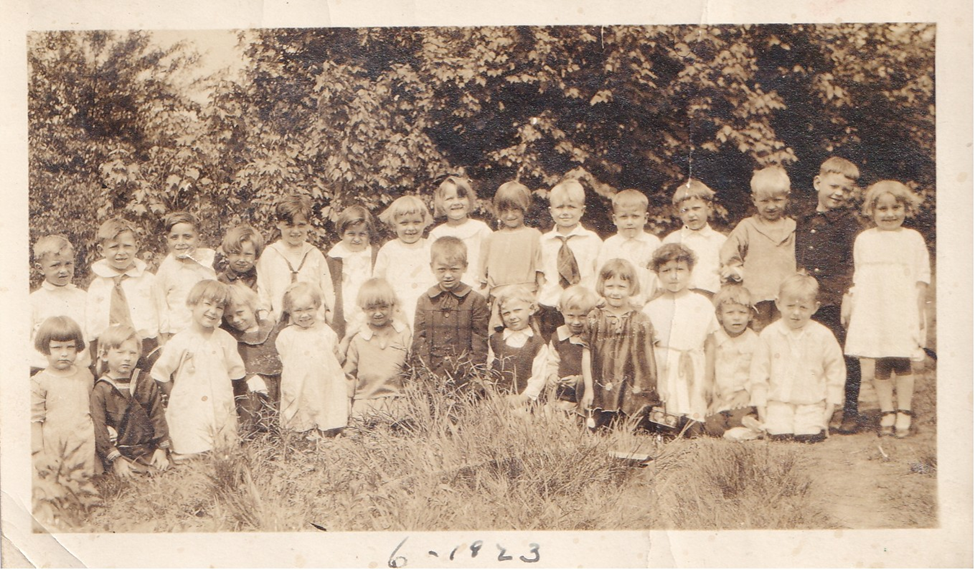
Figure 1 A party? Probably including my mother in law.
Summary
I want to close with advice that Gemini gave me:
Tips for Successful Research:
Be Patient and Persistent: Genealogical research takes time and often involves hitting dead ends before finding breakthroughs.
Keep Detailed Notes: Record every search you perform, what you found (or didn’t find), and where you looked. This prevents redoing work.
Vary Spelling: Names were often misspelled or inconsistently recorded in historical documents (e.g., “Makey” could be “Mackey,” “Maikey,” etc.). Try variations.
Utilize Public Libraries: Your local library likely offers free access to Ancestry.com Library Edition or other genealogical resources if you visit in person.
And a gift from Claude:
The FAN Club: A Genealogist’s Guide When ancestors seem lost to time’s cruel hand, Look beyond the bloodline’s narrow strand— Friends and Associates, Neighbors too, Form the FAN Club that will guide you through.
In wills they witness, deeds they sign, Their lives entwined with your family line. These supporting players hold the key To unlock your ancestry’s mystery.
Next Week’s Topic: “Favorite name” Disclosure This post was created by me with the help of AI tools. While AI helps organize research, the storytelling and discoveries are my own.
[1] New York State Archives; Albany, New York; State Population Census Schedules, 1905; Election District: A.D. 22 E.D. 12; City: Manhattan; County: New York; Page: 16














 The Ancestor Whisperer