I’ve adapted Amy Johnson Crow’s 52 ancestors in 52 weeks challenge by fixing the week number to the corresponding person on my children’s ahnentafel. This ensures no one until mid-sixth generation gets left behind.
52 Ancestors in 52 Weeks: 2026 Week 03: What This Story Means to Me
Introduction
My assigned person for Week 3 is – me. So this prompt felt especially fitting this week. (Thank you, Amy.)
What does genealogy mean to us? Why do we do it? To some, genealogy looks like a collection of names and dates. But those names and dates lead to stories, and those stories are what keep me coming back.
Discussion
My maternal grandmother was my first and best research partner. From her rocking chair, she shared what she knew and what she had carefully gathered over the years – which was a lot. She lost her mother at just three years old, and I can’t help but think that her devotion to family history came from a need to rebuild connections that had been severed too early. Genealogy, for her, was a way to reach back toward something lost.
My paternal grandmother approached family history differently. She shared stories, but over time I discovered that many of them were not quite accurate. Deaths were misplaced in time. Relationships were reshaped. One uncle’s story was transformed from something sad and marginal into something heroic. She grew up during the Depression, one of many children in a family shaped by instability and hardship. I’ve come to believe that her version of family history was an attempt to tell a kinder story – one that made sense of pain by smoothing its sharpest edges.
Seeing these two approaches side by side helped me understand something important: genealogy is never just about facts. It’s about meaning.
When I look at my own motivations, I see four strands that keep pulling me back.
- I am motivated by remembrance. I want to remember the forgotten. I want to restore visibility to people whose names haven’t been spoken in generations. I believe ordinary lives matter, and I feel I must say, you were here, and you counted.
- I am also motivated by connection across time. When I’m doing genealogy, I feel as though I’m standing with one foot in the past and one in the present, with my eyes turned toward the future. Genealogy becomes a bridge linking generations that will never meet, but are nonetheless connected.
- I am happy to say I am motivated by empathy and understanding. In my younger years, I was more judgmental than I’d like to admit. Encountering so many lives shaped by circumstances, limitations, and imperfect information has softened that stance. Once I truly internalized that people in the past made the best choices they could with what they had, their stories made more sense, and I found myself caring more deeply, not just about them, but about people in general.
- Finally, I just love curiosity and the hunt. I love learning. I love chasing down answers. If I stopped doing genealogy, I would miss the thrill of the search: the moment when a document appears, a theory clicks, or a long-standing question finally turns to the light. Genealogy is never finished, and that’s part of its appeal.
All of this leads me back to a simple truth:
I do genealogy to remember the forgotten, to stay connected across generations, to understand people in context, and because I genuinely love the hunt for answers.
Challenge
What is your motivation to do genealogy? What keeps you going when you want to tear your hair out, when the research feels impossible, or when the answers aren’t what you hoped they would be?
Summary
Genealogy allows me to hold empathy and curiosity at the same time. It gives me a way to honor people as they were, not as I wish they had been, and to keep their stories from slipping quietly into silence.
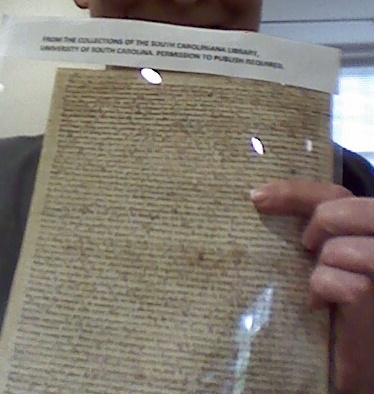
Me holding the letter my 7th great grandfather wrote in 1684.
AI Disclosure
This post was created by me with the help of AI tools. AI assisted with organization and refinement, but the research, reflections, and conclusions are my own.
Next Week’s Topic: A Theory in Progress
 The Ancestor Whisperer
You summed up the feelings and intentions of many family researchers, myself included, very nicely. Thank you for sharing!
LikeLike
I’m so glad that this resonated, Barb! Thank you for letting me know!
LikeLike