I’ve adapted Amy Johnson Crow’s 52 Ancestors in 52 Weeks challenge.
Each week I follow my children’s ahnentafel numbering to select the featured ancestor, ensuring no one through the mid–sixth generation is left behind.
52 Ancestors in 52 Weeks: 2026 Week 17: Working for a Living
Introduction
My Week 17 ancestor is Fanny Steinberg.
Discussion
How do I write a “working for a living” post about Fanny Steinberg? Like her husband, I have no direct records of her. I have to assume, though, that she was a traditional Jewish wife in the 19th century in Central Europe. Because no direct records have yet surfaced, this post takes a different approach: a historically grounded reconstruction of the kind of work Fanny may have done, based on the world she most likely inhabited.
The Work of Fanny Steinberg Birnbaum
The following is informed speculation, grounded in the documented experience of Jewish women living in the Austro-Hungarian Empire in the late nineteenth century. No direct records of Fanny Steinberg Birnbaum have been located; what follows imagines her life through the lens of the world she most likely inhabited.
We do not know the name of Fanny’s village. It may have been a market town in what is today Slovakia — one of those places that changed its name with every shifting border, that was Magyar on Monday and German on Thursday, and quietly, stubbornly Jewish every day of the week. The Austro-Hungarian Empire was a patchwork of languages and loyalties, and somewhere in that patchwork, Fanny Steinberg was born, grew up, married a man named Bernat Birnbaum, and built a life.
Her work was the household. But to call it that — the household — is to make it sound modest when it was anything but.
The Kitchen and the Calendar
Everything in Fanny’s domestic world was organized around two intersecting structures: the rhythms of the Jewish calendar and the laws of kashrut. Together they meant that her “work” was never simply cooking or cleaning in any generic sense. It was the maintenance of a system, a living architecture of rules that required constant attention and real expertise.
A kosher kitchen in a modest Austro-Hungarian Jewish household meant, at minimum, two complete sets of dishes, pots, and utensils — one for meat, one for dairy — stored separately, washed separately, never confused. It meant knowing which foods could touch which, which combinations were forbidden, how long to wait between a meat meal and a dairy one. It meant that shopping at the market was not simply a matter of price and freshness but of sourcing: the butcher she used was Jewish, his slaughtering shechitah, the cut inspected and salted to draw out the blood according to law. If she bought eggs, she cracked them one by one into a separate bowl first, checking for blood spots. None of this was performed mechanically. It was a practice, inherited from her mother, who had learned it from hers.
And then there was Shabbat.
From Thursday evening, the preparations began. Bread had to be braided — the challah, two loaves for each of the two portions of manna the Israelites received on Fridays in the desert, a story told in bread every single week. The house had to be cleaned. The best tablecloth, probably worn at the edges by now, had to be laid. Candles had to be readied. The Shabbat stew — a cholent, perhaps, heavy with beans and barley and whatever cut of meat the week had allowed — was assembled on Friday and carried, if they lived in a town with a communal baker, to the baker’s oven to cook slowly overnight, since no fire could be lit on the Sabbath itself. If there was no communal baker, it cooked in whatever arrangement could keep it warm till the next day’s midday meal.
On Friday, as the sun moved toward the horizon, Fanny lit the candles. She covered her eyes with her hands and moved them in three slow circles over the flames before pressing them to her face, drawing the light in. She spoke the blessing. In that moment, whatever the week had held — the arguing with vendors, the mending, the mud, the worry about money, the longing, the ordinary grief of living — was set aside. Shabbat had arrived.
This was also her work.
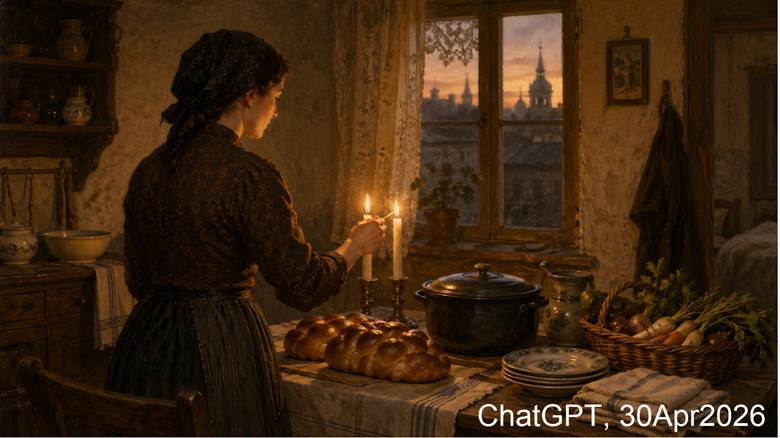
The Market and the Money
In many Jewish communities of Central Europe, the division of labor between husband and wife did not map neatly onto the Victorian ideal of the man who earns and the woman who keeps house. Jewish tradition, paradoxically, valorized male Torah study — ideally, a man spent his days learning — which in practice meant that women were often the economic actors, running small shops or market stalls while their husbands prayed and studied. The woman of valor praised in Proverbs 31, which husbands chanted to their wives each Shabbat eve, was explicitly a businesswoman: She considers a field and buys it; from her earnings she plants a vineyard.
We do not know if Bernat worked, or what he did if he did. We know almost nothing about him at all — not even that he survived to see his grandson Bernard born in 1908. If he died young, Fanny may have been left to manage whatever small livelihood they had on her own, as many Jewish widows did, with a quiet, practiced tenacity.
What seems likely is that she was not a stranger to commerce. On market days — typically once or twice a week in a provincial town — she would have gone out among the farmers and the traders, selecting vegetables, haggling, calculating. She knew prices. She knew who cheated and who didn’t. She knew how to stretch a small amount of money into a week’s worth of meals.
The Community of Women
Fanny’s world was not isolated. Jewish communal life meant that women moved through a web of mutual obligation and shared knowledge. There was the mikveh, the ritual bath, which she would have visited each month — a private practice embedded in a communal institution, maintained by the community, visited by all the married women of the town. There were the women who helped at births, who sat with the dying, who prepared the body of a woman who had died for burial. There were the charitable societies — gemilut hasadim — that every Jewish community organized to care for the poor, the sick, the stranger passing through. Fanny almost certainly participated in these, because in a community that size, everyone did.
She would have known her neighbors’ business and they would have known hers, not as intrusion but as the texture of interdependence. When someone’s husband lost work, when a baby was born too soon, when a daughter’s engagement fell apart — these things rippled through a small Jewish community the way a stone ripples through water. Women were the carriers of this knowledge, and also of the help that followed it.
The Son Who Left
Around the turn of the century, in 1902, her son Samuel left. He went to America — to New York, where other young Jewish men from the same region were already arriving by the tens of thousands, fleeing the combination of poverty, legal restriction, military service, and the periodic threat of violence that shadowed Jewish life in Eastern and Central Europe in those years. The pogroms of the 1880s sent waves of emigrants westward. Samuel was among them.
What it cost Fanny to watch him go, we cannot say. She never followed him. Whether she couldn’t, or was too old, or chose not to — whether Bernat was still alive and could not travel, or was already gone and she was alone — we don’t know. What we know is that her son crossed an ocean and built a life she would never see.
His children — her grandchildren — grew up speaking English, in a country she never visited. One of them, Sidney, would one day be asked about his grandmother, and name her: Fannie Steinhart of Czechoslovakia. He got the surname slightly wrong, the way family names drift in the retelling, but the country he gave her — Czechoslovakia, a state that didn’t exist until 1918, years after she would have given Samuel her last embrace — places her, approximately, in that part of the world.
She stayed. The borders changed around her. The empire dissolved. New nations were declared. And Fanny, whoever she had become by then — an aging woman in a town that now had a different name than the one she’d been born into — kept her kitchen kosher, lit her candles on Friday evening, drew the light toward her face, and carried the work of her life forward in the only direction time allowed.
This portrait is constructed from the historical record of Jewish life in the Austro-Hungarian Empire and its successor states, not from documents specific to Fanny Steinberg Birnbaum. Future research may yet surface records that confirm, complicate, or correct what is imagined here.
Thank you to Claude for this engaging reconstruction! If we know little about our ancestors, this helps us to feel more connected to them.
AI Disclosure
This post was created by me with the help of AI tools. While AI helps organize research, the storytelling and discoveries are my own.
Next Week’s Topic: Tradition
 The Ancestor Whisperer