I’ve adapted Amy Johnson Crow’s 52 Ancestors in 52 Weeks challenge.
Each week I follow my children’s ahnentafel numbering to select the featured ancestor, ensuring no one through the mid–sixth generation is left behind.
52 Ancestors in 52 Weeks: 2026 Week 18: Tradition
Introduction
The prompt for Week 18 is “Tradition.” Traditions can be an important part of family history, bringing context and connection between generations. What is an important tradition in your family, and who worked to keep that tradition going?
When I first thought about this prompt, I found myself thinking of the usual kinds of traditions: holiday meals, religious customs, family recipes, stories repeated from one generation to the next. Those are the traditions we usually recognize because they are visible. Someone lights the candles. Someone makes the dish. Someone tells the story again.
But sometimes a tradition is quieter than that.
Sometimes it is carved into stone.
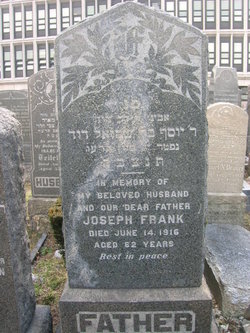
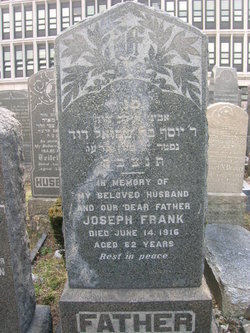
For my Week 18 ancestor, Joseph Frank, the most meaningful tradition may be the Jewish memorial tradition preserved on his tombstone. It did not give me a full biography. It did not solve every mystery about his origins. But it gave me something deeply important: his Hebrew name, his father’s name, and a connection to a generation I might not otherwise have been able to name.
Joseph Frank in the Records
Joseph Frank was born in April 1852 in Russia. His exact birth date and the specific place within Russia have not yet been determined. Like many immigrant ancestors, he appears in American records with enough consistency to follow him, but not enough detail to answer every question.
Most identified records name him as Joe or Joseph. His marriage record calls him Joe. His declaration of intention, naturalization record, death certificate, and tombstone identify him as Joseph. One record complicates the picture: his daughter Anna’s marriage record identifies him as Pincus.
That variation is worth noting, though I do not yet know how to explain it. It may represent a recording error, a name used in another context, a misunderstanding, or something more personal within the family. For now, it remains one of those small mysteries that family historians learn to live with while continuing to gather evidence.
Joseph immigrated to the United States in December 1872 and settled in Manhattan, New York, where he remained for the rest of his life. He filed his declaration of intent on 14 April 1885 and completed naturalization on 26 October 1887.
On 17 January 1888, he married Jennie Feltler, at least as her surname was spelled in that record. Joseph worked as a tailor, and his marriage record gives the more specific description of buttonhole maker.
I love that detail. “Tailor” tells us his trade. “Buttonhole maker” brings us closer to the texture of his daily work. It suggests long hours, careful hands, repetition, skill, and a very particular place within the garment trades of New York.
Joseph died on 14 June 1916 and was buried in Washington Cemetery in Brooklyn, Kings County, New York.
That could have been the end of what the records told me.
But his tombstone had more to say.
A Tradition Preserved in Stone
Joseph’s tombstone includes a Hebrew inscription. Simon Philip Jackson translated it as identifying him as:
Mr. Yosef son of Mr. Shmuel David
The inscription also gives the Hebrew date of death which, though that part of the stone was damaged from foliage, seems to correspond to his civil date of death, 14 June 1916.
That single line matters.
In English-language records, Joseph is usually Joseph or Joe Frank. Those records place him in the world of immigration, naturalization, work, marriage, and death in New York City. They are essential records, and I am grateful for them.
But the Hebrew inscription places him in another kind of record-keeping tradition. It remembers him not only by the name he used in American civil life, but by his Hebrew name and his father’s name:
Yosef, son of Shmuel David.
That is more than a translation. It is a connection.
The tradition of inscribing a Hebrew name and patronymic on a Jewish tombstone carried Joseph’s identity across time. It preserved his place in a family line. It named his father when other records I have found so far do not.
For a genealogist, that is incredibly valuable. For a descendant, it is also moving.
Because this tradition did not simply say, “Here lies Joseph Frank.” It said, in effect, “Here lies Yosef, son of Shmuel David. Remember him as part of a chain.”
What the Tombstone Gave Back
Joseph’s life still contains many unanswered questions. I do not yet know exactly where in Russia he was born. I do not know when or where his parents died. I do not know whether Shmuel David ever came to the United States, or whether Joseph left him behind when he immigrated.
The tombstone does not answer those questions.
But it gives me a name to carry forward.
Before the translation, Joseph’s father was not fully visible to me. After the translation, he had a name: Shmuel David. That does not prove every detail of his life, of course. It does not tell me his surname, occupation, residence, or story. But it gives me a starting point and, perhaps more importantly, it restores a relationship.
Joseph was someone’s son.
That may sound obvious, but genealogy has a way of turning people into isolated entries unless we are careful. Birth date. Marriage date. Occupation. Death date. Burial place. Those facts matter, but they are not the whole person.
The tombstone inscription pulls Joseph back into relationship. It reminds me that before he was an immigrant in Manhattan, before he was a tailor, before he was a husband and father, he was Yosef ben Shmuel David.
A son.
Who Kept the Tradition Going?
The prompt asks not only about the tradition, but about who worked to keep it going.
In Joseph’s case, the answer is layered.
His family likely kept it going first. Someone arranged for his burial. Someone made sure he was buried in Washington Cemetery. Someone chose, approved, or paid for a stone that included the Hebrew inscription. That act mattered. Whether they thought of it as “family history” or not, they preserved information that would matter more than a century later.
The Jewish community and burial tradition also helped keep it going. Joseph’s tombstone follows a practice larger than one family. It reflects a shared way of honoring the dead and remembering identity.
Then, much later, Simon Philip Jackson helped keep the tradition going by translating the inscription. Without that translation, the information was present, but not fully accessible to me. The words were carved there, but I needed help hearing what they said.
And now, in a small way, I am also helping keep the tradition going by recording it in Joseph’s story.
That is one of the quiet responsibilities of family history. We receive fragments: a record, a name, a photograph, a translation, a gravestone. Then we decide whether to let those fragments remain isolated, or whether to weave them back into memory.
A Different Kind of Family Tradition
This week’s prompt made me think differently about tradition.
Not every tradition is something handed down around a table. Not every tradition arrives as a story told by a grandparent. Some traditions are preserved in religious practice, in burial customs, in names, in dates, and in the choices families make when someone dies.
Joseph Frank’s tombstone did not preserve a recipe or a holiday custom. It preserved identity.
It told me that Joseph Frank was also Yosef.
It told me that his father was Shmuel David.
It gave me one more generation to hold onto.
And that, too, is tradition.
A tradition of remembrance.
A tradition of naming.
A tradition of keeping someone connected to those who came before him, even when the rest of the paper trail grows thin.
For Joseph Frank, the stone did more than mark a grave. It carried a family line forward.
And more than one hundred years later, it is still doing its work.
AI Disclosure
This post was created with the assistance of AI, which helped me organize the material, explore the theme of tradition, and draft language for review. The genealogical facts, interpretations, and final editorial choices are my own.
Next Week’s Topic: A Question the Records Can’t Answer