52 AI Ancestors in 52 Weeks: Week 11: Brick Wall

I’ve combined Amy Johnson Crow’s 52 ancestors in 52 weeks challenge, and Steve Little’s The 2025 AI Genealogy Do-Over, to create a unique 52 AI ancestors in 52 weeks party!

52 AI Ancestors in 52 Weeks: Week 11: Brick Wall

Introduction

The theme for Week 11 is “Brick Wall.” Every genealogist encounters an ancestor who seems impossible to trace. For me, that ancestor was Mary Catherine DENNY SMITH—until a breakthrough came with the help of generous volunteers. My search led to a book mentioning William DENNY’s daughter Mary marrying a Mr. SMITH, only for me to hit another dead end with Mary’s ancestor, Mary TIEBOUT.

Discussion

Years ago, Dorothy Koenig published New Netherland Connections, a newsletter focused on early American colonial genealogy. In 2009, I was lucky enough to publish a query in her newsletter (Vol 14 p 54):

TIEBOUT – Seeking parents of Mary TIEBOUT, who m. William YOUNG 5 Dec 1756 at Trinity Church Parish [NYG&BR 69:280] by NY Marriage License dated 4 Dec 1756 [NY Marriage Licenses Prior to 1784, p 388 (or 477), M.B. 1:372]

Three candidates present themselves:
Maria TIEBOUT bp 08 Aug 1736 NY NY; Albert TIEBOUT & Cornelia BOGERT
Maritje TIEBOUT bp 16 Jan 1732 SI NY; Teunis TIEBOUT & Margrietje DRINKWATER
Marytje TIEBOUT bp 29 Nov 1724 NY RDC; Hendricus TIEBOUT & Elisabeth BURGER

One clue may be that a sponsor of Mary’s dau Mary was Jane THIBOUT (1759).
That daughter Mary had as a sponsor of her children: Sponicus YOUNG and wife, Jane SHEBOU (1781); and also Jane TIEBOUT M.P. (1790); and finally John YOUNG and Jane THIBOU (1793).

Mary d 23 Jan 1811 Hackensack and was buried First Reformed Church there.

Any leads appreciated.

A kind reader, Bill Vinehout, found crucial details in the Viele Genealogy book that changed everything. Surprisingly, none of my original three candidates were correct! Thanks to Bill’s help, I was able to trace Mary’s lineage back multiple generations. One of my most exciting discoveries was her ancestor Louis THIBOU, a man so fascinating that I’ve written about him in this blog before. Holding a letter he wrote in 1683 with my own hands was a surreal experience.  (More info on the letter archived here.)
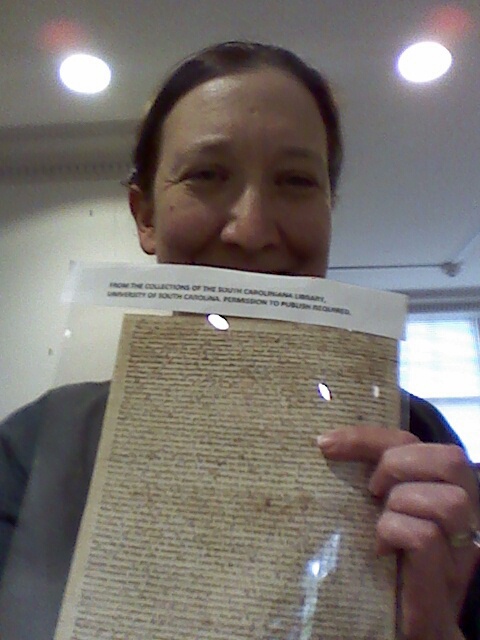
Figure 1 Me holding the letter my 7th great grandfather wrote!

Both Dorothy and Bill are gone now, but I am forever grateful for their generosity of spirit – and that of countless others.

How AI is Helping Break Brick Walls

Today, AI can play the role that Dorothy and Bill once did for me. I asked Claude, an AI assistant, for ways to help other researchers tackle brick walls. Here are some of its suggestions:

  • Create a step-by-step guide for solving brick wall cases.
  • Develop specialized guides for common genealogy challenges.
  • Compile overlooked records that may hold missing pieces.
  • Share success stories, breaking down the exact steps used.
  • Provide research log templates to help organize findings.

These are powerful ideas! If AI tools had been around in 2009, I could have used them to cross-reference sources, analyze surname variations, and uncover hidden patterns more quickly. While AI can’t replace human insight and experience, it can certainly speed up the process.

Paying It Forward

Both Dorothy and Bill have since passed away, but their generosity lives on through the research they contributed. Inspired by their kindness, I’ve committed to helping others by dedicating time each week to genealogical volunteer work. Whether it’s contributing to the New York GenWeb county site I coordinate or sharing research strategies, I want to give back.

Challenge for Readers

How can you pay it forward? Have you received help in your genealogy journey that you can pass on to others? Even small efforts—sharing records, answering queries, or mentoring new researchers—can make a difference. Many people have mentioned having breakthroughs thanks to FamilySearch AI indexing, for example, which we can learn and share about. Transkribus is posed to break down language barriers, which we can use to share information globally. Let’s continue the tradition of generosity in genealogy!

Summary and Next Steps

Breaking through genealogical brick walls often requires persistence, collaboration, and the right resources. My journey with Mary Catherine DENNY SMITH and Mary TIEBOUT proves that asking for help can lead to unexpected breakthroughs. AI tools now offer additional ways to assist in research, making discoveries more accessible than ever.

I’ve set a weekly reminder to contribute to genealogy projects and encourage you to do the same. How will you use your knowledge to help others? Let’s keep building connections, one discovery at a time.

Disclosure

This post was created by me and refined with AI assistance. While AI helps organize research, the storytelling and discoveries are my own.
52 AI Ancestors in 52 Weeks: Week 10: Siblings

I’ve combined Amy Johnson Crow’s 52 ancestors in 52 weeks challenge, and Steve Little’s The 2025 AI Genealogy Do-Over, to create a unique 52 AI ancestors in 52 weeks party!

52 AI Ancestors in 52 Weeks: Week 10: Siblings

Introduction

Amy Johnson Crow’s theme for Week 10 is “Siblings.” I’d like to take this opportunity to reflect on Lydia Coral West (1888-1944) and Grace West Crozier (1890-1975), sisters of my grandfather A Gordon West.

Discussion

Lydia Coral West was the unmarried sister and the eldest girl of the family. Her mother’s sister had named her daughter Lydia Cora, so I am sure there was someone the sisters wanted to honor. It may have been a woman who ran the orphanage where Lydia’s mother lived for a time. Aunt Lydia had artistic talents—my grandparents hung a still life that she painted, and I admired it as a girl without initially knowing its provenance. (I was promised that painting, but my own siblings decided otherwise… a sibling story I do not want to discuss.) My uncle has a painting of my grandfather that Aunt Lydia created when Grandpa was a boy. What a treasure! Lydia died at only 56, but I don’t know why—I just scheduled myself a task of ordering her death certificate.

Unlike Lydia, who remained unmarried, Grace’s life took a different path. Grace West Crozier lived into my lifetime, but I never got to meet her. I remember when she died, though, and that due to illness my grandfather was unable to travel back to Ohio to attend her funeral. Aunt Grace had chased the family history and left many details on the WEST family line—many details, but no sources—which I have had a lot of fun chasing (and proving correct) over the years.

Tantalizingly, Aunt Grace added onto the tree that there were others of this line (collateral relatives) but she didn’t know if the intended recipient was interested. That document gave me much pleasure and helped feed the growing genealogy bug in me. Aunt Grace had three children whom I met, and her son, Stephen Crozier, had corresponded with me for years. (To do: ask my uncle about her.) Her obituary, frustratingly headlined “Mrs. Earl Crozier” rather than with her name, says that she was a practical nurse.

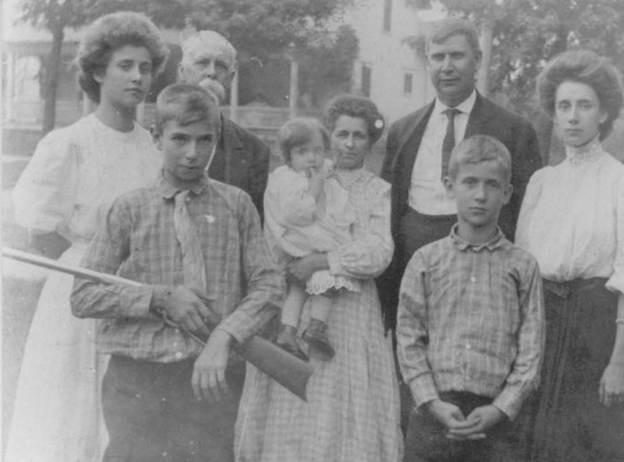
A 3-generation family posing for a black and white photo

The WEST family; Grace on the left and Lydia on the right

How AI is Helping My Research

The photo above, of three generations of the family, is a true treasure to me. (My grandfather is the baby.) I would love to see if AI can tell me more about it. Steve Little has created a custom GPT to use in analyzing photos. I asked it,

Please analyze this photo and tell me what you can about the people in it. I am particularly interested in the woman on the left and the woman on the right.

It gave me detailed information, including:

About Grace:

  • She is wearing a long, white dress with a high neckline and sleeves, which is common in Edwardian fashion.
  • Her hair is styled voluminously, possibly using a “Gibson Girl” style, which was fashionable in the early 1900s.
  • She stands slightly apart from the others, appearing tall and poised, with an air of confidence.
  • Her expression is serious and somewhat distant, which was typical of the era, as smiling in photos wasn’t common.

About Lydia:

  • She is also dressed in a high-necked, long-sleeved blouse with a dark skirt, another fashion trend of the early 1900s.
  • Her hair is styled in an updo, similar to the woman on the left, with a puffed-out shape.
  • Her facial expression is stern and composed, and she has an upright posture.
  • She stands next to a young boy, who may be a sibling or child.

Much like Mark Thompson discussed in the seminar, Artificial Intelligence and Family History: The Basics and Beyond, AI helped me notice details I had previously overlooked. Why is Grace wearing a white dress? I looked up her wedding and it was in July 1910, when the baby in this picture was about to turn 3. Was that a nearly 3-year-old, making this a wedding photo? (AI doesn’t think so – it’s dating the photo to around 1908, based on baby development, shoes, musculature, and other factors.) And why did they (I just learned) marry in Canada, in a division which is now a 1 hour 41-minute drive away? (First known baby is 16 months later.) Is the marriage why she appears “poised, with an air of confidence?”

AI is definitely in genealogy mode, as it raises as many questions as it answers! But it is helping me to better understand those who came before, and I am grateful.

Challenge for Readers

Identify an ancestor’s sibling that you’d like to learn more about, and ask AI to give you ideas, analyze photos, or provide new perspectives!

Summary and Next Steps

Exploring Lydia and Grace’s lives through AI-driven photo analysis has given me new insights into their era, fashion, and personalities—things I might not have noticed on my own. AI has also sparked new questions: Was Grace’s dress related to her wedding? Why did she marry in Canada? And what more can I learn about Lydia’s life and her artistic legacy?

To take this further, my next steps include:

  • Ordering Lydia’s death certificate to uncover details about her passing.
  • Asking my uncle for any additional memories or documents about Aunt Grace.
  • Investigating Canadian marriage records to better understand why Grace married there.
  • Running additional AI analysis on the family photo, perhaps comparing it with other dated images.
  • Testing other AI tools to refine facial recognition and dating estimates for family photos.

Genealogy is never truly finished—it’s a continuous journey of learning, verifying, and connecting. AI is proving to be a fascinating assistant in this process, uncovering patterns and prompting new avenues of research. With AI as a research companion, I look forward to uncovering even more about Lydia, Grace, and the family members who shaped their lives.

Disclosure

This post was created by me and refined with AI assistance. While AI helps organize research, the storytelling and discoveries are my own.

52 AI Ancestors in 52 Weeks: Week 9: Family Secrets

I’ve combined Amy Johnson Crow’s 52 ancestors in 52 weeks challenge, and Steve Little’s The 2025 AI Genealogy Do-Over, to create a unique 52 AI ancestors in 52 weeks party!

52 AI Ancestors in 52 Weeks: Week 9: Family Secrets

Introduction

This week’s discussion is on Family Secrets. My paternal grandmother told me many family history stories – all of them wrong. I loved Grandma, but boy, did she spin them.

Discussion

One of the stories I got was about her maternal grandfather, James HART. When I was a baby genealogist and new to the hunt, I did manage to do the “family interviews” part. Grandma told me that James was killed “in a hunting accident” when she (born 1916) was “a girl.”

To say that I searched for years for his death is an understatement. When my boys were small and I was a Cub Scout den leader, we visited a state park where I asked a Park Ranger about researching hunting deaths from the 1920s. They gave me a phone number but it didn’t get me anywhere.

I didn’t find his death in the vitals indexes during the time period I thought it would have happened.

When newspapers started coming online, I spent many late nights getting bleary-eyed.

Finally one day, after my grandmother and father died in quick succession, I was going through family photos and found one labeled “Bob [my dad] with Joseph and Joe <redacted>.” That surname had cousins on this line so I did an internet search to get the photo back to the family. I connected with a cousin and we spent time discussing family history.

“James?” he said. “Oh, he shot himself.”

Wait, what?

Must have been a hunting accident, right?

Nope.

The newspaper headline is “Despondent Man Ends Life With Shotgun.” He was not in the woods and he very deliberately exited this world.  

Grandma, your family secret is no more.

Depression runs through our family, but until recently no one would discuss it.

How AI is Helping My Research

I asked AI how it can help me identify patterns of depression running in a family. It offered several options:

  1. Analyzing Obituaries and Newspaper Reports

AI-powered tools like Newspapers.com and Chronicling America use Optical Character Recognition (OCR) to search for terms like “despondent,” “melancholy,” or “troubled” in historical newspapers, which might indicate depression or suicide.

AI sentiment analysis can review obituaries or death reports to detect language patterns related to mental health struggles.

2. Detecting Mental Health Clues in Family Records

AI-assisted genealogy platforms (like Ancestry and MyHeritage) can analyze cause-of-death records across generations, looking for recurring trends such as “self-inflicted wound,” “nervous breakdown,” or “institutionalized.”

AI handwriting recognition tools can decode personal letters, diaries, and census records to find mentions of mental health conditions.

3. Cross-Referencing Medical and Historical Data

AI can help analyze old medical records and census documents to identify patterns of institutionalization or hospitalization in a family tree.

Tools like Google’s BERT AI model or ChatGPT can scan large volumes of historical text and extract relevant information related to mental health.

4. Family Tree Pattern Recognition

AI tools can analyze relationships and life events to identify stressors that may have led to depression or suicide, such as economic downturns, family deaths, or war experiences.

Predictive modeling could compare your family’s history to broader social trends, revealing external factors that contributed to mental health struggles.

5. Speech-to-Text for Oral Histories

AI transcription tools (like Otter.ai or Whisper) can convert old family interviews into searchable text, helping you detect recurring themes of depression or emotional distress in family stories.

6. Photo Analysis for Hidden Clues

AI-powered facial recognition tools might help analyze historical photos for physical signs of illness or distress.

Some AI models can even compare expressions across multiple generations to spot potential inherited traits related to emotional well-being.

Challenge for Readers

Mental health research may not be as thrilling as chasing an elusive ancestor, but it’s just as important. It’s crucial to have the knowledge in order to combat it.

My recommendation: give your GEDcom to an AI model such as Claude or ChatGPT and ask it to look for words indicating mental health struggles, identify the people, and identify clusters or potential inheritance of such. Add in other factors such as military service and other situational and environmental factors. With that information, we may be able to identify those who are more at risk, and take early steps for treatment.

Summary and Next Steps

I’m so grateful that my father, a young adult in the 1960s, thought it important to be open and honest with me, and impressed on me the value of keeping the lines of communication open, even as we had our own mighty struggles. He worked so hard to fight the secrecy he’d been raised in so that we could do better.

Grandma, the truth is finally known—and it’s for the better.

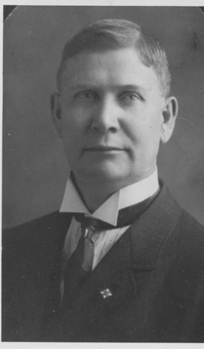
A man with two boys posing for a photo, in black and white

The photo that broke the brick wall

Disclosure

This post was created by me and refined with AI assistance. While AI helps organize research, the storytelling and discoveries are my own.
52 AI Ancestors in 52 Weeks: Week 8: Migration

I’ve combined Amy Johnson Crow’s 52 ancestors in 52 weeks challenge, and Steve Little’s The 2025 AI Genealogy Do-Over, to create a unique 52 AI ancestors in 52 weeks party!

52 AI Ancestors in 52 Weeks: Week 8: Migration

Introduction

Migration is a theme that touches every genealogist because all of us descend from migrants. My own maternal haplogroup, I4, traces a journey from eastern Africa through the Middle East to Europe. But rather than focusing on just my distant ancestors, I’m turning the lens inward—to my own migration story.

Migrations

I take great pride in my American ancestors, from the religiously persecuted Huguenots who arrived in 1624 to the post-famine Irish who faced hardship head-on. For generations, my family remained rooted on the East Coast of the United States, particularly Staten Island, New York, where they settled in 1665. I was born and raised there, had my children there, and expected that our roots would remain firmly planted.

Then came the attacks of September 11, 2001.

I was in Manhattan when the towers fell. My husband managed to reach our small children, but I was trapped in the city, desperate to get home and hold them close. Like many others, I left New York in the time that followed. My father remained, the last of my direct line on Staten Island. When he passed in 2009, the link to my ancestral home of nearly 350 years was severed. What was once my family’s anchor became a memory.

Figure 1 By Niels Jørgensen (1859-1943) – bruun-rasmussen.dk, Public Domain, https://commons.wikimedia.org/w/index.php?curid=80153432

How AI is Helping My Research

AI is transforming how we understand migration, both in the broader historical sense and in personal genealogy. Here are some ways AI is assisting my research:

  1. DNA Analysis & Migration Patterns: AI-driven tools like MyHeritage’s “Theory of Family Relativity” and 23andMe’s haplogroup mapping provide insights into ancestral migration routes. AI helps compare my DNA with ancient population data, identifying possible pathways my ancestors took.
  2. Historical Record Analysis: AI-powered platforms like Ancestry’s StoryScout and FamilySearch’s record hinting system analyze documents, connecting names, locations, and migration events. AI can surface records I might have overlooked, revealing new details about how and why my ancestors moved.
  3. Newspaper & Obituary Searching: AI-driven newspaper archives can identify migration clues hidden in articles, obituaries, and legal notices. By scanning old papers for names, locations, and key terms, AI has helped me uncover mentions of family moves, ship arrivals, and land purchases.
  4. Census & Ship Passenger List Analysis: AI makes searching census records more intuitive, predicting potential matches and migrations by analyzing occupation changes, neighbors, and household structures. Passenger lists and naturalization papers also benefit from AI’s ability to extract and organize details quickly.
  5. Geographical Data Visualization: Tools like Google Earth’s AI-powered historical overlays allow me to visualize ancestral locations. AI-driven mapping software reconstructs old neighborhoods, providing a clearer sense of the landscapes my ancestors knew.

Challenge for Readers

Have you traced your ancestors’ migration patterns? Try using an AI-powered genealogy tool to uncover a migration story in your family tree. Look at census records, passenger lists, or even DNA migration maps. You might be surprised at what you find! Share your discoveries in the comments or with fellow researchers.

Summary and Next Steps

Migration is not just an event—it’s a story of movement, struggle, and change. Whether fleeing persecution, seeking better opportunities, or adapting to life-altering events like 9/11, migration shapes our family narratives.

AI offers new ways to uncover these stories, making research faster and more insightful. By harnessing AI, we can connect with our ancestors in ways never before possible.

Disclosure

This post was created by me and refined with AI assistance. While AI helps organize research, the storytelling and discoveries are my own.

52 AI Ancestors in 52 Weeks: Week 7: Letters and Diaries

UPDATED 16Aug2025 with the letter!

I’ve combined Amy Johnson Crow’s 52 ancestors in 52 weeks challenge, and Steve Little’s The 2025 AI Genealogy Do-Over, to create a unique 52 AI ancestors in 52 weeks party!

52 AI Ancestors in 52 Weeks: Week 7: Letters and Diaries

Introduction

Every family has a story passed down through generations, and sometimes, a single letter can open a window into the past. In my family, that letter is known as “The Patience Letter.”

Patience P. SPIEGLE (1833-1889), my great-great-grandmother, was born in New Jersey and married John T. WEST (1830-1924) in 1852. They started a family in Philadelphia before moving to Liberty Center, Henry County, Ohio, in 1858. Among their children was my great-grandfather, Adam Grant WEST (1866-1939), a traveling salesman.

Decades ago, I saw a letter that Patience wrote to her son Adam, presumably while he was on the road. Though I haven’t seen it in years, its content and significance have stuck with me.

A handsome man in a suit

Figure 1 Adam West, the letter’s recipient


The Letter: A Glimpse Into the Past

While I can’t quote the letter verbatim, I remember key details that made an impression:

  • Remarkably Literate – Patience’s handwriting, spelling, and grammar were far better than one might expect for a woman born in the early 19th century. This suggests she had a solid education, likely from American-born parents of German and English descent.
  • A Family in Motion – The letter mentions that her husband, John, was considering another move—perhaps to Michigan. Given that I’ve traced at least six moves in John’s lifetime, this letter confirms his “wandering spirit.”
  • A Piece of History Lost – Unfortunately, my grandmother, the last known owner of the letter, passed away 28 years ago. I have asked my uncle if he has a copy or remembers more details, but the fate of the letter remains unknown at the moment. UPDATE: he sent me a copy!

How AI is Helping My Research

Losing a treasured family letter is frustrating, but modern technology—especially AI—offers new ways to recover lost history. Here’s how AI can assist:

  • Handwriting Recognition & Analysis – If I find even a fragment of the letter, AI-driven Optical Character Recognition (OCR) tools can help transcribe difficult-to-read handwriting and reconstruct missing words.
  • Historical Context & Language Analysis – AI can analyze old letters and compare them with similar writings from the same period, offering insights into common expressions and historical references.
  • Predictive Text Generation – While AI can’t fully recreate Patience’s words, it can generate plausible reconstructions based on similar letters and known details of her life.

By applying these tools, I hope to get closer to understanding what Patience might have written—and what insights she left behind.


Challenge for Readers

Have you ever discovered an old family letter or diary entry? What did it reveal about your ancestors? If you have a historical document but struggle to read it, try using an AI-powered transcription tool to bring it to life.

If a cherished letter is missing, consider reconstructing its contents with family memories and historical research. AI might just help you fill in the gaps!


Summary and Next Steps

Even when original documents disappear, modern genealogy tools—including AI—can help us reconstruct and preserve family history. Whether through transcription, historical context analysis, or predictive modeling, AI is a powerful ally in uncovering the past.

Next week, I’ll explore another AI-enhanced discovery in my family history. Stay tuned!


Disclosure

This post was created with AI assistance and refined with my insights. While AI helps organize research, the storytelling and discoveries are my own.

52 AI ancestors in 52 weeks: Week 1: In the Beginning

52 AI ancestors in 52 weeks: Week 1: In the Beginning

I’ve combined Amy Johnson Crow’s 52 ancestors in 52 weeks challenge, and Steve Little’s The 2025 AI Genealogy Do-Over, to create a unique 52 AI ancestors in 52 weeks party!

History says I won’t do it every week. But we’re talking about progress, not perfection. So, let’s just jump in and have fun.

52 AI Ancestors in 52 Weeks: Week 1: In the Beginning

Genealogy is like solving a family mystery—part detective work, part heartfelt storytelling. Throw AI into the mix, and it’s a whole new level of discovery. This year, I’m taking up a challenge that blends Amy Johnson Crow’s “52 Ancestors in 52 Weeks” with a techy twist inspired by Steve Little’s “The 2025 AI Genealogy Do-Over.” The goal? To explore both my family’s roots and the potential of AI in genealogy. Let’s kick it off with Week 1.


Why I Got Started

My genealogy obsession began in 6th grade when I got an assignment to create a family tree. Lucky for me, my grandmother—my biggest cheerleader—was just a few steps away. She dug out old records, shared stories, and filled in the gaps with amazing details. Thanks to her, I didn’t just complete the assignment; I caught the genealogy bug for life.

Grandma’s love for family history had its own story. She lost her mother at the tender age of three, and I believe her passion for genealogy was her way of reconnecting with that lost connection. She came from a prominent local family but struggled to tie certain pieces together. Those mysteries drove her—and now, they drive me.


The AI Connection

Fast forward to today. I’ve got tools my grandmother couldn’t have dreamed of—AI among them. This week, I gave an AI model a task: review and rewrite a tribute I wrote for my grandmother. Here’s how it went:

  • Step 1: I asked the AI to evaluate my tribute’s emotional resonance and clarity.
    • Please create guidelines for writing a tribute on the Internet, rate my page according to them, make suggestions, rewrite using the suggestions, and regrade. The page:
  • Step 2: I pasted the text (AI and links don’t always get along) and let it suggest edits.
  • Step 3: After trying a few models, Gemini delivered the most heartfelt rewrite. I put it below this post. What do you think? Let me know in the comments!

AI didn’t just polish the words—it helped me reflect on the way I’d captured my grandmother’s story. But, as powerful as AI is, it didn’t replace my voice; it enhanced it.

Grandma holding me at what was probably my first birthday


Your Challenge

Genealogy is personal, but technology can make it interactive. Here’s how you can join the journey:

  1. Pick an Ancestor: Choose someone in your family tree who inspires you. Write a short tribute to them (just 300 words or so).
  2. Add AI to the Mix: Use a free AI tool to refine your writing. ChatGPT, Claude, or Gemini are great options.
  3. Compare and Reflect: Does the AI version improve your story, or does it miss the mark? Adjust it to reflect your voice.

Share your experience in the comments—I’d love to hear how AI shapes your family’s stories.


In the End, It’s All About Connection

Genealogy and AI might seem like an odd pairing, but at their core, both are about uncovering connections. Whether it’s piecing together family lore or fine-tuning a tribute, every little discovery brings us closer to understanding who we are.

Here’s to Week 1—and to Grandma, who started it all. Without her, this journey wouldn’t be possible. And thanks to AI, it’s more exciting than ever.


Final Thoughts: Technology can amplify the past, but it’s the stories we share that keep it alive. So here’s my challenge: embrace both the wisdom of your ancestors and the tools of today to create something truly timeless.

The AI-revised tribute:

A Tribute to Edith Lillian Makey West (1913-1997)

Edith Lillian Makey West, my beloved Grandma, was born on September 12, 1913, in Staten Island, New York. Her life, though marked by early loss – her mother passed away when she was just three years old – was a testament to resilience and love.

Raised by her strong and loving [Janet adds: aunt, her namesake Edith, and] stepmother, Elfrida, Edith grew into a vibrant young woman. She graduated from Bryant High School and embarked on her career, working first as a candy packer and then for The Corporation Trust Company, where she dedicated many years.

Edith and my Grandpa, Gordon, shared a deep and enduring love. Their marriage, celebrated in 1935, was a cornerstone of her life. They traveled extensively, exploring 37 states together, and cherished raising their children, Alan and Elise.

Grandma’s passion for family history ignited my own. Countless hours were spent discussing ancestors, sharing stories, and piecing together our family’s past. Her excitement was contagious, fueling my own genealogical pursuits.

More than anything, Grandma embodied strength and resilience. She faced life’s challenges with grace and determination, inspiring me with her quiet strength.

Though she is gone, her memory lives on. I will always cherish the warmth of her smile, the comforting sound of her laughter, and the enduring lessons she imparted.