52 AI Ancestors in 52 Weeks: Week 32: Wide open spaces

I’ve combined Amy Johnson Crow’s 52 ancestors in 52 weeks challenge, and Steve Little’s The 2025 AI Genealogy Do-Over, to create a unique 52 AI ancestors in 52 weeks party!

52 AI Ancestors in 52 Weeks: Week 32 Wide open spaces

Introduction

This is a Public Service Announcement about researching at the United States Bureau of Land Management (BLM). There is no better use of the Wide Open Spaces topic if you’re in the US.

Discussion

What prompted me to think of this was a to-do list item which unfortunately was only in my head until now. Michael DOBBINS and his wife Mary MALONE were an Irish couple with several children. The family emigrated bit by bit during An Gorta Mór (The Great Hunger). They settled in Morris County, New Jersey for a time, where at least two daughters married and settled, and then the parents and younger children moved out to Shawnee, Wyandotte, Kansas, to farm. Numerous census schedules show Michael engaged in farming and with a considerable amount of land.

His will (Ancestry link; it’s restricted on FamilySearch) distributed much land:

  • To my daughter Bridget Murphy: west half of South East (1/4) quarter of south west (1/4) quarter of section Eighteen (18) Town Eleven (11) Range Twenty five (25) containing twenty acres
  • To my son Michael Dobbins the west half (1/2) of north east quarter (1/4) of South West quarter (1/4) of section Eighteen (18) Township Eleven (11) Range Twenty five (25) containing twenty acres
  • To William Dobbins and James Dobbins the children of my [deceased] son James Dobbins the East half of South East quarter (1/4) of South West quarter (1/4) of Section (18) Eighteen, town Eleven (11) Range twenty five (25) containing twenty acres

(Side note: Michael’s son James was killed in a duel in 1879.) I went back to the 1880 census, agricultural schedules (Ancestry link), and sure enough he has 58 acres improved and 2 acres unimproved, farm valued at $3,000.

What brought this poor Irish immigrant to Kansas? How did he end up with sixty acres of land? I suspect the answer for both questions is the same. I wonder if I might find answers at the Bureau of Land Management.

How AI can help

I went to Microsoft Researcher, and asked:

How do I use the Bureau of Land Management for genealogical research, if my ancestor unexpectedly got property in Kansas?

It gave me the chance to be more specific in my prompting ( 😊 ) so I replied:

My poor ancestor in New Jersey, Michael Dobbins, moved to Shawnee Township, Wyandotte, Kansas around 1865 and acquired 60 acres of property. How would he have been able to do this?

I added:

How would I be able to research any records that might exist around this grant or acquisition?

Microsoft Researcher was surprisingly thorough – AI gave me a to-do list I didn’t know I needed. It kindly provided me with a hefty output called Genealogical Research Report: Land Acquisition in 1860s Kansas (Case of Michael Dobbins). I’ll attach it at the bottom of this post. What it does (its thinking) is in the beginning, and the report starts on page 8. I think the list on page 11 is the meat of it:

Step 1: Search Federal Land Patent Records (BLM GLO)
Step 2: Analyze the Patent Details (Acquisition Method)
Step 3: Obtain the Land Entry Case File (National Archives)
Step 4: Search State and Local Records (Kansas Archives & County Deeds)

This research is still on my to-do list (this was a big enough rabbit hole for today), but I now have a better idea what to do and where to go.

Challenge for Readers

Use Microsoft Researcher or Perplexity to suggest records for your specific situation: especially location and time frame and possible military service.

Want to Learn More?

A few resources:

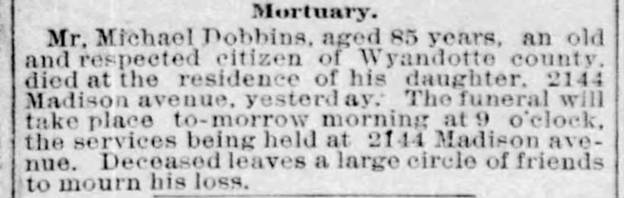
Here is Michael’s death notice; it says he “leaves a large circle of friends to mourn his loss”:
Next Week’s Topic: “Legal troubles”

AI Disclosure

This post was created by me with the help of AI tools. While AI helps organize research, the storytelling and discoveries are my own.
Link: https://theancestorwhisperer.com/wp-content/uploads/2025/08/land-acquisition-in-1860s-kansas-case-of-michael-dobbins.pdf

52 AI Ancestors in 52 Weeks: Week 17: DNA

I’ve combined Amy Johnson Crow’s 52 ancestors in 52 weeks challenge, and Steve Little’s The 2025 AI Genealogy Do-Over, to create a unique 52 AI ancestors in 52 weeks party!

52 AI Ancestors in 52 Weeks: Week 17: DNA

Introduction

Whose NPE is this, anyway?, or, Check your biases at the door

A couple of years ago, I had an intriguing DNA match on 23andMe. Our Relatives in common indicated a match on my Ohio branch – maternal grandfather’s line. The match has a somewhat unique name and is from a town 8 miles from where Grandpa was born. Unfortunately, that is the town the match died in, three months after the message I sent him on 23andMe. Since he’s not living, I’ll call him RZ here.

RZ has a reasonably easy lineage to trace, and we clearly branched apart once we went back 2 generations from Grandpa. It should have been easy to identify our common ancestor. But it wasn’t. I became convinced that RZ had an NPE. RZ’s mom was born 12 years after her closest sibling, and when her “sister” was 17… perhaps one of Grandpa’s brothers fathered a child with RZ’s mom’s “sister”… my digging didn’t produce convincing evidence (e.g., opportunity in the form of the same location).

Discussion

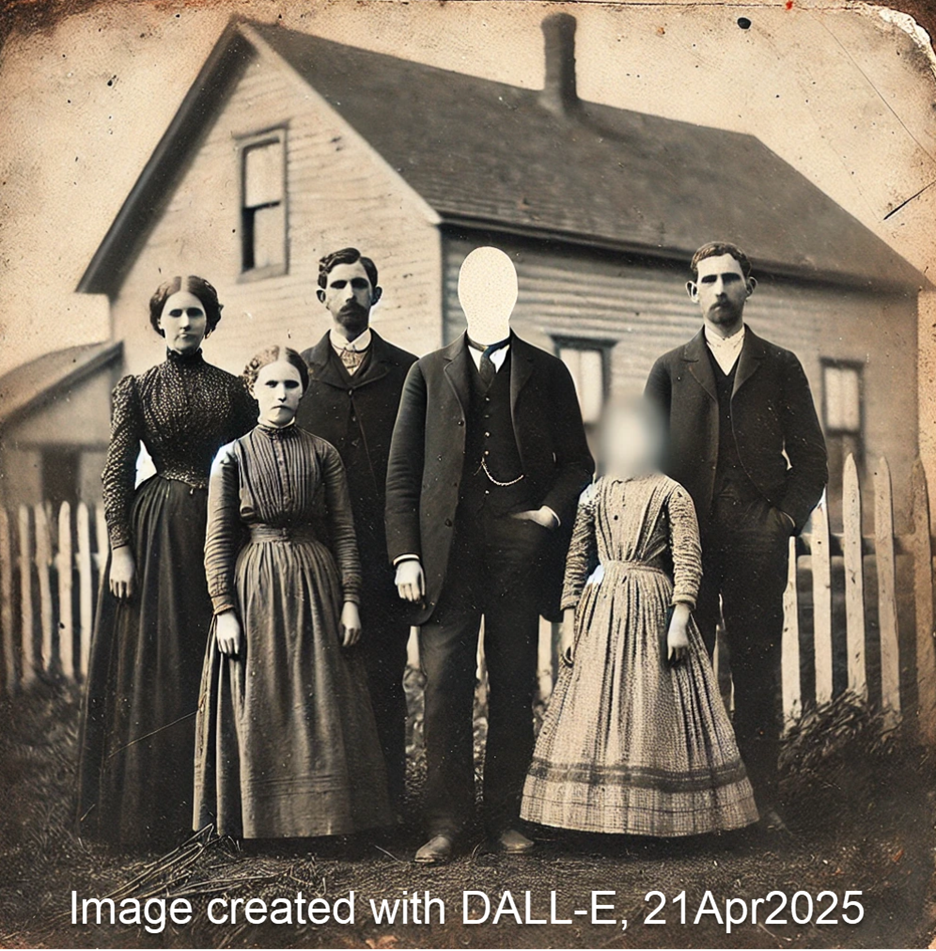
I took two of Steve Little’s Artificial Intelligence classes given at the National Genealogical Society and his course AI Genealogy Seminars: From Basics to Breakthroughs at the Genealogical Research Institute of Pittsburgh (GRIP) (wow! Highly recommend all of them). During the latter, Steve was showing us his custom chat Photo Analyst, and we used a photo I had of Grandpa with his siblings, parents, and grandfather. Steve asked me if the photo showed three generations or four and I suddenly had a light bulb moment.

Grandpa was born ten years after his next older sibling, when his sisters were 17 and 19… suddenly it wasn’t so obvious that it was RZ’s mom that was the NPE after all.

How AI can help

It’s tempting to stare at a brick wall and hope it blinks first. But when it comes to DNA mysteries, AI can be your sidekick with better night vision.

Here’s how AI assisted me:

  • Clustering DNA Matches: While DNA sites offer tools like “shared matches,” I used ChatGPT to summarize common surnames and locations across clusters. Asking it, “Do you see any recurring names or places in this list of matches?” can nudge you in a direction you hadn’t considered.
  • Reframing the Question: AI helped me phrase the real question: “Could the NPE be on my side instead?” That reframing gave me the ah-ha moment during Steve Little’s seminar. Sometimes it’s not the facts that need changing—it’s the lens.

Despite the current uncertainty around 23andMe, I’m reluctant to give up my account there, in the hopes that a Relative in common there will break through this mystery.

If you’re feeling stuck, AI might not have the answer, but it sure can ask a better question.

Summary and challenge

Sometimes DNA doesn’t reveal a clean answer—it kicks up dust and asks if you’re sure that branch belongs where you thought it did. What started as a search for someone else’s NPE brought me face-to-face with my own family’s possibilities.

Your turn:

Challenge #1: Use ChatGPT to compare 3–5 of your DNA matches. Ask it to spot shared surnames or birthplaces. Copy-paste the match notes or segment info (no personal identifiers!) and ask, “What patterns do you notice?”

Challenge #2: Have an old photo? Upload it to an AI photo enhancer like MyHeritage’s Deep Nostalgia or use ChatGPT’s image tools to generate a caption or age estimate. What stories surface?

Genealogy isn’t about finding the answer—it’s about learning to ask better ones, again and again.

We’ll wade into the world of Institutions next week—those places that held, housed, or helped (sometimes harmed) our ancestors. Think prisons, hospitals, orphanages, and more. Bring tissues… and curiosity.

Old-style image of a family standing in front of a farmhouse, with a man's and a girl's faces blurred out

Disclosure

This post was created by me and refined with AI assistance. While AI helps organize research, the storytelling and discoveries are my own.

52 AI Ancestors in 52 Weeks: Week 11: Brick Wall

I’ve combined Amy Johnson Crow’s 52 ancestors in 52 weeks challenge, and Steve Little’s The 2025 AI Genealogy Do-Over, to create a unique 52 AI ancestors in 52 weeks party!

52 AI Ancestors in 52 Weeks: Week 11: Brick Wall

Introduction

The theme for Week 11 is “Brick Wall.” Every genealogist encounters an ancestor who seems impossible to trace. For me, that ancestor was Mary Catherine DENNY SMITH—until a breakthrough came with the help of generous volunteers. My search led to a book mentioning William DENNY’s daughter Mary marrying a Mr. SMITH, only for me to hit another dead end with Mary’s ancestor, Mary TIEBOUT.

Discussion

Years ago, Dorothy Koenig published New Netherland Connections, a newsletter focused on early American colonial genealogy. In 2009, I was lucky enough to publish a query in her newsletter (Vol 14 p 54):

TIEBOUT – Seeking parents of Mary TIEBOUT, who m. William YOUNG 5 Dec 1756 at Trinity Church Parish [NYG&BR 69:280] by NY Marriage License dated 4 Dec 1756 [NY Marriage Licenses Prior to 1784, p 388 (or 477), M.B. 1:372]

Three candidates present themselves:
Maria TIEBOUT bp 08 Aug 1736 NY NY; Albert TIEBOUT & Cornelia BOGERT
Maritje TIEBOUT bp 16 Jan 1732 SI NY; Teunis TIEBOUT & Margrietje DRINKWATER
Marytje TIEBOUT bp 29 Nov 1724 NY RDC; Hendricus TIEBOUT & Elisabeth BURGER

One clue may be that a sponsor of Mary’s dau Mary was Jane THIBOUT (1759).
That daughter Mary had as a sponsor of her children: Sponicus YOUNG and wife, Jane SHEBOU (1781); and also Jane TIEBOUT M.P. (1790); and finally John YOUNG and Jane THIBOU (1793).

Mary d 23 Jan 1811 Hackensack and was buried First Reformed Church there.

Any leads appreciated.

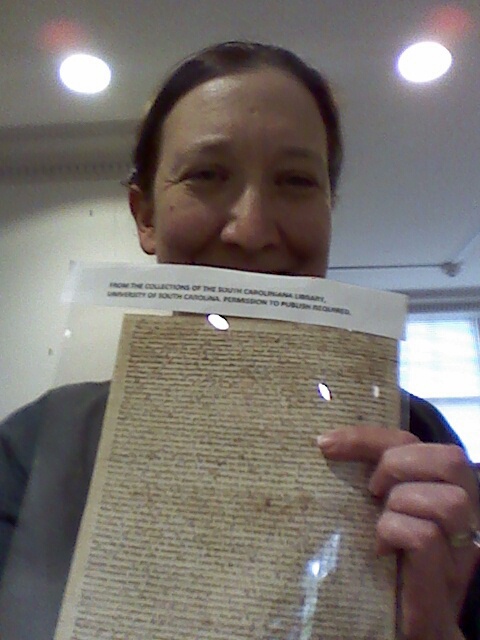
A kind reader, Bill Vinehout, found crucial details in the Viele Genealogy book that changed everything. Surprisingly, none of my original three candidates were correct! Thanks to Bill’s help, I was able to trace Mary’s lineage back multiple generations. One of my most exciting discoveries was her ancestor Louis THIBOU, a man so fascinating that I’ve written about him in this blog before. Holding a letter he wrote in 1683 with my own hands was a surreal experience.  (More info on the letter archived here.)

Figure 1 Me holding the letter my 7th great grandfather wrote!

Both Dorothy and Bill are gone now, but I am forever grateful for their generosity of spirit – and that of countless others.

How AI is Helping Break Brick Walls

Today, AI can play the role that Dorothy and Bill once did for me. I asked Claude, an AI assistant, for ways to help other researchers tackle brick walls. Here are some of its suggestions:

  • Create a step-by-step guide for solving brick wall cases.
  • Develop specialized guides for common genealogy challenges.
  • Compile overlooked records that may hold missing pieces.
  • Share success stories, breaking down the exact steps used.
  • Provide research log templates to help organize findings.

These are powerful ideas! If AI tools had been around in 2009, I could have used them to cross-reference sources, analyze surname variations, and uncover hidden patterns more quickly. While AI can’t replace human insight and experience, it can certainly speed up the process.

Paying It Forward

Both Dorothy and Bill have since passed away, but their generosity lives on through the research they contributed. Inspired by their kindness, I’ve committed to helping others by dedicating time each week to genealogical volunteer work. Whether it’s contributing to the New York GenWeb county site I coordinate or sharing research strategies, I want to give back.

Challenge for Readers

How can you pay it forward? Have you received help in your genealogy journey that you can pass on to others? Even small efforts—sharing records, answering queries, or mentoring new researchers—can make a difference. Many people have mentioned having breakthroughs thanks to FamilySearch AI indexing, for example, which we can learn and share about. Transkribus is posed to break down language barriers, which we can use to share information globally. Let’s continue the tradition of generosity in genealogy!

Summary and Next Steps

Breaking through genealogical brick walls often requires persistence, collaboration, and the right resources. My journey with Mary Catherine DENNY SMITH and Mary TIEBOUT proves that asking for help can lead to unexpected breakthroughs. AI tools now offer additional ways to assist in research, making discoveries more accessible than ever.

I’ve set a weekly reminder to contribute to genealogy projects and encourage you to do the same. How will you use your knowledge to help others? Let’s keep building connections, one discovery at a time.

Disclosure

This post was created by me and refined with AI assistance. While AI helps organize research, the storytelling and discoveries are my own.