52 AI Ancestors in 52 Weeks: Week 41: Water

I’ve combined Amy Johnson Crow’s 52 ancestors in 52 weeks challenge, and Steve Little’s The 2025 AI Genealogy Do-Over, to create a unique 52 AI ancestors in 52 weeks party!

52 AI Ancestors in 52 Weeks: Week 41: Water

A canal boat from Philly to northwest Ohio: fact or fiction?

Introduction

Sometimes we are lucky enough that a family story is passed down: my grandfather’s sister Lydia Coral West did family history work and my uncle Alan G West wrote up her facts. Part of the writeup states that John Thomas WEST and his wife Patience P. SPIEGLE moved [from Philadelphia] to northwestern Ohio “by canal boat”:

a typed document including "He and his wife, Patience, along with their two small children; Mary Ann and John Thomas Jr. moved west about 1858. Travelling by canal boat, they landed at Damascus, in north western Ohio."

How can we research the veracity and details of these stories?

Discussion

I have studied maps and am not clear how a canal boat could be used to go from Philadelphia to northwestern Ohio. Google search helped me, though.

Pennsylvania: Pennsylvania had a complex canal system in the 19th century, and it was entirely possible to travel from Philadelphia to Lake Erie via water and some portage.
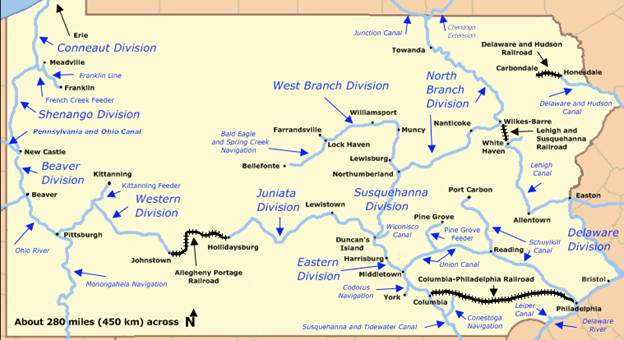
A canals map of Pennsylvania, showing that it's possible to go from Philadelphia to Lake Erie bit a bit of portage (overland travel).

https://en.wikipedia.org/wiki/Pennsylvania_Canal

Ohio: First, to locate the target location. The story says they landed in “Damascus, in north western Ohio.” But Damascus Ohio is landlocked in eastern Ohio. However, a further Google search informs us of  “a former town called Old Damascus in Northwest Ohio that was replaced by a new bridge over the Maumee River.” My grandfather grew up around the Maumee River, so now I know we are talking. But later searches showed me a better candidate – Damascus, in Henry County, just across the Maumee from what was or would become Liberty Center, where three generations of my ancestors lived.

A map entitled Canals of Ohio.

https://ohiomemory.org/digital/collection/p267401coll32/id/15560/

Between the canals that these two states had to offer, it is clear that the trip was entirely possible. Every fact in that particular written history has proven true so far, and this follows the pattern. (Don’t get me started about my OTHER side, where I was able to DISPROVE everything I was told…)

How AI can help

I chose Gemini because it surely can call upon Google maps and Google searches for an assist here.

Can you tell me how my ancestors might have traveled from Philadelphia, Pennsylvania to Damascus, Henry County, Ohio, via canal boat in 1858?

(Kindly note that this was a refined prompt, not my first one, and know that “few-shot prompting” is a valuable tool in the toolbox. You should rarely take the first answer.) What I received was absolutely fascinating:

The journey from Philadelphia to Damascus, Henry County, Ohio, via canal boat in 1858 would have been a long, multi-system voyage that crossed the entire width of Pennsylvania and traversed nearly the full length of the Ohio canal network.

By 1858, the “golden age” of canals was over, and the state-owned canals in Pennsylvania had just been sold to private interests. However, canal boat travel, especially for moving household goods and for travelers with limited funds, was still an option.

Here is the most plausible canal boat route your ancestors would have taken:

Phase 1: Across Pennsylvania (Philadelphia to Pittsburgh)

The first challenge was crossing the Appalachian Mountains. This required a mixed-mode transportation system known as the Pennsylvania Main Line of Public Works, which was a series of canals and railroads designed to link Philadelphia to the Ohio River at Pittsburgh.

  1. Philadelphia to Columbia, PA: They would have started by taking the Philadelphia and Columbia Railroad (a steam-powered railway) about 80 miles west from Philadelphia. By the 1850s, the railroad had generally replaced the earlier canal sections near the city for passenger travel.
  2. Columbia to Hollidaysburg, PA: From Columbia, they would switch to a canal boat on the Eastern Division of the Pennsylvania Canal, traveling up the Susquehanna and Juniata Rivers to Hollidaysburg.
  3. The Allegheny Portage Railroad: At Hollidaysburg, the boat or its cargo would be transferred onto special flatbed railcars to be hauled over the Allegheny Mountains to Johnstown, PA. This was a 36-mile incline plane and railroad system that served as the necessary land bridge.
  4. Johnstown to Pittsburgh, PA: Once on the western side, they would re-enter the water via the Western Division of the Pennsylvania Canal and float down the Conemaugh and Kiskiminetas Rivers to the terminus in Pittsburgh on the Ohio River.

Phase 2: Connecting to the Ohio Canal System (Pittsburgh to Akron/Cleveland)

At Pittsburgh, they would need to find a connection to the canals leading into Ohio.

  1. Pittsburgh to New Castle, PA: They would take a boat north up the Beaver Division of the Pennsylvania Canal to reach New Castle, Pennsylvania.
  2. New Castle to Akron, OH: Here, they would transfer onto the Pennsylvania and Ohio (P & O) Canal (also known as the “Cross-Cut” Canal). This canal ran 82 miles and connected New Castle to Akron, Ohio.

Phase 3: Across Ohio (Akron to Damascus, Henry County)

Akron served as the hub of the Ohio canal system, connecting the P & O Canal to the major north-south artery: the Ohio and Erie Canal.

  1. Akron to Toledo, OH: Your ancestors would board a boat on the Ohio and Erie Canal and travel north toward Lake Erie to the city of Toledo.
  2. Toledo to Damascus, Henry County: In Toledo, the Ohio and Erie Canal merged with the Miami and Erie Canal. They would change boats onto the Miami and Erie Canal to travel southwest toward their destination.
    • Damascus is located in Henry County, situated directly on the Miami and Erie Canal, near the town of Napoleon, Ohio. The boat would pass through or near the town of Junction, Ohio, where the canal system was connected to the Wabash and Erie Canal.
    • Their canal boat journey would end when they disembarked at the closest landing point to Damascus, likely at a canal town like Napoleon or another landing in Henry County.

The Journey Experience and Duration

This route was a major undertaking, likely covering over 600 miles and involving multiple boat changes, a railroad section, and many locks.

  • Pace: Canal boats, pulled by mules on the towpath, averaged a slow but steady pace of about 4 miles per hour, moving approximately 30 to 40 miles per day.
  • Total Time: Factoring in the delays for transferring to the Portage Railroad, waiting for boat transfers, and navigating hundreds of locks, the complete journey would have taken a minimum of 3 to 4 weeks.
  • 1858 Context: By this time, railroads were faster and were heavily competing with (and replacing) the canals. While the canal route was still operating and was cheaper, your ancestors may have faced delays due to deteriorating infrastructure or chosen to use faster, parallel railroad lines for certain segments, especially across Pennsylvania, to shorten the overall travel time.

Can you create a map of this route?

The result was a little disappointing, but further prompting revealed that Gemini could not create a historical map, which makes sense, and it could not sufficiently interact with an existing historical map in order to mark it up for me.

Knowing that a young couple with two young children made this arduous journey gives me a healthy respect for what people will do for opportunity.

Tracing this journey showed me that what seemed like family folklore was entirely plausible, with stops, transfers, and towpaths all lining up. A young family could have realistically made the canal-heavy trek from Philadelphia to northwest Ohio in the late 1850s, likely taking several weeks. AI didn’t replace the research; it simply helped me ask better questions and find new leads. What began as a passing reference in a family write-up became a full-fledged route through history.

Challenge for Readers

Think about the water in your ancestors’ lives.

  • Did they work on rivers, canals, or ships?
  • Did they settle near lakes or ports?
  • Can you trace their movements using historic waterways or maps?

Try plugging one ancestor’s location and time period into an AI tool like ChatGPT or Gemini with a question like:
“How could someone have traveled from [Location A] to [Location B] in [Year] using canals, rivers, or railroads?”
Then see what splashes up!

Bonus: If a story in your family lore involves water (a flood, a sea voyage, a ferry, etc.), investigate it. Was it possible? What would it have felt like?

Have you ever traced an ancestor’s route? I’d love to hear how your research flowed.

Want to Learn More?

  • The Pennsylvania Canal on Wikipedia – A detailed history of the route.
  • Ohio Memory – Miami and Erie Canal – Visual archives and canal history.
  • Try AI tools like ChatGPT or Gemini to “roleplay” as 19th-century travel assistants! Prompt them with: “Pretend you are a canal boat captain in 1858. How would you get a family from Philadelphia to Henry County, Ohio?”

Next Week’s Topic: “Fire”

AI Disclosure

This post was created by me with the help of AI tools. While AI helps organize research, the storytelling and discoveries are my own.

52 AI Ancestors in 52 Weeks: Week 27: Family business

I’ve combined Amy Johnson Crow’s 52 ancestors in 52 weeks challenge, and Steve Little’s The 2025 AI Genealogy Do-Over, to create a unique 52 AI ancestors in 52 weeks party!

52 AI Ancestors in 52 Weeks: Week 27: Family business

Introduction

My ancestor John West was a carpenter. His son, John T. West, was also a carpenter (stair builder). But I thought it died there, until I looked again.

Discussion

First generation

John West, the elder, was listed as a carpenter in 1850[1]:

I believe this was him in 1860, a carpenter, living with a man who was probably his son, a stair builder:[2]

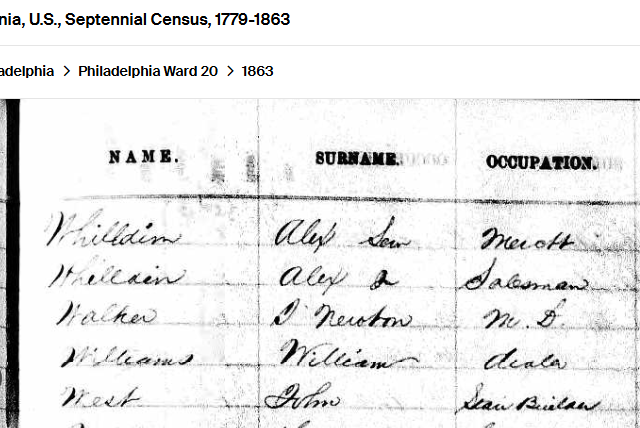
In 1863, he was a stair builder in Philadelphia:[3]

In 1870, the last federal census he was alive, he was a carpenter:[4]

Second generation

Figure 1 John T. West

His son, John T., in 1850 was a carpenter:

[5]

In 1860 he was a carpenter:[6]

In 1870 he was keeping a farm and that may have become the bulk of his income:[7]

In 1880 he was still a farmer, perhaps in that small town there wasn’t enough carpentry work to keep him going:[8]

While he was enumerated in 1890, the veteran’s schedule does not list his occupation.

Come 1900, John was finally a carpenter again:[9]

In 1910, John is in a Soldier’s and Sailor’s home with no occupation:[10]

And finally, in 1920, he is in the Solder’s and Sailor’s home with no occupation again: [11]

Third generation

John T.’s son, John Thomas West Jr., not my ancestor, also became a carpenter.

When the prompt came out this week, “Family business,” I was stumped as to what I would discuss. But I think a three-generation craft is respectable for this purpose!

Another string

My great-grandfather on another line was a financial secretary; his son in law (my grandfather) was an accountant; his son (my father) was a tax accountant. It skipped a generation, but my son is a Certified Public Accountant.

How AI can help

AI can speed up occupational sleuthing by scanning census records, city directories, and digitized newspapers for mentions of trades, apprenticeships, and business listings. Tools like ChatGPT can summarize occupation trends in a timeline, helping you spot shifts like when John T. traded his tools for a plow – or back again. AI can even suggest leads, like tax records or guild memberships, you might not have considered.

Want to map your family’s job history? Ask your favorite AI assistant to help sort your ancestors by occupation and decade. It’s like a career fair with everyone already dressed for the part.

Challenge

Try this:

  1. Timeline Game: Make a visual timeline of your ancestor’s occupations using census and city directory data. Add changes in location or family structure to spot patterns.
  2. Skill Set Detective: Choose one ancestor’s job and research what tools, training, or licensing it involved in their era. Use AI to compare their role to modern equivalents—was your 1860 stair builder today’s architectural woodworker?

Bonus challenge: Ask ChatGPT to help write a “Help Wanted” ad your ancestor might have answered—or placed!

Summary

Fleshing out ancestor’s livelihoods can help fill out their stories, and noticing changes in occupation can show perhaps hard times like my ancestor probably faced on the Ohio frontier. Looking for occupational patterns can shed new light on our family tree.

AI tools can help speed up the research, but the real gold is in noticing the stories between the job titles.

Further Resources

Next Week’s Topic: “Travel”

Disclosure

This post was created by me with the help of AI tools. While AI helps organize research, the storytelling and discoveries are my own.


[1] Ancestry.com. 1850 United States Federal Census [database on-line]. Lehi, UT, USA: Ancestry.com Operations, Inc., 2009. Images reproduced by FamilySearch.
Original data: Seventh Census of the United States, 1850; (National Archives Microfilm Publication M432, 1009 rolls); Records of the Bureau of the Census, Record Group 29; National Archives, Washington, D.C.

[2] Ancestry.com. 1860 United States Federal Census [database on-line]. Lehi, UT, USA: Ancestry.com Operations, Inc., 2009. Images reproduced by FamilySearch.
Original data:1860 U.S. census, population schedule. NARA microfilm publication M653, 1,438 rolls. Washington, D.C.: National Archives and Records Administration, n.d.

[3] Ancestry.com. Pennsylvania, U.S., Septennial Census, 1779-1863 [database on-line]. Provo, UT, USA: Ancestry.com Operations, Inc., 2012.
Original data: Septennial Census Returns, 1779–1863. Box 1026, microfilm, 14 rolls. Records of the House of Representatives. Records of the General Assembly, Record Group 7. Pennsylvania Historical and Museum Commission, Harrisburg, PA.

[4] Ancestry.com. 1870 United States Federal Census [database on-line]. Lehi, UT, USA: Ancestry.com Operations, Inc., 2009. Images reproduced by FamilySearch.
Original data:1870 U.S. census, population schedules. NARA microfilm publication M593, 1,761 rolls. Washington, D.C.: National Archives and Records Administration, n.d

[5] The National Archives in Washington, DC; Record Group: Records of the Bureau of the Census; Record Group Number: 29; Series Number: M432; Residence Date: 1850; Home in 1850: Spring Garden Ward 5, Philadelphia, Pennsylvania; Roll: 819; Page: 223b

[6] Ancestry.com. 1860 United States Federal Census [database on-line]. Lehi, UT, USA: Ancestry.com Operations, Inc., 2009. Images reproduced by FamilySearch.
Original data:1860 U.S. census, population schedule. NARA microfilm publication M653, 1,438 rolls. Washington, D.C.: National Archives and Records Administration, n.d.

[7] Ancestry.com. 1870 United States Federal Census [database on-line]. Lehi, UT, USA: Ancestry.com Operations, Inc., 2009. Images reproduced by FamilySearch.
Original data:1870 U.S. census, population schedules. NARA microfilm publication M593, 1,761 rolls. Washington, D.C.: National Archives and Records Administration,

[8] Year: 1880; Census Place: Liberty Center, Henry, Ohio; Roll: 1032; Page: 30d; Enumeration District: 109

[9] Year: 1900; Census Place: Liberty Center, Henry, Ohio; Roll: 1286; Page: 11; Enumeration District: 0027

[10] Year: 1910; Census Place: Perkins, Erie, Ohio; Roll: T624_1178; Page: 5a; Enumeration District: 0051; FHL microfilm: 1375191

[11] Year: 1920; Census Place: Perkins, Erie, Ohio; Roll: T625_1377; Page: 10A; Enumeration District: 15

52 AI Ancestors in 52 Weeks: Week 21: Military

I’ve combined Amy Johnson Crow’s 52 ancestors in 52 weeks challenge, and Steve Little’s The 2025 AI Genealogy Do-Over, to create a unique 52 AI ancestors in 52 weeks party!

52 AI Ancestors in 52 Weeks: Week 21: Military

Three Wars, Four Stories: A Family’s Legacy of Service

Introduction

It starts with a name on a gravestone. Or an old photo of a young man in uniform. My family’s military story stretches across nearly 200 years, from militia musters to wartime telegrams and folded flags.

This post is about four relatives—each touched by military service—whose lives reflect how war, and the people who fight it, have changed over time.

Discussion

Part I: The Militiaman (Revolutionary War)

Henry Denny (1758-1839) wasn’t a soldier, not in the professional sense. He was a hatter with a musket and a sense of duty. My Revolutionary War ancestor served in the local militia, answering the call when British troops threatened their region. His records are sparse—a muster roll here, a pension application there—but they remind me that early American soldiers were ordinary citizens first, reluctantly drawn into extraordinary times.

Henry Denny served “during the whole of said [Revolutionary] war,”[1] according to his son’s declaration for his father’s pension. He was a Sergeant in Captain John Outwater’s regiment in Bergen County, New Jersey and on one occasion “was wounded by a hessian rifleman”[2] and another time defended Hackensack when the enemy tried to burn it down. Outwater’s sons made depositions to Henry’s service, one of them saying, “Henry Denny and Sylvester Marius (now dead) were two men on whom he could depend … a faithful soldier”[3] and Outwater’s nephew stating that Henry “was brave and unflinching in the cause of his country, a clever, honest man, and a good soldier.”[4]

Figure 1 From Henry Denny’s pension file, not successful until Outwater’s records were located after Denny’s death.

Service then was seasonal, often local, and deeply tied to one’s community.

Part II: The Soldiers (Civil War), or, Patience’s sacrifice

Fast-forward nearly a century. Another ancestor, John Thomas West, husband of Patience Spiegle, wore Union blue, enlisted in the thick of the Civil War, and was posted to a prison camp: Johnson’s Island, in Ohio.

John served as a Private in Company C of the 128th Ohio Volunteer Infantry, from Independence day in 1863 until after the war ended.

Figure 2 John Thomas West (1830-1924)

John lived to come home—but his brother in law did not.

Patience’s brother, William Speagles, enlisted in the 12th New Jersey as a Private on August 13, 1862 at the age of 17 (saying he was 18), an orphan. He marched, camped, and fought in places now etched in bronze plaques and field trip itineraries. He was wounded in Cold Harbor and died in a field hospital a week later. His belongings (clothing, thread needle roll, pictures, memorandum book, gold ring, gold pen holder, “Testament”) were sent to his sister Hannah. He was buried in the National Cemetery in Alexandria, Virginia, but I believe he was reinterred to his home state at some point.

Figure 3 A casualty ledger showing William P. Speagles

This war was industrial, brutal, and personal. The letters home were fewer, the distances longer, and the weapons deadlier. These men were part of enormous, impersonal armies—but still deeply rooted in their towns and families.

Service had become more organized, more dangerous, and far less optional.

Part III: The Fallen Cousin (World War II)

He was just 24. A cousin whose name I only knew through whispered family stories until I found his records. Killed in action overseas in World War II, his death sent ripples that are still felt today. Unlike the earlier wars, this one pulled Americans onto a truly global stage. His body never came home, but his photograph, his name on a memorial, and the folded letter to his parents keep him present.

Private Robert J. Anderson (1920-1944), a first cousin to my grandfather, served in the 116th Infantry Regiment, 29th Infantry Division, which was one of the first on the beach on D-Day. Their backup didn’t make it, and they suffered heavy losses. After D-Day, they went across France, liberating the towns. It was in St. Lô that Robbie was killed. They say (source unknown):

The 29th took five weeks to reach St. Lo. Just before the final drive captured the city Maj. Thomas Howie, commander of the 3d Battalion, 116th Infantry, promised his men “I’ll see you [at] St. Lo.” He was killed immediately afterwards but General Gerhardt ordered the column to carry his body into the town square. A New York Times correspondent’s story of the incident immortalized the “Major of St. Lo.”

Robbie was posthumously awarded the Purple Heart and is buried at the Brittany American Cemetery outside St. James, France.

Figure 4 Robbie’s burial site, kindly sent to me by the American Battle Monuments Commission

Service now meant a world war, mechanized death, and sacrifice at a scale families still struggle to reckon with.

Part IV: The Thread That Ties Them

Each of these relatives served in different wars, in different centuries, and under vastly different circumstances. But what unites them is a quiet sense of duty—not necessarily to “country” in the abstract, but to their neighbors, families, and values. The idea of service changed over time—from informal militias to massive military bureaucracies—but the personal cost never stopped being personal.

How AI can help

How AI Can Help With Military Research

Researching military ancestors used to mean squinting at microfilm or decoding government forms from 1863. Good news: AI can help with that—without stealing the fun of discovery.

Here are a few ways it lends a hand:

Translate That Handwriting

Found an old pension file or draft card full of spidery handwriting? AI tools can help transcribe or summarize these documents. You can even upload scans into some AI platforms and ask, “What is this telling me?”

Build a Timeline with background information

If your ancestor served across several battles or regiments, AI can help you turn scattered dates and places into a readable timeline—with historical context built in. Just feed it your notes, and ask for a summary. AI can give you quick background info so you don’t get lost in research rabbit holes.

I do need to mention Researcher here, which Microsoft revealed this month as part of Copilot. In my test runs, it does a great job starting your research.

Make Sense of the Story

Have some facts but not sure how to thread them into a narrative? AI can help you outline your blog post, suggest titles, or smooth out transitions—without rewriting your voice. You stay the storyteller. AI is the editor that never takes lunch.

Want to try it? Copy this into your notes:

“Here’s what I know about my ancestor who served in [war]. Can you help me understand what these records mean and how I might tell their story?”

You’ll be surprised by what unfolds.

Summary and challenge

From colonial militiaman to World War II casualty, my ancestors’ stories mirror the evolution of American military service. Their paths—marked by dusty muster rolls, battlefield graves, and pension papers—remind me that history isn’t abstract. It’s inherited.

Three wars. Four stories. One family.

Your Turn: Challenges for the Curious

Want to explore your own family’s military history?

Challenge 1:

Check Fold3.com or the free NARA archives for pension files, enlistment records, or draft cards. Even one document can tell a rich story.

Challenge 2:

Compare military service across generations in your family. How did roles, reasons, or outcomes differ? Make a simple timeline to trace the shift.

Next week’s topic: “Reunion.

Disclosure

This post was created by me with the help of AI tools. While AI helps organize research, the storytelling and discoveries are my own.


[1] “Revolutionary War Pension and Bounty-Land Warrant Application Files,” images online, footnote.com (https://www.fold3.com/file/16580523 : accessed 23-Sep-2008) page 3; citing The National Archives, M804, Washington, D. C..

[2] Ibid, page 8

[3] Ibid, page 14

[4] Ibid, page 18

