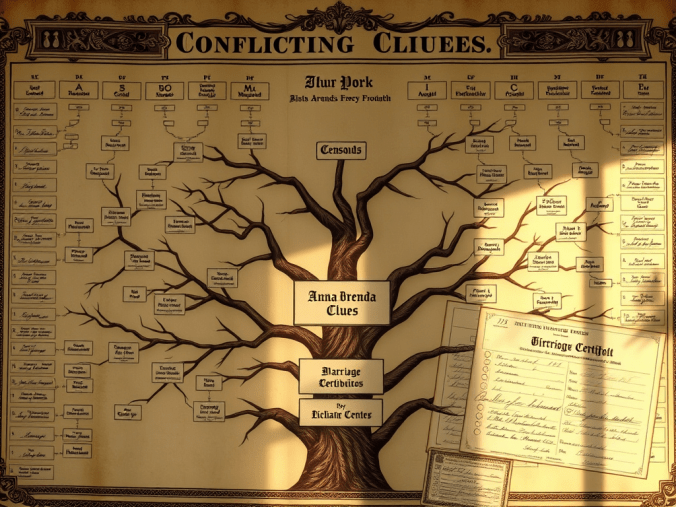
Conflicting Clues

Conflicting Clues

I’ve adapted Amy Johnson Crow’s 52 ancestors in 52 weeks challenge.

Each week’s post follows my children’s ahnentafel numbering, which determines the featured ancestor.

This ensures no one until mid-sixth generation gets left behind.

52 Ancestors in 52 Weeks: 2026 Week 09: Conflicting Clues

Introduction

My assigned Week 9 ancestor is Anna Brenda FRANK BIRNBAUM.

And “Conflicting Clues” turned out to be a particularly instructive one.

Was Anna a U.S. citizen?

Discussion

Anna was born in New York City in 1889. While I haven’t found her birth record, I have found her siblings’, and I have her with her family in the 1900 and 1905 censuses. She married Samuel Birnbaum, an immigrant, in 1906.

The following year, the 1907 Expatriation Act automatically revoked the citizenship of women who married non-citizens. Suddenly many women who had grown up here and never seen a ship were aliens.

Because Anna married in 1906, just before the law took effect, she may have narrowly avoided this automatic expatriation.

Imagine what that was like for them. Did it affect them socially? Did they feel disenfranchised from a place that had been their home for perhaps decades? And what would the consequences be? The act remained in place until the early 1920s – right around the time women gained the right to vote. Imagine fighting for suffrage only to learn your marriage disqualified you?

Imagine if I had seen Anna in 1910 listed as an alien and thought, “Well, that’s not my Anna.”

So, the moral of the story is, as Judy Russell, The Legal Genealogist, keeps reminding us, to know the laws in effect in the time and place of the event.

The law was largely (but not completely) repealed by the Cable Act of 1922. (Asians were still discriminated against.)

The National Archives has a helpful PDF at When Saying “I Do” Meant Giving Up Your U.S. Citizenship.

Challenge

Reexamine your no-brainers and look for incongruities which may have escaped notice previously. Investigate why!

You can look for:

  • Citizenship shifts
  • Border changes
  • Age discrepancies
  • Marital status laws

What conflicting clues are you dealing with?
AI Disclosure

This post was created by me with the help of AI tools. While AI helps organize research, the storytelling and discoveries are my own.

Next Week’s Topic: Changed My Thinking

52 AI Ancestors in 52 Weeks: Week 19: At the Library

I’ve combined Amy Johnson Crow’s 52 ancestors in 52 weeks challenge, and Steve Little’s The 2025 AI Genealogy Do-Over, to create a unique 52 AI ancestors in 52 weeks party!

52 AI Ancestors in 52 Weeks: Week 19: At the Library

Check This Out: Libraries, Family, and a Little Help from AI

Introduction

I’ve felt at home in the library for as long as I can remember. It’s a comfortable, non-judgmental environment where I can get transported to a world not my own, or learn how to do something new.

Discussion

Several good memories of mine happened in libraries.

When my divorced dad finally got weekend visitation, one of the activities he took us on was trips to the library. A newspaper photographer caught me searching in the card catalog (oh, boy, I wish I could find that photo!).

My first volunteer job was at my middle school library, putting books away. To this day, if I see a book misfiled in the library, I’ll furtively put it back in the proper spot according to the Dewey Decimal code on its spine.

We had a snail who left the tank’s water to lay eggs, which had us worried. I checked a book about pet care out of the library, and wrote the author with a question about my weird snail. How thrilling it was to hear back! (She didn’t know, but the thrill was hearing back! – and it turned out Mama Snail knew what she was doing.)

When I had children, I hyped them up to get their own library cards. As soon as they could print their names, they were eligible—and you better believe we got them cards when they were each four years old!

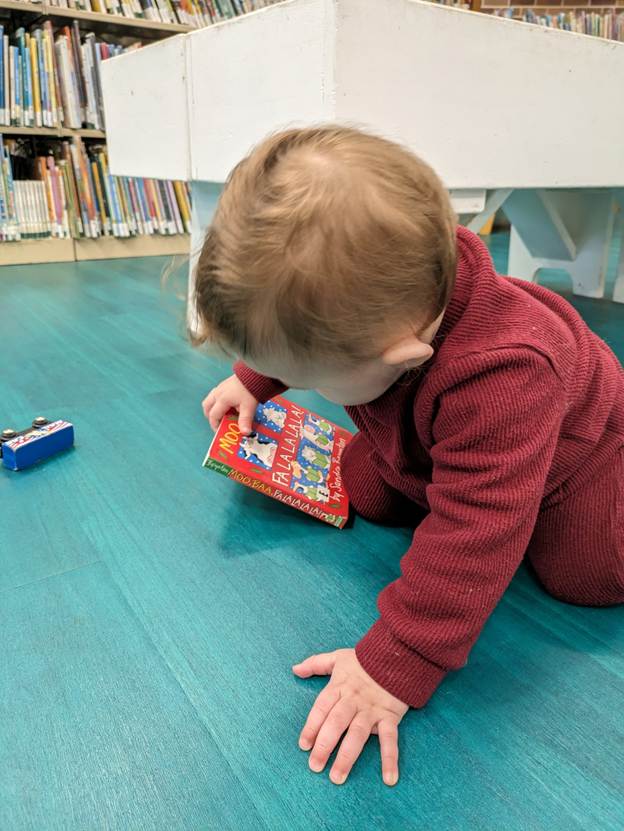
I care for my young granddaughter some days, and enjoy bringing her to the library so she can choose a board book which I’ll read to her.

Without really thinking about it, I helped to carry on the tradition of family bonding at the library to at least the fourth generation.

How AI can help

I track my reading on Goodreads, and have done so since I inadvertently started a book I’d already completed. This turned out to be very helpful for recommendations. Here’s what I did:

  • I exported my 5-star reads from Goodreads.
  • I shared them with ChatGPT using this prompt…

Consider the attached list of books that I have read and highly rated. What books would you recommend I read?

  • ChatGPT replied with personalized recommendations…

Summary and challenge

Books are deeply personal. What matters most is that they speak to you. This week, I invite you to pass on a love of the library—or rediscover it yourself—and let AI help you uncover your next great read.

Your Turn:

Determine who you’d like to get to the library – yourself? A family member? Get a library card and use AI’s help for book recommendations.

Little one’s first visit to a library

Next week’s topic: “Wheels.

Disclosure

This post was created by me and refined with AI assistance. While AI helps organize research, the storytelling and discoveries are my own.