I’ve combined Amy Johnson Crow’s 52 ancestors in 52 weeks challenge, and Steve Little’s The 2025 AI Genealogy Do-Over, to create a unique 52 AI ancestors in 52 weeks party!
52 AI Ancestors in 52 Weeks: Week 10: Siblings
Introduction
Amy Johnson Crow’s theme for Week 10 is “Siblings.” I’d like to take this opportunity to reflect on Lydia Coral West (1888-1944) and Grace West Crozier (1890-1975), sisters of my grandfather A Gordon West.
Discussion
Lydia Coral West was the unmarried sister and the eldest girl of the family. Her mother’s sister had named her daughter Lydia Cora, so I am sure there was someone the sisters wanted to honor. It may have been a woman who ran the orphanage where Lydia’s mother lived for a time. Aunt Lydia had artistic talents—my grandparents hung a still life that she painted, and I admired it as a girl without initially knowing its provenance. (I was promised that painting, but my own siblings decided otherwise… a sibling story I do not want to discuss.) My uncle has a painting of my grandfather that Aunt Lydia created when Grandpa was a boy. What a treasure! Lydia died at only 56, but I don’t know why—I just scheduled myself a task of ordering her death certificate.
Unlike Lydia, who remained unmarried, Grace’s life took a different path. Grace West Crozier lived into my lifetime, but I never got to meet her. I remember when she died, though, and that due to illness my grandfather was unable to travel back to Ohio to attend her funeral. Aunt Grace had chased the family history and left many details on the WEST family line—many details, but no sources—which I have had a lot of fun chasing (and proving correct) over the years.
Tantalizingly, Aunt Grace added onto the tree that there were others of this line (collateral relatives) but she didn’t know if the intended recipient was interested. That document gave me much pleasure and helped feed the growing genealogy bug in me. Aunt Grace had three children whom I met, and her son, Stephen Crozier, had corresponded with me for years. (To do: ask my uncle about her.) Her obituary, frustratingly headlined “Mrs. Earl Crozier” rather than with her name, says that she was a practical nurse.
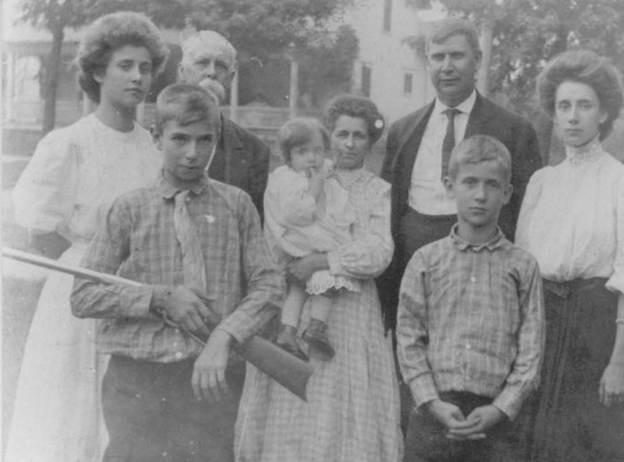
The WEST family; Grace on the left and Lydia on the right
How AI is Helping My Research
The photo above, of three generations of the family, is a true treasure to me. (My grandfather is the baby.) I would love to see if AI can tell me more about it. Steve Little has created a custom GPT to use in analyzing photos. I asked it,
Please analyze this photo and tell me what you can about the people in it. I am particularly interested in the woman on the left and the woman on the right.
It gave me detailed information, including:
About Grace:
- She is wearing a long, white dress with a high neckline and sleeves, which is common in Edwardian fashion.
- Her hair is styled voluminously, possibly using a “Gibson Girl” style, which was fashionable in the early 1900s.
- She stands slightly apart from the others, appearing tall and poised, with an air of confidence.
- Her expression is serious and somewhat distant, which was typical of the era, as smiling in photos wasn’t common.
About Lydia:
- She is also dressed in a high-necked, long-sleeved blouse with a dark skirt, another fashion trend of the early 1900s.
- Her hair is styled in an updo, similar to the woman on the left, with a puffed-out shape.
- Her facial expression is stern and composed, and she has an upright posture.
- She stands next to a young boy, who may be a sibling or child.
Much like Mark Thompson discussed in the seminar, Artificial Intelligence and Family History: The Basics and Beyond, AI helped me notice details I had previously overlooked. Why is Grace wearing a white dress? I looked up her wedding and it was in July 1910, when the baby in this picture was about to turn 3. Was that a nearly 3-year-old, making this a wedding photo? (AI doesn’t think so – it’s dating the photo to around 1908, based on baby development, shoes, musculature, and other factors.) And why did they (I just learned) marry in Canada, in a division which is now a 1 hour 41-minute drive away? (First known baby is 16 months later.) Is the marriage why she appears “poised, with an air of confidence?”
AI is definitely in genealogy mode, as it raises as many questions as it answers! But it is helping me to better understand those who came before, and I am grateful.
Challenge for Readers
Identify an ancestor’s sibling that you’d like to learn more about, and ask AI to give you ideas, analyze photos, or provide new perspectives!
Summary and Next Steps
Exploring Lydia and Grace’s lives through AI-driven photo analysis has given me new insights into their era, fashion, and personalities—things I might not have noticed on my own. AI has also sparked new questions: Was Grace’s dress related to her wedding? Why did she marry in Canada? And what more can I learn about Lydia’s life and her artistic legacy?
To take this further, my next steps include:
- Ordering Lydia’s death certificate to uncover details about her passing.
- Asking my uncle for any additional memories or documents about Aunt Grace.
- Investigating Canadian marriage records to better understand why Grace married there.
- Running additional AI analysis on the family photo, perhaps comparing it with other dated images.
- Testing other AI tools to refine facial recognition and dating estimates for family photos.
Genealogy is never truly finished—it’s a continuous journey of learning, verifying, and connecting. AI is proving to be a fascinating assistant in this process, uncovering patterns and prompting new avenues of research. With AI as a research companion, I look forward to uncovering even more about Lydia, Grace, and the family members who shaped their lives.
Disclosure
This post was created by me and refined with AI assistance. While AI helps organize research, the storytelling and discoveries are my own.
 The Ancestor Whisperer