52 AI Ancestors in 52 Weeks: Week 12: Historic event
Introduction
I am lucky enough to remember two of my great-grandparents, my father’s maternal grandparents. My dad used to tell me how his grandfather, Francis William CAREY (1881-1975), lived through times of significant change. Dad wrote:
“When he passed away, I thought he had seen most of the technological progress mankind had ever made: he traveled on a train pulled by a steam engine to his new home, and saw men land on the moon.”
Discussion
When great-grandpa was young, he worked at a carriage house for the wealthy – before motor vehicles were common. He used to say that the rich had two-horse carriages, and the very rich had four-horse carriages. That perspective helped me realize that history isn’t just grand world-changing events—it’s also personal experiences, the moments that shape families.
Each generation witnesses history in its own way. My father shared stories about computers, my son interviewed me about the Challenger explosion, and my children watched the 9/11 attacks unfold on live television.
What will be your story? Don’t let these stories fade away. Share them—write them in a blog, a family newsletter, a book, or even a social media post. Your story matters.
How AI is Helping
AI can be tremendously useful in identifying historical events that may have affected our ancestors. Using historical records and timelines, AI can help pinpoint major local and global events that influenced their lives.
Frances William Carey was born 1881 in Madison, Morris, New Jersey, USA, lived in Manhattan, New York, and died in New City, Rockland, New York, USA in 1975. List historical events that he may have witnessed, heard of, been part of, or that may have otherwise affected his life.
These are just a few examples, but AI can take things further. By analyzing census data, newspapers, and historical maps, AI tools can provide even deeper insights into the lives our ancestors lived.
Summary and Next Steps
History isn’t just found in textbooks—it’s found in family stories, passed down through generations. We can use AI to uncover and document these moments, ensuring they aren’t lost. This week, take time to reflect: What major events have you lived through? How did they shape you? Try using AI to draft a short biography of yourself or an ancestor based on historical records.
Next week, we explore “Home sweet home.”
Disclosure
This post was created by me and refined with AI assistance. While AI helps organize research, the storytelling and discoveries are my own.
The theme for Week 11 is “Brick Wall.” Every genealogist encounters an ancestor who seems impossible to trace. For me, that ancestor was Mary Catherine DENNY SMITH—until a breakthrough came with the help of generous volunteers. My search led to a book mentioning William DENNY’s daughter Mary marrying a Mr. SMITH, only for me to hit another dead end with Mary’s ancestor, Mary TIEBOUT.
Discussion
Years ago, Dorothy Koenig published New Netherland Connections, a newsletter focused on early American colonial genealogy. In 2009, I was lucky enough to publish a query in her newsletter (Vol 14 p 54):
TIEBOUT – Seeking parents of Mary TIEBOUT, who m. William YOUNG 5 Dec 1756 at Trinity Church Parish [NYG&BR 69:280] by NY Marriage License dated 4 Dec 1756 [NY Marriage Licenses Prior to 1784, p 388 (or 477), M.B. 1:372]
Three candidates present themselves: Maria TIEBOUT bp 08 Aug 1736 NY NY; Albert TIEBOUT & Cornelia BOGERT Maritje TIEBOUT bp 16 Jan 1732 SI NY; Teunis TIEBOUT & Margrietje DRINKWATER Marytje TIEBOUT bp 29 Nov 1724 NY RDC; Hendricus TIEBOUT & Elisabeth BURGER
One clue may be that a sponsor of Mary’s dau Mary was Jane THIBOUT (1759). That daughter Mary had as a sponsor of her children: Sponicus YOUNG and wife, Jane SHEBOU (1781); and also Jane TIEBOUT M.P. (1790); and finally John YOUNG and Jane THIBOU (1793).
Mary d 23 Jan 1811 Hackensack and was buried First Reformed Church there.
Any leads appreciated.
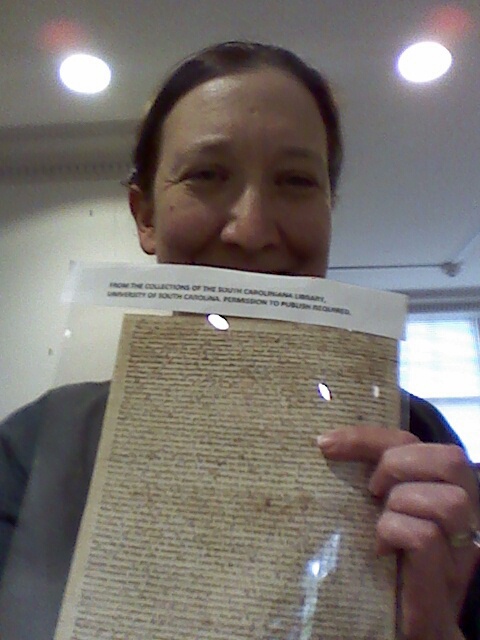
A kind reader, Bill Vinehout, found crucial details in the Viele Genealogy book that changed everything. Surprisingly, none of my original three candidates were correct! Thanks to Bill’s help, I was able to trace Mary’s lineage back multiple generations. One of my most exciting discoveries was her ancestor Louis THIBOU, a man so fascinating that I’ve written about him in this blog before. Holding a letter he wrote in 1683 with my own hands was a surreal experience. (More info on the letter archived here.)
Figure 1 Me holding the letter my 7th great grandfather wrote!
Both Dorothy and Bill are gone now, but I am forever grateful for their generosity of spirit – and that of countless others.
How AI is Helping Break Brick Walls
Today, AI can play the role that Dorothy and Bill once did for me. I asked Claude, an AI assistant, for ways to help other researchers tackle brick walls. Here are some of its suggestions:
Create a step-by-step guide for solving brick wall cases.
Develop specialized guides for common genealogy challenges.
Compile overlooked records that may hold missing pieces.
Share success stories, breaking down the exact steps used.
Provide research log templates to help organize findings.
These are powerful ideas! If AI tools had been around in 2009, I could have used them to cross-reference sources, analyze surname variations, and uncover hidden patterns more quickly. While AI can’t replace human insight and experience, it can certainly speed up the process.
Paying It Forward
Both Dorothy and Bill have since passed away, but their generosity lives on through the research they contributed. Inspired by their kindness, I’ve committed to helping others by dedicating time each week to genealogical volunteer work. Whether it’s contributing to the New York GenWeb county site I coordinate or sharing research strategies, I want to give back.
Challenge for Readers
How can you pay it forward? Have you received help in your genealogy journey that you can pass on to others? Even small efforts—sharing records, answering queries, or mentoring new researchers—can make a difference. Many people have mentioned having breakthroughs thanks to FamilySearch AI indexing, for example, which we can learn and share about. Transkribus is posed to break down language barriers, which we can use to share information globally. Let’s continue the tradition of generosity in genealogy!
Summary and Next Steps
Breaking through genealogical brick walls often requires persistence, collaboration, and the right resources. My journey with Mary Catherine DENNY SMITH and Mary TIEBOUT proves that asking for help can lead to unexpected breakthroughs. AI tools now offer additional ways to assist in research, making discoveries more accessible than ever.
I’ve set a weekly reminder to contribute to genealogy projects and encourage you to do the same. How will you use your knowledge to help others? Let’s keep building connections, one discovery at a time.
Disclosure
This post was created by me and refined with AI assistance. While AI helps organize research, the storytelling and discoveries are my own.
Amy Johnson Crow’s theme for Week 10 is “Siblings.” I’d like to take this opportunity to reflect on Lydia Coral West (1888-1944) and Grace West Crozier (1890-1975), sisters of my grandfather A Gordon West.
Discussion
Lydia Coral West was the unmarried sister and the eldest girl of the family. Her mother’s sister had named her daughter Lydia Cora, so I am sure there was someone the sisters wanted to honor. It may have been a woman who ran the orphanage where Lydia’s mother lived for a time. Aunt Lydia had artistic talents—my grandparents hung a still life that she painted, and I admired it as a girl without initially knowing its provenance. (I was promised that painting, but my own siblings decided otherwise… a sibling story I do not want to discuss.) My uncle has a painting of my grandfather that Aunt Lydia created when Grandpa was a boy. What a treasure! Lydia died at only 56, but I don’t know why—I just scheduled myself a task of ordering her death certificate.
Unlike Lydia, who remained unmarried, Grace’s life took a different path. Grace West Crozier lived into my lifetime, but I never got to meet her. I remember when she died, though, and that due to illness my grandfather was unable to travel back to Ohio to attend her funeral. Aunt Grace had chased the family history and left many details on the WEST family line—many details, but no sources—which I have had a lot of fun chasing (and proving correct) over the years.
Tantalizingly, Aunt Grace added onto the tree that there were others of this line (collateral relatives) but she didn’t know if the intended recipient was interested. That document gave me much pleasure and helped feed the growing genealogy bug in me. Aunt Grace had three children whom I met, and her son, Stephen Crozier, had corresponded with me for years. (To do: ask my uncle about her.) Her obituary, frustratingly headlined “Mrs. Earl Crozier” rather than with her name, says that she was a practical nurse.
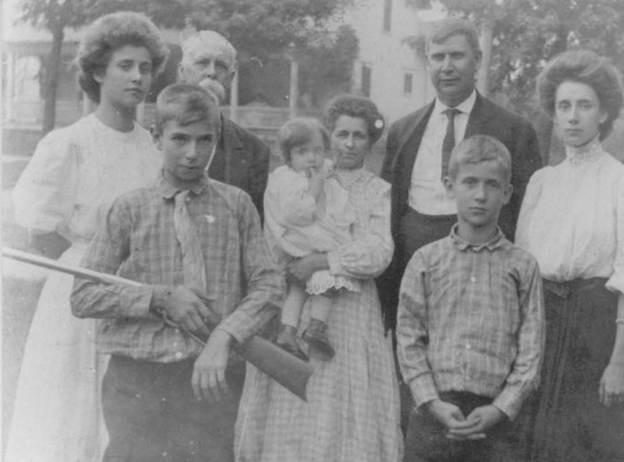
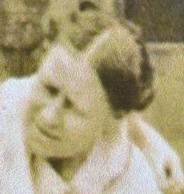
The WEST family; Grace on the left and Lydia on the right
How AI is Helping My Research
The photo above, of three generations of the family, is a true treasure to me. (My grandfather is the baby.) I would love to see if AI can tell me more about it. Steve Little has created a custom GPT to use in analyzing photos. I asked it,
Please analyze this photo and tell me what you can about the people in it. I am particularly interested in the woman on the left and the woman on the right.
It gave me detailed information, including:
About Grace:
She is wearing a long, white dress with a high neckline and sleeves, which is common in Edwardian fashion.
Her hair is styled voluminously, possibly using a “Gibson Girl” style, which was fashionable in the early 1900s.
She stands slightly apart from the others, appearing tall and poised, with an air of confidence.
Her expression is serious and somewhat distant, which was typical of the era, as smiling in photos wasn’t common.
About Lydia:
She is also dressed in a high-necked, long-sleeved blouse with a dark skirt, another fashion trend of the early 1900s.
Her hair is styled in an updo, similar to the woman on the left, with a puffed-out shape.
Her facial expression is stern and composed, and she has an upright posture.
She stands next to a young boy, who may be a sibling or child.
Much like Mark Thompson discussed in the seminar, Artificial Intelligence and Family History: The Basics and Beyond, AI helped me notice details I had previously overlooked. Why is Grace wearing a white dress? I looked up her wedding and it was in July 1910, when the baby in this picture was about to turn 3. Was that a nearly 3-year-old, making this a wedding photo? (AI doesn’t think so – it’s dating the photo to around 1908, based on baby development, shoes, musculature, and other factors.) And why did they (I just learned) marry in Canada, in a division which is now a 1 hour 41-minute drive away? (First known baby is 16 months later.) Is the marriage why she appears “poised, with an air of confidence?”
AI is definitely in genealogy mode, as it raises as many questions as it answers! But it is helping me to better understand those who came before, and I am grateful.
Challenge for Readers
Identify an ancestor’s sibling that you’d like to learn more about, and ask AI to give you ideas, analyze photos, or provide new perspectives!
Summary and Next Steps
Exploring Lydia and Grace’s lives through AI-driven photo analysis has given me new insights into their era, fashion, and personalities—things I might not have noticed on my own. AI has also sparked new questions: Was Grace’s dress related to her wedding? Why did she marry in Canada? And what more can I learn about Lydia’s life and her artistic legacy?
To take this further, my next steps include:
Ordering Lydia’s death certificate to uncover details about her passing.
Asking my uncle for any additional memories or documents about Aunt Grace.
Investigating Canadian marriage records to better understand why Grace married there.
Running additional AI analysis on the family photo, perhaps comparing it with other dated images.
Testing other AI tools to refine facial recognition and dating estimates for family photos.
Genealogy is never truly finished—it’s a continuous journey of learning, verifying, and connecting. AI is proving to be a fascinating assistant in this process, uncovering patterns and prompting new avenues of research. With AI as a research companion, I look forward to uncovering even more about Lydia, Grace, and the family members who shaped their lives.
Disclosure
This post was created by me and refined with AI assistance. While AI helps organize research, the storytelling and discoveries are my own.
Migration is a theme that touches every genealogist because all of us descend from migrants. My own maternal haplogroup, I4, traces a journey from eastern Africa through the Middle East to Europe. But rather than focusing on just my distant ancestors, I’m turning the lens inward—to my own migration story.
Migrations
I take great pride in my American ancestors, from the religiously persecuted Huguenots who arrived in 1624 to the post-famine Irish who faced hardship head-on. For generations, my family remained rooted on the East Coast of the United States, particularly Staten Island, New York, where they settled in 1665. I was born and raised there, had my children there, and expected that our roots would remain firmly planted.
Then came the attacks of September 11, 2001.
I was in Manhattan when the towers fell. My husband managed to reach our small children, but I was trapped in the city, desperate to get home and hold them close. Like many others, I left New York in the time that followed. My father remained, the last of my direct line on Staten Island. When he passed in 2009, the link to my ancestral home of nearly 350 years was severed. What was once my family’s anchor became a memory.
AI is transforming how we understand migration, both in the broader historical sense and in personal genealogy. Here are some ways AI is assisting my research:
DNA Analysis & Migration Patterns: AI-driven tools like MyHeritage’s “Theory of Family Relativity” and 23andMe’s haplogroup mapping provide insights into ancestral migration routes. AI helps compare my DNA with ancient population data, identifying possible pathways my ancestors took.
Historical Record Analysis: AI-powered platforms like Ancestry’s StoryScout and FamilySearch’s record hinting system analyze documents, connecting names, locations, and migration events. AI can surface records I might have overlooked, revealing new details about how and why my ancestors moved.
Newspaper & Obituary Searching: AI-driven newspaper archives can identify migration clues hidden in articles, obituaries, and legal notices. By scanning old papers for names, locations, and key terms, AI has helped me uncover mentions of family moves, ship arrivals, and land purchases.
Census & Ship Passenger List Analysis: AI makes searching census records more intuitive, predicting potential matches and migrations by analyzing occupation changes, neighbors, and household structures. Passenger lists and naturalization papers also benefit from AI’s ability to extract and organize details quickly.
Geographical Data Visualization: Tools like Google Earth’s AI-powered historical overlays allow me to visualize ancestral locations. AI-driven mapping software reconstructs old neighborhoods, providing a clearer sense of the landscapes my ancestors knew.
Challenge for Readers
Have you traced your ancestors’ migration patterns? Try using an AI-powered genealogy tool to uncover a migration story in your family tree. Look at census records, passenger lists, or even DNA migration maps. You might be surprised at what you find! Share your discoveries in the comments or with fellow researchers.
Summary and Next Steps
Migration is not just an event—it’s a story of movement, struggle, and change. Whether fleeing persecution, seeking better opportunities, or adapting to life-altering events like 9/11, migration shapes our family narratives.
AI offers new ways to uncover these stories, making research faster and more insightful. By harnessing AI, we can connect with our ancestors in ways never before possible.
Disclosure
This post was created by me and refined with AI assistance. While AI helps organize research, the storytelling and discoveries are my own.
52 AI Ancestors in 52 Weeks: Week 7: Letters and Diaries
Introduction
Every family has a story passed down through generations, and sometimes, a single letter can open a window into the past. In my family, that letter is known as “The Patience Letter.”
Patience P. SPIEGLE (1833-1889), my great-great-grandmother, was born in New Jersey and married John T. WEST (1830-1924) in 1852. They started a family in Philadelphia before moving to Liberty Center, Henry County, Ohio, in 1858. Among their children was my great-grandfather, Adam Grant WEST (1866-1939), a traveling salesman.
Decades ago, I saw a letter that Patience wrote to her son Adam, presumably while he was on the road. Though I haven’t seen it in years, its content and significance have stuck with me.
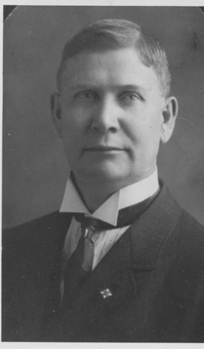
Figure 1 Adam West, the letter’s recipient
The Letter: A Glimpse Into the Past
While I can’t quote the letter verbatim, I remember key details that made an impression:
Remarkably Literate – Patience’s handwriting, spelling, and grammar were far better than one might expect for a woman born in the early 19th century. This suggests she had a solid education, likely from American-born parents of German and English descent.
A Family in Motion – The letter mentions that her husband, John, was considering another move—perhaps to Michigan. Given that I’ve traced at least six moves in John’s lifetime, this letter confirms his “wandering spirit.”
A Piece of History Lost – Unfortunately, my grandmother, the last known owner of the letter, passed away 28 years ago. I have asked my uncle if he has a copy or remembers more details, but the fate of the letter remains unknown at the moment. UPDATE: he sent me a copy!
How AI is Helping My Research
Losing a treasured family letter is frustrating, but modern technology—especially AI—offers new ways to recover lost history. Here’s how AI can assist:
Handwriting Recognition & Analysis – If I find even a fragment of the letter, AI-driven Optical Character Recognition (OCR) tools can help transcribe difficult-to-read handwriting and reconstruct missing words.
Historical Context & Language Analysis – AI can analyze old letters and compare them with similar writings from the same period, offering insights into common expressions and historical references.
Predictive Text Generation – While AI can’t fully recreate Patience’s words, it can generate plausible reconstructions based on similar letters and known details of her life.
By applying these tools, I hope to get closer to understanding what Patience might have written—and what insights she left behind.
Challenge for Readers
Have you ever discovered an old family letter or diary entry? What did it reveal about your ancestors? If you have a historical document but struggle to read it, try using an AI-powered transcription tool to bring it to life.
If a cherished letter is missing, consider reconstructing its contents with family memories and historical research. AI might just help you fill in the gaps!
Summary and Next Steps
Even when original documents disappear, modern genealogy tools—including AI—can help us reconstruct and preserve family history. Whether through transcription, historical context analysis, or predictive modeling, AI is a powerful ally in uncovering the past.
Next week, I’ll explore another AI-enhanced discovery in my family history. Stay tuned!
Disclosure
This post was created with AI assistance and refined with my insights. While AI helps organize research, the storytelling and discoveries are my own.
Figure 1 Alice Britton Makey, my great grandmother and product of Cornelius’ second marriage
Surprise! My Ancestor Had a Secret First Family 52 AI Ancestors in 52 Weeks: Week 6: Surprise!
Introduction
Have you ever thought you knew everything about an ancestor, only to find out there was an entire family you never knew existed? That’s exactly what happened when I stumbled upon Cornelius Britton’s hidden past. I believed I had his life well-documented—until one record changed everything.
Background
Cornelius Britton (1852-1910) and his wife, Alice Matilda Smith (1850-1913), were the proud parents of three daughters, including my great-grandmother. Oral history in my family confirmed I had everything squared away about this branch of my tree. But, as genealogy often teaches us, our ancestors have their own ways of keeping secrets!
The Discovery
As I refined my genealogy skills, I became determined to fill in every missing piece. Cornelius had always been a well-documented figure in my family’s history—until I uncovered a record that rewrote his story.
I was reviewing census records, expecting to confirm what I already knew, when I found something that made me freeze. Before marrying Alice, Cornelius had a first wife, Frances Housman, and together they had three sons. I stared at the screen. Three boys? I had never heard a single mention of them.
In the 1880 census, Cornelius and Alice were listed as “married within the year,” but the boys weren’t with them. Instead, they were living with their maternal grandparents. My heart sank as I followed their trail. One son died young, another disappeared from the records, but the third? He had descendants—relatives I never knew existed.
I tried to imagine Cornelius’s reality. A widower in the 1870s, left to raise three young boys alone—it must have been overwhelming. But why didn’t he reclaim them after remarrying? Did Alice refuse? Did circumstances make it impossible? His granddaughter, my great-grandmother, never spoke of them. Did she even know?
This discovery left me with more questions than answers. And that’s when I turned to AI for help.
How AI Helped My Research
Realizing I had missing branches in my tree, I wondered—could AI help me track them down? I started with ChatGPT, asking how I could investigate Cornelius’s first marriage. The responses were generic at first, so I refined my prompt, a key step when working with AI.
I also brought in Claude, which is known for its web searching capabilities. I asked both tools to create an AI-assisted locality guide for Cornelius’s time in New York City, focusing on records I might have missed.
Here’s what AI suggested:
🗂 Census & Vital Records ✔ Federal Census (1850-1880): Track household changes over time. ✔ New York State Census (1855, 1865, 1875): Available at the NY Public Library. ✔ Birth, Marriage, Death Records: NYC Municipal Archives has key documents.
📚 Local Directories & Newspapers ✔ Trow’s NYC Directory (Manhattan) & Lain’s Brooklyn Directory: Track Cornelius’s addresses and occupations. ✔ Newspaper Archives: Obituaries, announcements, and news mentions in the Brooklyn Public Library and online databases.
🏛 Legal & Church Records ✔ Probate & Land Records: Wills and deeds at county clerk offices could show connections. ✔ Church Records: Baptisms, marriages, and burials often provide missing details.
🔎 What Surprised Me? I expected Claude to be stronger at web searches, since it’s known for research, but ChatGPT provided direct links to resources, while Claude gave broader summaries. I also revisited Judy Russell’s “Reasonably Exhaustive Research Checklist” (free download here), which helped me double-check my sources.
Challenge for Readers
Have you ever uncovered a surprise in your family tree? Maybe a secret sibling, a hidden marriage, or an ancestor who vanished? I’d love to hear your stories! Share in the comments.
Summary and Next Steps
This discovery has left me with more questions than answers, and I’m eager to keep searching. My next steps? Exploring Cornelius’s families with the tools that AI suggested, particularly city directories and newly digitized newspapers, to see if I can track down more information about his missing son and his descendants.
Disclosure
This post was created with AI assistance and refined with my insights. While AI helps organize research, the storytelling and discoveries are my own.
Week 4 of the 52 Ancestors challenge dives into the overlooked. “Who is someone in your family tree who you haven’t researched very much?” It didn’t take any time for me to come up with the name: Andrew Driskol.
52 AI Ancestors in 52 Weeks: Week 4 – Overlooked
Introduction
Who in your family tree have you overlooked? For me, it’s Andrew Driskol. Or, rather, Andrew “Does-He-Even-Exist?” Driskol. He’s a puzzle—a man whose shadow falls across family records but refuses to leave a solid footprint. One of my very first finds as a baby genealogist was the marriage record of his daughter, my great grandmother, which listed his name. But as I dug deeper, the trail went cold. This week, I decided to tackle Andrew’s mystery with the help of a modern-day Watson: artificial intelligence.
Andrew Driskol: A Ghost in the Records
Andrew’s story—or lack thereof—begins in the 19th century, when civil and church records were often kept. The absence of documentation for someone like Andrew is unusual because his life spanned eras and locations where detailed records typically existed. This gap raises questions about whether his name was misspelled, misrecorded, or lost in migration. when civil and church records were often kept. He was likely born in Prussia, possibly Hesse-Darmstadt, around the 1830s or 1840s. He presumably married Malvina Hendell in England before emigrating to the United States in the 1870s. But here’s the kicker: there’s no direct record of Andrew. Not a birth certificate, not an immigration record, not a census entry. Yet, his children’s records consistently name him as their father.
The hunt for Andrew is a genealogist’s equivalent of chasing a will-o’-the-wisp. And yet, his legacy lives on in the scattered records of his children, like breadcrumbs leading nowhere. With AI in the picture, though, I wondered if I could piece together these fragments into something more substantial.
Figure 1 Anna Driskol Anderson ca 1914
My Data
I created a table of information I’ve gathered about him, all from records of his children; names:
Parents’ names as per childrens’ vitals
Child
Marriage Year
Marriage Parents Listed
Death Year
Death Parents Listed
Edward
Not found
Not applicable
Not found
Not applicable
Mary
1891
Andrew Driskoll M. Hendell
1938
Andrew Driskol (Ger) Malvina Helda (Ger)
1926
Andrew Driscol Malvina Henall
Josephine
1899
Andrew Driscoll Melvina Hendel
1925
Andrew Driscoll (Ger) Malvina _endels (Ger)
Anna
1906
Andrew Driskol Malvina
1922
Andrew Driscoll (Ger) Malvina Driscoll (Eng)
Joseph
Not found
Not applicable
1925
Andrew Driscoll (Ger) Malvina Hendell (Eng)
I also created a table of places of birth, since there is a little variation:
Census parents’ places of birth (child/father/mother)
Child
1900 census
1910 census
1920 census
1930 census
Edward
Ger/Ger/Ger
Mary
NY/Ger/Eng
NY/NY/NY
NY/Ger/Eng
NY/Ger/Eng
Josephine
NY/Ger/Ger
NY/Ger/Eng
NY/PRUS-Ger/PRUS-Ger
Anna
NY/Ger/Ger
NY/IRE/Ger
NY/Ger/Ger
Joseph
NY/Ger/Ger
NY/Ger/Eng
I’ve created a timeline for him:
Timeline for Andrew Driskol
ca. 1830s – Andrew Driskol is born, perhaps in Prussia and/or Hesse-Darmstadt, Germany.
by 1864 – He migrates to England and (presumably) marries Malvina Hendell.
ca. 1864 – His son, Edward, is born in England.
ca. 1866 – His daughter, Edith, is born in England.
by 1875 – Andrew immigrates to the United States.
1875 – His wife Malvina and their children arrive in the United States, probably joining him.
1873 – A child is born in New York [sic].
1878 – Another child is born in New York.
1880 – Another child is born in New York. Andrew and family are not located in the 1880 census.
1883 – Last known child is born in New York.
1890 – Had Andrew died by now, as his son purchased land?
by 1900 – Andrew Driskol dies, as Malvina is listed as a widow in the census.
I’ve not been able to locate him and every so often, I track him for a while, encounter the same nonanswers, and give up again for a time.
My AI-Assisted Research Plan
Using AI tools to analyze my data, I created a structured research plan.
Using the three tables in the attached (parents names as per childrens’ vitals, census parents places of birth, and timeline, create a research plan for Andrew Driskol.
<I attached a document with the three tables above>
It replied with a research plan, containing a research objective, timeline hypothesis, research goals, specific research steps, analysis and documentation, and further considerations:
Research Plan for Andrew Driskol
Research Objective
To confirm the life events of Andrew Driskol, including his birth, marriage, immigration, and death, and to verify family relationships and origins through vital records, census data, and immigration documents.
Timeline Hypothesis
<not reproduced here; it was really the timeline above>
Research Goals
Locate Vital Records:
Birth record (Prussia, ca. 1835–1840).
Marriage record (possibly England, ca. 1860–1865).
Death record (United States, ca. 1890).
Children’s vital records to confirm parentage.
Investigate Immigration:
Ship manifests for Andrew, Malvina, and children.
Naturalization records for Andrew.
Census Records:
Locate Andrew and family in the 1870 and 1880 U.S. censuses.
Review 1900 and later censuses for children to verify reported parent birthplaces and relationships.
Confirm Parentage and Origins:
Cross-reference children’s marriage and death certificates for consistency.
Explore German and Prussian records for potential leads.
Community and Local Records:
Staten Island and NYC directories or church records.
Burial records or cemetery listings.
Specific Research Steps
Step 1: Census Research
Goal: Locate Andrew in 1870 and 1880 censuses and confirm family details.
Strategy:
Search for “Andrew Driskol” with variations (e.g., Driscoll, Driscol) in New York City and Staten Island.
Explore neighboring areas for missed or misindexed records.
Step 2: Immigration Records
Goal: Confirm immigration details for Andrew, Malvina, and children (1868–1875).
Strategy:
Search passenger lists on major databases (e.g., Ancestry, FamilySearch) for ships arriving in New York.
Check manifests for individuals born in Prussia, traveling with family.
Step 3: Vital Records
Goal: Obtain key documents to confirm relationships and dates.
Strategy:
Search NYC vital records for Andrew’s death record (ca. 1890).
Obtain marriage certificates for Mary (1891, 1926), Josephine (1899), and Anna (1906).
Acquire death certificates for Josephine (1925), Anna (1922), Joseph (1925), and Mary (1938).
Step 4: European Records
Goal: Identify Andrew’s origins in Prussia and confirm marriage details in England.
Strategy:
Search Prussian birth records (1835–1840) using German archives or online resources.
Investigate English marriage records (1860–1865) for Andrew and Malvina.
Step 5: Community and Church Records
Goal: Supplement missing information with local data.
Strategy:
Explore Staten Island directories, church baptismal records, and cemetery logs.
Check for obituaries or probate records in local archives.
Analysis and Documentation
Focus Areas:
Reconcile discrepancies in children’s vital records (e.g., variation in mother’s maiden name: Hendell, Helda, Henall).
Note inconsistencies in census parentage (e.g., Germany vs. Ireland vs. England origins).
Track potential family movement between census years.
Tools:
Timeline to track findings against the hypothesis.
Research log to document sources and results.
Further Considerations
If records are inconclusive, pursue DNA testing with known descendants to confirm connections.
Collaborate with online genealogy communities for fresh insights or rare record access.
AI’s Role in Clarity
AI didn’t magically find Andrew hiding in a forgotten archive (though I wished for that). Instead, it helped me organize my research into actionable steps and avoid the dreaded rabbit holes. By using tools like ChatGPT for brainstorming and database-specific AI search assistants, I was able to identify patterns, generate alternative search strategies, and refine my focus on critical records. ChatGPT didn’t help much with creating a timeline, but Dana Leeds encouraged me to try it with Claude. This structured approach keeps me grounded as I continue the search.
Summary and Next Steps
Artificial Intelligence is actually a really good way to ground the genealogist who tends to dive down rabbit holes (not that I do that, wink wink).
For Andrew, the search continues. My next steps are to delve into European records, seek out local church and burial data, and perhaps even explore DNA testing with descendants. Andrew may be a ghost in the records, but with persistence and a little AI assistance, I’m determined to uncover his story—or at least understand why it’s missing.
Challenge for Readers
Who’s the most elusive ancestor in your tree? Apply these research strategies to uncover their story. For example, try creating a timeline of what you already know about your ancestor. Highlight gaps where records are missing and focus your searches on those areas. This simple step can make your research more efficient and targeted. Start by organizing what you know, then create a clear plan using actionable steps like those above. AI tools can help you stay on track and think critically.
Week 3 of the 52 Ancestors challenge dives into nicknames. “Which of your ancestors had a nickname? Do you know how they got it?”
This week, I’ll step away from my maternal grandmother’s line to focus on my paternal grandmother’s mother, my great-grandmother Mary Agnes HART CAREY (1892-1978) —known to us as “Nanny.”
Background
Great Grandma, “Nanny” we called her, was named Mary Agnes HART CAREY. She was born, you might have guessed, into an Irish Catholic family.
The nickname
Her formal name, Mary Agnes, seemed typical for her heritage and era, but it also carried a hidden twist: she was universally called “Aggie.”
My grandmother shared how, after Nanny passed, she was shocked to learn her mother’s first name wasn’t actually “Agnes.” Nanny named one of her children “Agnes,” but not “Mary,” indicating how she wanted to leave the name behind.
Nicknames like “Aggie” often reflect personal preferences, family traditions, or even community influences. But what’s fascinating is how these seemingly small details offer insights into how ancestors presented themselves to the world or were seen by others.
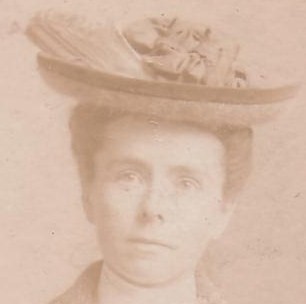
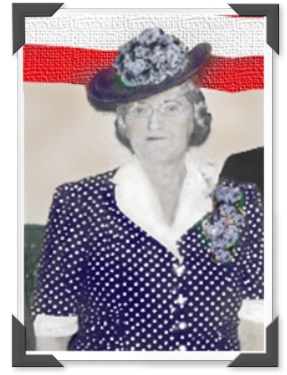
Figure 1 Mary Agnes HART CAREY, date perhaps 1940s to early 1950s
The AI Connection: How AI Can Help Decode Nicknames
Nicknames can be tricky in genealogy, especially when records use formal names instead of the name your ancestor was commonly called. AI tools can be a game-changer here by offering innovative ways to trace and decode these hidden connections:
Name Matching in Records AI-powered genealogy platforms can identify patterns in historical records, connecting nicknames to formal names. For example, searching for “Aggie” might yield records for Mary Agnes, even if “Aggie” isn’t explicitly listed. AI algorithms that analyze phonetic similarities (like the Soundex system) make this possible.
Document Analysis Some AI tools can scan personal letters, diaries, or even old newspapers to detect nicknames alongside formal names. This can help clarify how nicknames were used and even uncover clues about their origins.
Family Tree Suggestions Platforms like Ancestry.com and MyHeritage use AI to suggest connections. If an ancestor was known by different names in various documents, AI can consolidate the data, revealing hidden patterns or relationships you might otherwise miss.
Cultural Context Insights AI can also analyze naming trends by era and region. For instance, “Aggie” as a nickname for Agnes was more popular in Irish communities during certain periods. Understanding these trends can make your ancestor’s story richer and more relatable.
Going Forward
What about you? Who in your family had a nickname that stood out? Did it reveal a personality quirk, a fond memory, or a cultural connection?
Take this week’s challenge to the next level by pairing your research with AI tools. You might discover a nickname hiding in plain sight or uncover how a loved one’s identity evolved over time.
52 AI Ancestors in 52 Weeks: Week 2: Favorite Photo
Introduction
Week 2 of the 52 Ancestors challenge dives into your favorite photo. “Photos capture our family history like few other things can,” right? Picking a favorite is tough—I have a handful that hold deep meaning for me. Let me share one particularly special image with you: a portrait I labeled “Unknown Sailor.”
Background
My maternal grandmother, whom I wrote about last week, lost her mother at the age of three. As the only daughter, she inherited a collection of keepsakes, including a stack of photographs—most of them frustratingly unlabeled. One photo, though, stood out:
This sailor seemed to radiate pride and confidence, but who was he?
The search
At first, I had no clues to identify him. Then, while researching Grandma’s maternal grandmother, Alice, I learned Alice had three brothers who served in the Civil War, including one in the Navy. That gave me a potential name: Oscar Smith.
For years, Oscar remained an enigma. No evidence could prove his identity. Then one day, while exploring collateral research, I connected with another genealogist studying the surname of Alice’s first husband (I descend from the second), my second cousin once removed. We compared notes and decided to meet, each bringing our family photo collections.
Imagine my surprise when she produced the exact same [unlabeled] sailor photo! Together, we became convinced the sailor was indeed Oscar Smith. Over a century after his naval service, Oscar had unwittingly brought two branches of our family back together.
Kathie and I corresponded and collaborated for quite a while. I assume she is now asking Alice for family information.
The AI connection
Here’s where modern tools entered the picture. Steve’s Photograph Analysis, a custom GPT from Steve Little, became my new research ally. I uploaded the sailor photo, and the AI provided a detailed analysis:
Composition: Lighting, subject placement, and atmosphere.
Context: Potential date, location, and even identity clues.
Insights: Surprising details about the photo’s timeline.
To my amazement, ChatGPT placed the photo in a time frame after Oscar had died. Was my theory wrong? Or was there a misstep in the analysis? This unexpected twist turned the photo into a deeper mystery, one I’m still unraveling.
Going forward
I have my theories, but as any genealogist knows, personal beliefs don’t meet the Genealogical Proof Standard. For now, Oscar’s (?) photo remains a tantalizing puzzle. Who knows—maybe future 52 Ancestors prompts will give me the chance to share updates as this story unfolds.
Try it yourself
Curious about your own family photos? Give Steve’s photo analyzer a spin, or prompt an AI tool yourself to uncover hidden details in your family’s history. Happy hunting!







 The Ancestor Whisperer