I’ve combined Amy Johnson Crow’s 52 ancestors in 52 weeks challenge, and Steve Little’s The 2025 AI Genealogy Do-Over, to create a unique 52 AI ancestors in 52 weeks party!
52 AI Ancestors in 52 Weeks: Week 33: Legal troubles
Introduction
My first clue was my ancestor John West’s will, dated 01 December 1875, and proven 30 September 1876: “I, John West… give and devise to my son John T. West one dollar.”[1]
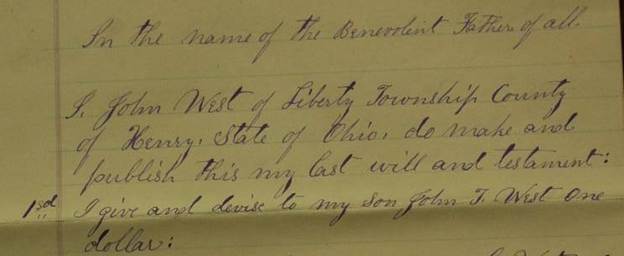
Figure 1 Opening lines of John West’s 1875 will, Henry County, Ohio
I would be remiss if I did not mention that I was the fortunate recipient of a copy of this will before FamilySearch got them online, thanks to a volunteer from the sadly disbanded Henry County (Ohio) Genealogical Society. [Shoutout to Jim Rebar!]
Discussion
It seems my great-great grandfather John T. and his father had a schism which was never resolved. Digging into court records revealed more information: In September 1870, John the father, “an old man over seventy” sold his son John T some land for a fraction of its value in return for the son supporting the father “as long as he shall live.”
The father and son did not get along well; the father claims the son required him to “perform manual labor continually,” verbally abused him, did not furnish him with necessary clothing or sufficient food, and more. The father did “not feel safe longer to remain in the family of” his son. The father asserts the son was intending to sell what was left of the father’s property “with the view and intention to leave the state,” which may be corroborated by a letter I have written by the son’s wife (see 52 AI Ancestors in 52 Weeks: Week 7: Letters and Diaries). This complaint was sworn on December 17, 1875, when the father moved out of the son’s house., about two weeks after the will mentioned above.
In January, the son filed a statement alleging that the complaints were untrue and he was ready and willing to support his father as contractually obligated. He submitted a financial statement for 5 years, 3 months, and two weeks of boarding and purchases, mostly clothing.
The father responded on February 19, disagreeing with his son’s statement.
Sadly, in “the October term” of that year, the plaintiff “has departed this life,” and was later dismissed.
I’m sorry that father and son never mended their rift, and am sorry that the family pattern has carried forward, to some extent. While my research took patience, time, and long distance volunteer help, I now know there are AI tools that can make the search easier.
How AI Can Help
(as suggested by, of course, AI)
AI can be useful when you’re researching an ancestor with a colorful legal history. Here’s how I might have used them in my own search to understand the John Wests:
- Transcribing and Summarizing Old Legal Documents
Many legal records are written in challenging handwriting or dense legal language. AI-powered transcription tools can turn scanned documents into readable text, while summarizers can condense them into plain language without losing important details. - Finding Background from Historical Laws
AI can search digitized law books, newspapers, and historical archives to explain the laws of the time. This can help you understand why your ancestor might have been in trouble – or what their rights and obligations were. - Cross-Referencing with Other Records
Court cases often connect to land deeds, wills, or even census data. AI search tools can spot names, places, and dates across different record sets, saving hours of manual work. - Creating Timelines
AI can take scattered facts and dates from different sources and lay them out in an easy-to-follow timeline. This can reveal patterns, conflicts, or missing pieces in your ancestor’s story.
Tip: Always review AI’s results against the original sources – AI is great at spotting leads, but it’s not a substitute for your genealogist’s judgment.
Challenge for Readers
- Decode a Court Record with AI
- Find a legal record from your own research: a will, court case, or land dispute.
- Use an AI-powered transcription tool (such as Transkribus or Google Docs OCR) to turn the scan into text.
- Paste the text into a free AI tool and ask it to explain the document in plain English.
- Compare its interpretation with your own.
- AI Timeline Builder
- Gather 5–10 dated events from your ancestor’s legal troubles (court filings, sales of property, letters, etc.).
- Feed the events into a free AI tool like ChatGPT free plan or Claude.ai and ask it to arrange them into a chronological timeline with a short summary for each event.
- Look for gaps or unexpected patterns you might have missed before.
If I’d had these tools when I first read John West’s will, I might have untangled the drama faster.
Want to Learn More?
📚 Suggested Resources
- Transcription Tools
- Transkribus – For handwritten historical documents.
- Google Docs OCR – Free and quick for printed text.
- Historical Law References
- Library of Congress: Law Library Digital Collections – US legal history.
- HathiTrust Digital Library – Digitized law books and court reports.
- Genealogy Research
- FamilySearch Wiki: Court Records – Tips on finding and interpreting court documents.
- Chronicling America – Historic newspapers for background and case mentions.
- Free AI Tools
- ChatGPT Free Plan – Summarize, explain, or build timelines.
- Claude.ai – Another free AI option for long-text analysis.
Next Week’s Topic: “Playtime”
AI Disclosure
This post was created by me with the help of AI tools. While AI helps organize research, the storytelling and discoveries are my own.
[1] https://www.familysearch.org/ark:/61903/3:1:3QS7-89M2-D8VY, or properly cited: “Ohio, Probate Records, 1789-1996,” images, FamilySearch (https://www.familysearch.org/en/search/catalog/352900 : accessed 11 Aug 2025) Film # 005430581 > Item 2 > Image 317/649; citing Henry County, Ohio, Record of Wills Vol. 2 page 200.
















 The Ancestor Whisperer