
Hello all!
I recently went to the New York Public Library for personal research and examined the Truax genealogy files. I’m transcribing and posting what I found in the hopes that it might help other researchers – much as Theodore de T. Truax, Howard S. F. Randolph, Allan L. Truax, and others did a century ago.
Please note that my interest – Philippe’s daughter Maria – is not much covered, so I have little of the generations which are in the files. There is so, so much more in the file available to the visitor! Be warned that these files are kept offsite and must be requested in advance.
Without further ado, my first House of Truax transcription: Etymology. (Theories as to the origin of the name.)
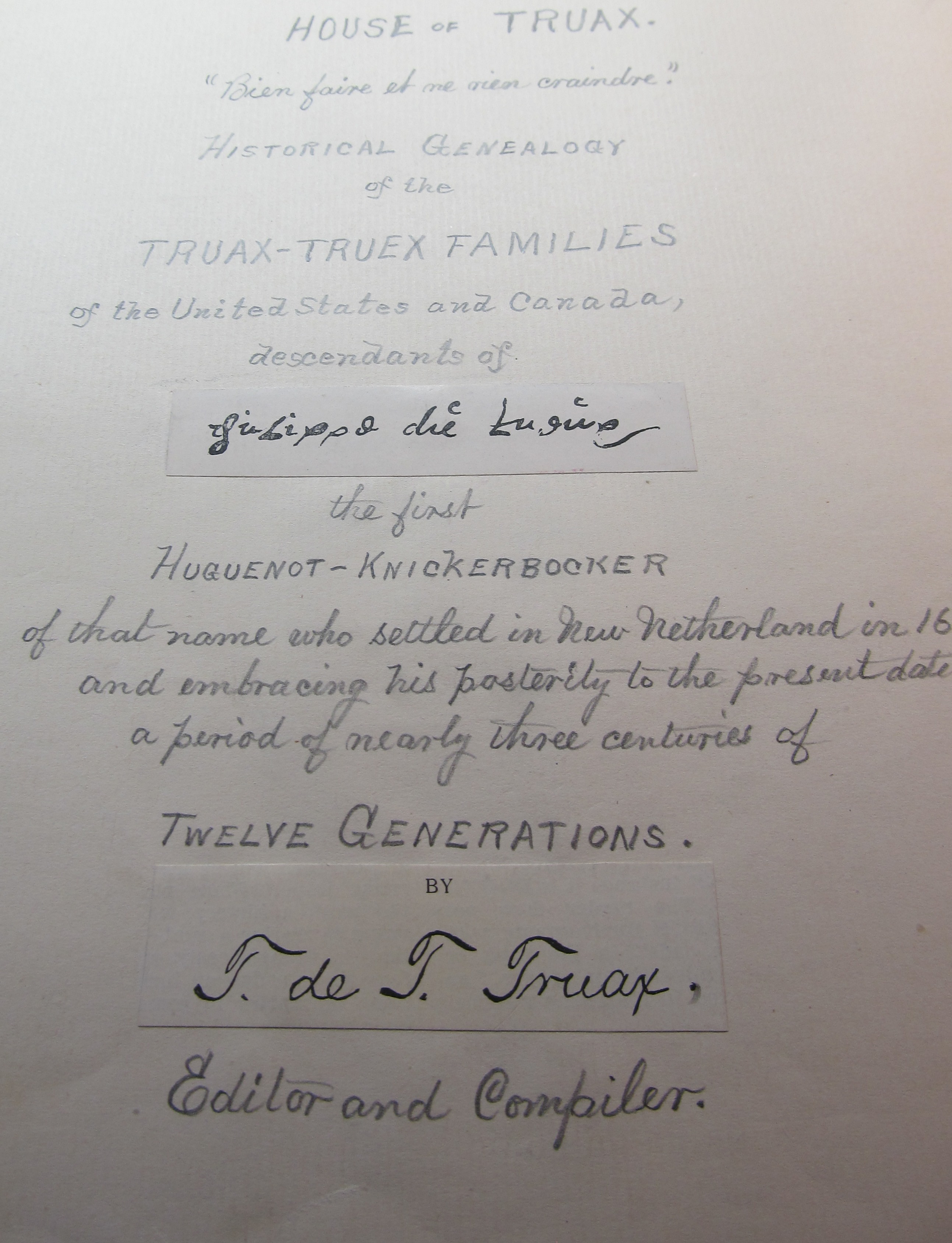
Truax, T. de T., House of Truax. “Bien faire et ne rien craindre.” Historical Genealogy of the Truax-Truex Families of the United States and Canada, descendants of Philippe de Trieux, the first Huguenot-Knickerbocker of that name who settled in New Netherland in 16__ and embracing his posterity to the present date a period of nearly three centuries of Twelve Generations. Manuscript. From New York Public Library, Call No. NYGB Coll-94 Box 1 and Box 2. http://catalog.nypl.org/record=b18209329~S1 . (Accessed 18Jul2015)
[An interesting history of this manuscript can be found at http://freepages.genealogy.rootsweb.ancestry.com/~truax/TheHouseofTruax.html ]
pp. 11-12
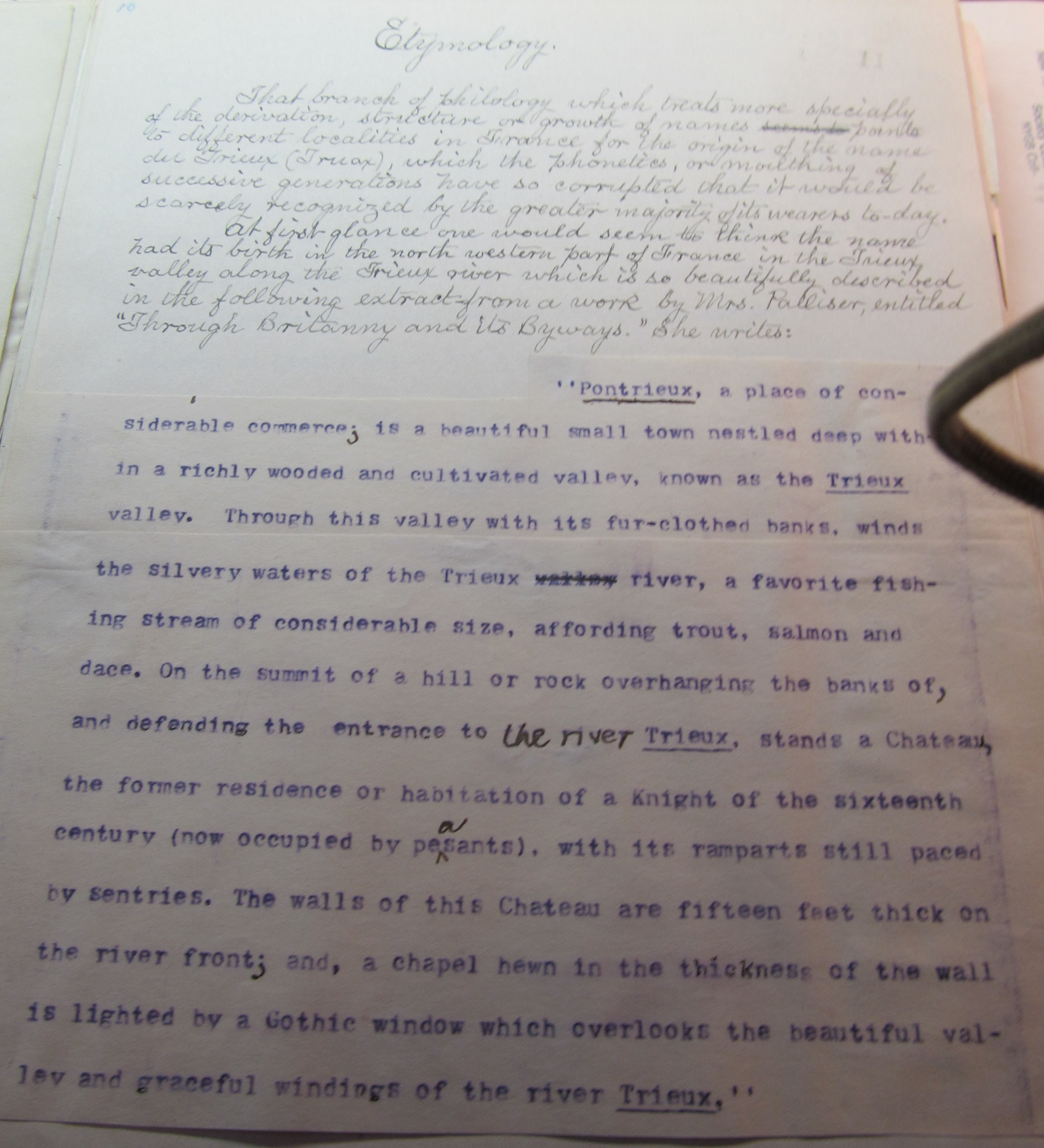
Etymology.
That branch of philology which treats more specially of the derivation, structure or growth of names points to different localities in France for the origin of the name du Trieux (Truax), which the phonetics, or mouthing of successive generations have so corrupted that it would be scarcely recognized by the greater majority of its wearers to-day.
At first glance one would seem to think the name had its birth in the north western part of France in the Trieux valley along the Trieux river which is so beautifully described in the following extract from a work by Mrs. Palliser, entitled “Through Britanny and its Byways.” She writes:
“Pontrieux, a place of considerable commerce; is a beautiful small town nestled deep within a richly wooded and cultivated valley, known as the Trieux valley. Through this valley with its fur-clothed banks, winds the silvery waters of the Trieux river, a favorite fishing stream of considerable size, affording trout, salmon and dace. On the summit of a hill or rock overhanging the banks of, and defending the entrance to the river Trieux, stands a Chateau, the former residence or habitation of a Knight of the sixteenth century (now occupied by peasants), with its ramparts still paced by sentries. The walls of this Chateau are fifteen feet thick on the river front; and, a chapel hewn into the thickness of the wall is lighted by a Gothic window which overlooks the beautiful valley and graceful windings of the river Trieux.”
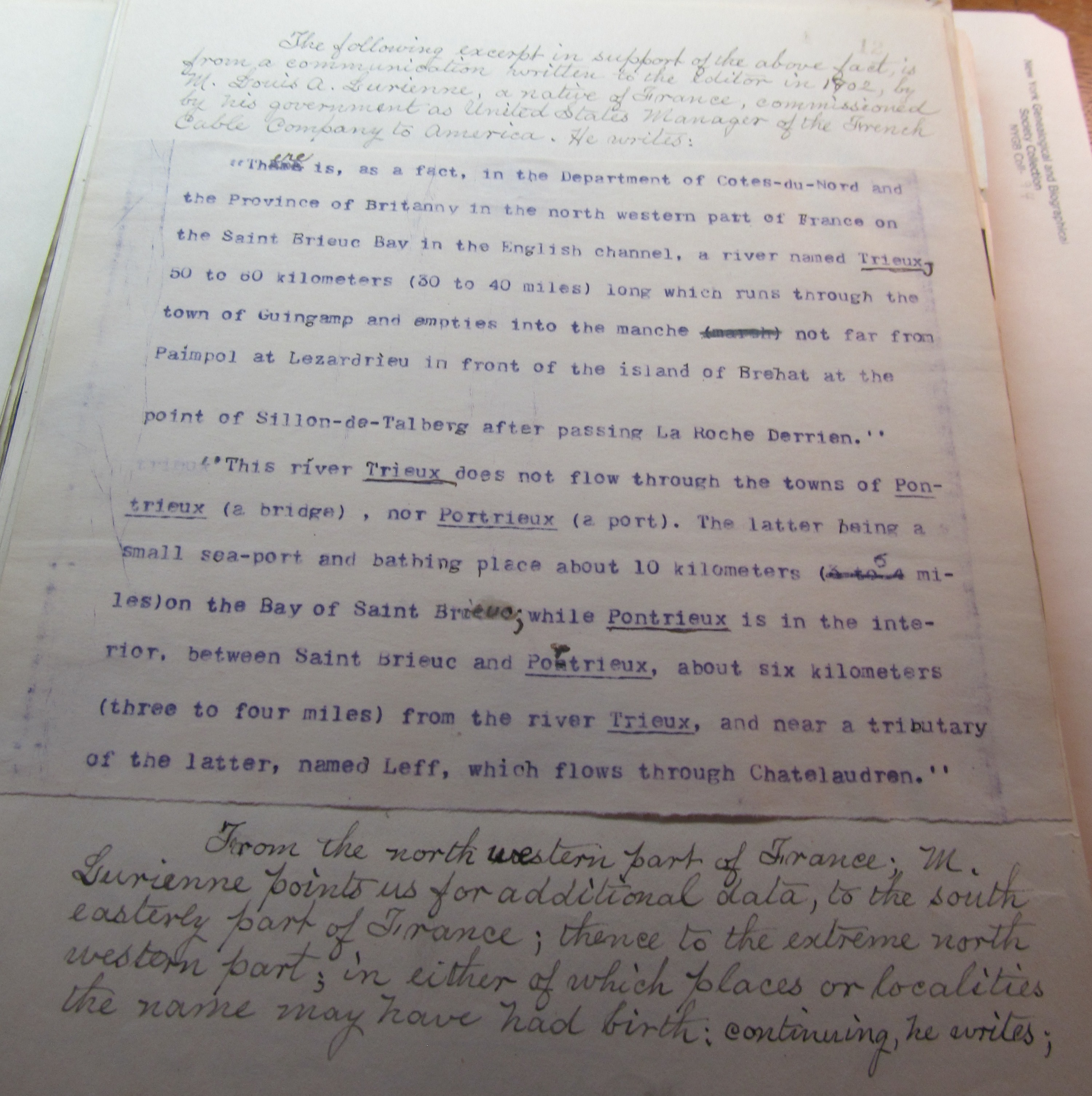
The following excerpt in support of the above fact, is from a communication written to the Editor in 1902, by M. Louis A. Lurienne, a native of France, commissioned by his government as United States Manager of the French Cable Company to America. He writes:
“There is, as a fact, in the Department of Cotes-du-Nord and the Province of Britanny in the north western part of France on the Saint Brieuc Bay in the English channel, a river named Trieux, 50 to 60 kilometers (30 to 40 miles) long which runs through the town of Guingamp and empties into the manche not far from Paimpol at Lezardrieu in front of the island of Brehat at the point of Sillon-de-Talbert after passing La Roche Derrien.”
“This river Trieux does not flow through the towns of Pontrieux (a bridge), nor Portrieux (a port). The latter being a small sea-port and bathing place about 10 kilometers (15 miles) on the Bay of Saint Brieuc, while Pontrieux is in the interior, between Saint Brieuc and Pontreiux, about six kilometers (three to four miles) from the river Trieux, and near a tributary of the latter, named Leff, which flows through Chatelaudren.”
From the north western part of Franc; M. Lurienne points us for additional data, to the south easterly part of France; thence to the extreme north western part; in either of which places or localities the name may have had birth; continuing, he writes;
[stopped this section here]
Edit:
Adding links to the series:
Part I – House of Truax – Etymology
Part II – House of Truax – Historical
Part III – House of Truax – Church records
Part IV – House of Truax – New Amsterdam records
Part V – House of Truax – First Generation
Part VI – House of Truax – Truax Genealogy (Land Records)
Part VI – House of Truax – “First” Generation – Maria
Part VII – House of Truax – Second Generation (Philip, Rachel, Sara)
Part VIII – House of Truax – Second Generation (Susanna, Rebecca, Abraham)
Part IX – Randolph’s House of Truax – Introduction
Part X – Randolph’s House of Truax – First Generation
Part XI – Randolph’s House of Truax – Second Generation (Philippe, Maria)
Part XII – Randolph’s House of Truax – Second Generation (Sara, Susanna, Rachel)
 The Ancestor Whisperer
Pingback: House of Truax – Historical | janetbgenealogy
Pingback: House of Truax – Church records | janetbgenealogy
Pingback: House of Truax – New Amsterdam records | janetbgenealogy
Pingback: House of Truax – First Generation | janetbgenealogy
Pingback: House of Truax – Truax Genealogy (Land records) | janetbgenealogy
Pingback: House of Truax – “First” Generation – Maria | janetbgenealogy
Pingback: House of Truax – Second Generation (Philip, Rachel, Sara) | janetbgenealogy
Pingback: House of Truax – Second Generation (Susanna, Rebecca, Abraham) | janetbgenealogy
Pingback: Randolph’s House of Truax – Introduction | janetbgenealogy
Pingback: Randolph’s House of Truax – First Generation | janetbgenealogy
Pingback: Randolph’s House of Truax – Second Generation (Philippe, Maria) | janetbgenealogy
Pingback: Randolph’s House of Truax – Second Generation (Sara, Susanna, Rachel) | janetbgenealogy
Pingback: 52 AI Ancestors in 52 Weeks: Week 31: Earliest Ancestor | janetbgenealogy